

Why IT Projects Fail in Australia: Root Causes and Strategic Solutions
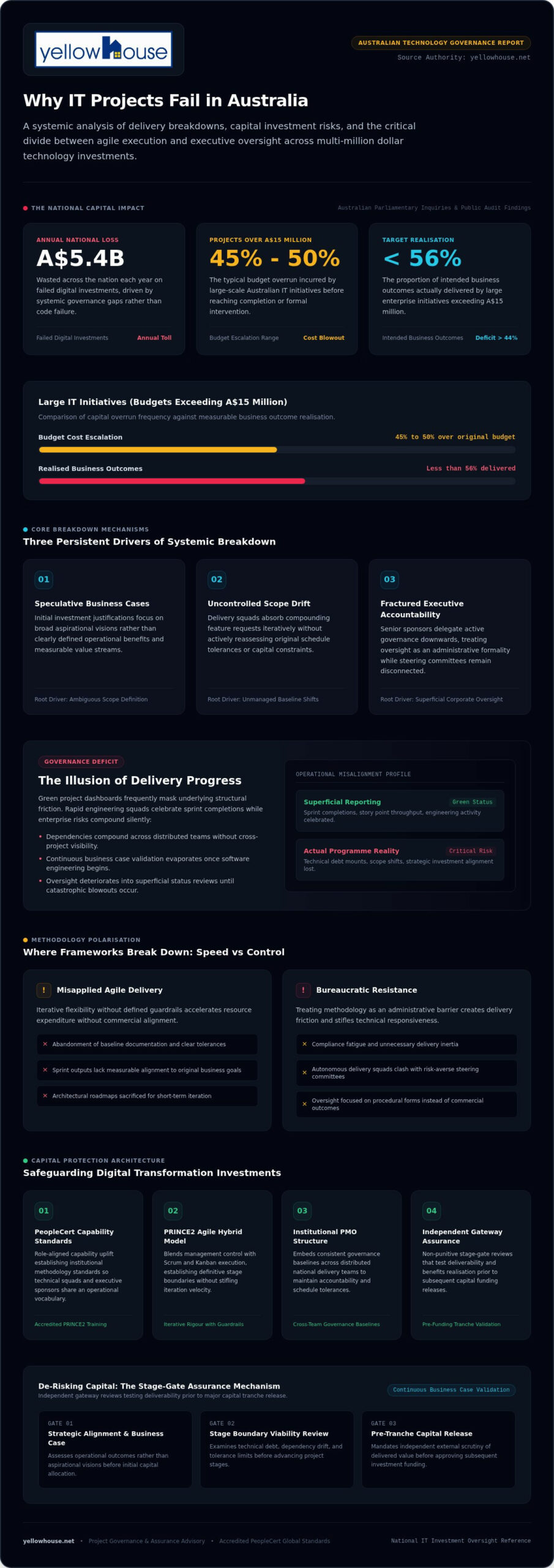
Australian IT projects rarely collapse because of flawed code or technical incompetence; they fall apart because organisational governance fails to keep pace with delivery. With failed digital investments wasting an estimated A$5.4 billion across the nation each year, understanding why IT projects fail in Australia has become an urgent priority for project leaders and executives alike.
You’ve likely felt the strain firsthand when rapid delivery teams sprint ahead, while corporate risk structures struggle to maintain meaningful control under intense stakeholder scrutiny. In this guide, you’ll discover the systemic governance, capability, and assurance gaps driving these costly timeline blowouts, along with practical strategies to safeguard your capital investments. We examine the verified root causes behind major delivery breakdowns and outline how to bridge the divide between agile execution and robust corporate governance.
Key Takeaways
- Uncover the systemic drivers behind why IT projects fail in Australia, moving past technical scapegoats to address ambiguous business cases and fragmented executive ownership.
- Learn how to balance agile delivery velocity with robust governance frameworks without generating unnecessary delivery inertia or compliance fatigue.
- Discover how structured stage-gate checkpoints and independent assurance reviews protect capital investments before major funding releases occur.
- Establish consistent delivery capability across distributed teams by embedding proven PMO structures and institutional methodology standards.
The Root Causes Behind Australia’s High IT Project Failure Rates
Scratch beneath the surface of blown delivery timelines and escalating budgets, and you’ll find that flawed commercial tendering is rarely the true culprit. When examining project management failures across corporate and public sectors, Australian parliamentary inquiries and public audit findings consistently point to organisational culture, ambiguous scope definitions, and fractured leadership. In fact, large IT initiatives with budgets exceeding A$15 million frequently run 45% to 50% over budget while delivering less than 56% of their intended business outcomes.
Adopting modern software platforms won’t fix structural capability voids. Systemic breakdowns occur when organisations mistake technical activity for strategic progress, ignoring three persistent drivers:
- Speculative business cases: Initial investment justifications focus on broad aspirational visions rather than defined operational benefits.
- Uncontrolled scope drift: Delivery teams absorb compounding feature requests without reassessing original schedule tolerances.
- Fractured executive accountability: Senior sponsors delegate active governance downwards, treating oversight as an administrative formality.
Understanding these drivers explains why IT projects fail in Australia far more accurately than vendor-focused procurement reviews ever can.
Governance Deficits and the Illusion of Delivery Progress
Green project dashboards frequently mask underlying friction. Programme teams often celebrate sprint completions and technical milestones while dependencies compound and technical debt grows unchecked behind the scenes. Continuous business case validation evaporates the moment software engineering begins, reducing corporate oversight to superficial status meetings. Unchecked governance failure represents Australia’s greatest risk to technology transformation investments, leaving project boards unable to intervene before catastrophic budget blowouts occur.
Where Frameworks Break Down: Agile Delivery vs Structured Oversight
A common operational myth suggests teams must choose between agile speed and structured control. In practice, misapplying agile principles creates a dangerous vacuum where teams abandon baseline documentation, clear tolerances, and architectural roadmaps under the banner of iterative flexibility. Boards then face high-frequency sprint outputs that lack measurable alignment to original business goals.
Conversely, executives often resist governance reforms because they equate methodology with bureaucratic inertia. This friction between autonomous delivery teams and risk-averse steering committees is a core reason why IT projects fail in Australia. Speed without guardrails doesn’t create agility; it simply accelerates waste.
Reconciling Speed and Accountability with Modern Governance Standards
Bridging this gap requires adaptive frameworks that protect capital investments while enabling fast technical iteration. Adopting PRINCE2 Agile provides a structured bridge, blending the governance rigour of established management controls with the flexibility of Scrum and Kanban execution.
Embedding role-aligned capability uplift backed by global PeopleCert standards ensures technical squads and executive sponsors speak the same operational language. Exploring structured methods through accredited PRINCE2 training helps your leadership team balance empowerment with definitive stage boundaries, ensuring projects deliver measurable value without sacrificing delivery velocity.
De-Risking Australian IT Initiatives with Independent Assurance
Preventing delivery failure requires moving beyond internal reporting and crisis firefighting. While internal squads often develop optimism bias, structured stage-gate checkpoints mandate independent scrutiny of strategic alignment, benefits realisation, and technical viability before releasing subsequent capital tranches. If you want to understand why IT projects fail in Australia, look at how often funding is approved upfront without ongoing validation gates.
Establishing institutional project management office (PMO) structures provides the operational baseline needed to enforce delivery standards across distributed national teams. Independent external reviewers bring fresh eyes to complex delivery landscapes, identifying unmanaged dependencies and governance frictions that internal teams often overlook.
Implementing Gateway Reviews to Safeguard Capital Investments
Engaging independent gateway assurance reviews offers senior executives non-punitive, evidence-based confidence at critical project milestones. These reviews test deliverability, uncover systemic delivery risks early, and confirm that investments remain commercially viable before major contracts are executed.
To sustain these standards internally, organisations reinforce PMO oversight through accredited P3O training, embedding consistent portfolio and programme governance across enterprise divisions. Backed by PeopleCert global standards, Yellowhouse supports leaders across Brisbane, Sydney, Melbourne, and Canberra with the independent assurance and practical capability needed to protect their technology investments.
Transforming Governance into Your Strongest Delivery Advantage
Resolving why IT projects fail in Australia requires looking beyond technology and confronting systemic governance gaps. Lasting delivery success happens when you align agile execution with transparent stage boundaries, active executive sponsorship, and continuous benefits tracking. When independent assurance and structured frameworks guide delivery, teams move faster with complete clarity.
Yellowhouse stands alongside your organisation as a trusted delivery partner. As an accredited training organisation delivering PeopleCert global standard qualifications, and experienced Gateway assurance reviewers supporting Australian government and corporate enterprises, we help you de-risk investments before crises emerge. Strengthen your project governance with Yellowhouse advisory and training to give your teams the capability and confidence to succeed on every major initiative.
Frequently Asked Questions
What is the most common reason IT projects fail in Australia?
The primary reason stems from inadequate project governance and misaligned strategic intent rather than technical shortcomings. When examining why IT projects fail in Australia, public sector audits consistently point to speculative business cases, unmanaged scope drift, and detached executive sponsorship. Without clear accountability and active steering committees, project teams easily lose direction long before technical delivery begins.
How does poor governance impact Australian technology project budgets?
Poor governance directly drives compounding budget blowouts by obscuring emerging risks until corrective action becomes financially crippling. Without disciplined stage gates and realistic baseline tolerances, organisations continue releasing funds into off-track initiatives. Unchecked scope additions and hidden technical debt accumulate silently behind optimistic dashboards, ultimately triggering severe cost blowouts under intense regulatory and stakeholder scrutiny.
Can agile delivery methodologies succeed without formal project management governance?
No, agile delivery squads require overarching governance frameworks to ensure speed remains aligned with enterprise strategic goals. Iterative methods excel at rapid product development, but abandoning structured boundaries creates chaos. Balancing frameworks like PRINCE2 Agile bridges the divide between fast technical iteration and capital accountability, resolving a central tension in why IT projects fail in Australia.
What is a Gateway review and when should Australian organisations conduct one?
A Gateway review is an independent, non-punitive assessment conducted at critical decision gates to evaluate project deliverability. Australian organisations across Brisbane, Sydney, Melbourne, and Canberra conduct these reviews prior to key milestones, such as finalising business cases, initiating procurement, or entering operational rollout. They provide senior executives with objective assurance before major capital investments are committed.


About Post Author
