

How to Prevent Project Budget Overruns: A Practical Governance Guide
According to Wellingtone’s 2026 research, only 49% of organisations manage to complete projects on budget. If you’ve ever sat across from an executive sponsor explaining unexpected cost variations that eroded delivery margins, you know how uncomfortable that pressure feels. Most delivery leaders assume tighter financial tracking is the solution, but learning how to prevent project budget overruns requires moving beyond reactive spreadsheets into structured governance controls.
You shouldn’t have to wait for month-end reporting to discover critical variances. In this guide, you’ll discover how to protect your project finances using structured governance, realistic baseline forecasting, and proven control mechanisms. We examine practical ways to set defensible tolerances, implement disciplined change control, and secure predictable spend across your entire delivery lifecycle.
Key Takeaways
- Understand why optimistic business cases and informal scope adjustments compromise delivery margins, and how to counter them with evidence-based cost baselines.
- Master how to prevent project budget overruns by establishing clear financial tolerances and management-by-exception mechanisms that expose variances early.
- Discover how independent Gateway assurance reviews provide executive sponsors with objective validation before committing capital to subsequent phases.
- Build long-term organizational immunity against budget blowouts through structured governance capabilities certified by PeopleCert.
Why Project Budgets Bleed: Diagnosing the Core Drivers of Cost Overruns
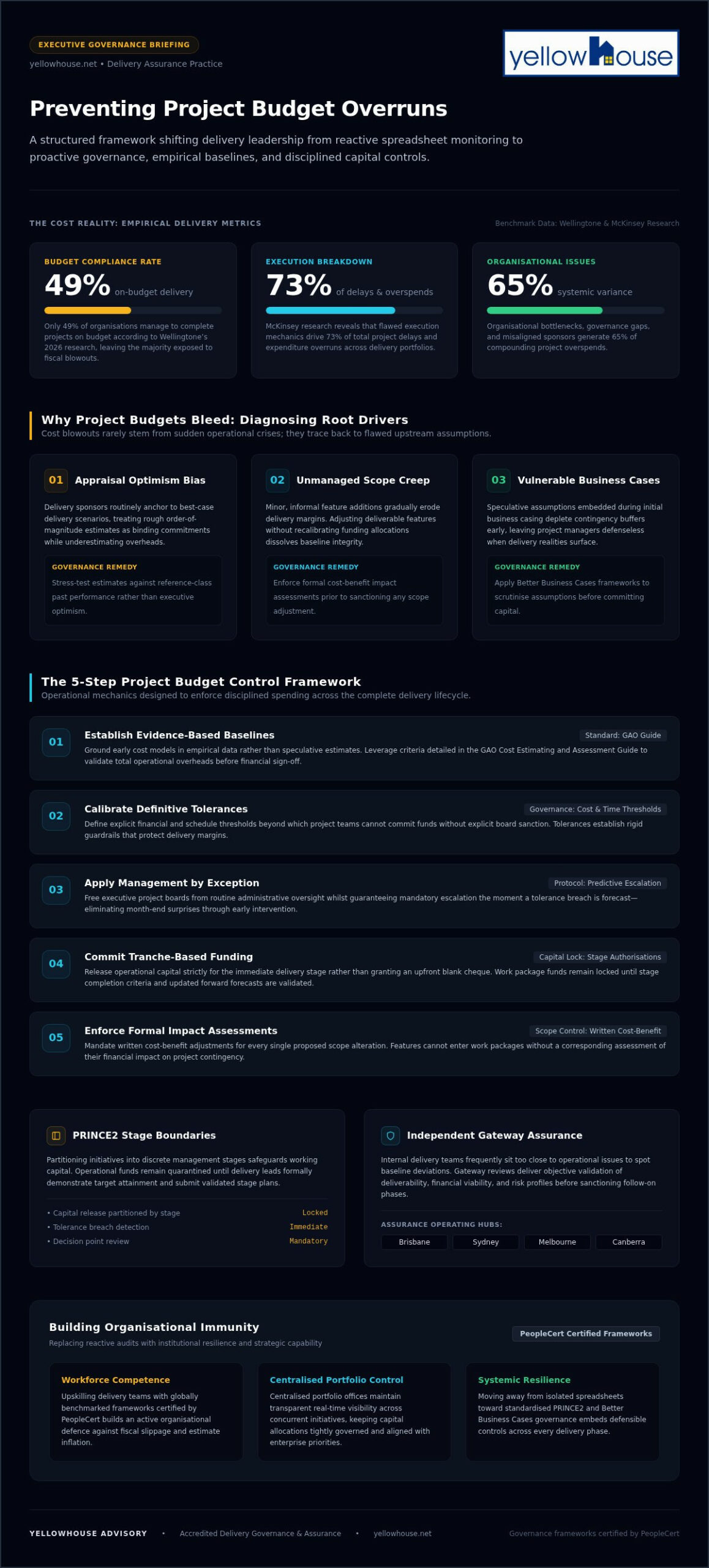
Cost blowouts rarely stem from sudden operational crises. Instead, a systemic cost overrun usually traces back to flawed assumptions embedded during initial business casing. Research from McKinsey reveals that execution problems account for 73% and organisational issues drive 65% of project delays and overspends. When business cases rely on optimistic delivery speed and underestimate total operational overheads, the baseline is compromised before work starts. Establishing robust structures through Better Business Cases frameworks ensures strategic assumptions face proper scrutiny before capital commitment.
Compounding this baseline vulnerability is unmanaged scope creep. Minor, unapproved additions erode margins incrementally. When teams adjust deliverable features without adjusting funding allocations, the baseline dissolves. Knowing how to prevent project budget overruns demands isolating these scope expansions before they exhaust financial reserves.
Tackling Optimism Bias and the False Security of Rough Estimates
Appraisal optimism presents a dangerous psychological hurdle. Delivery sponsors frequently anchor to best-case scenarios, treating rough order-of-magnitude estimates as fixed commitments. This optimism bias blinds leadership to technical complexity. To master how to prevent project budget overruns, governance boards must actively stress-test initial figures against reference-class past performance rather than executive hope. Without objective historical benchmarking, unvetted assumptions quickly deplete contingency buffers, leaving project leaders defenseless when deliverable realities surface.
How to Prevent Project Budget Overruns: A 5-Step Control Framework
Disciplined execution requires operational mechanics, not wishful monitoring. To understand how to prevent project budget overruns across complex delivery cycles, organisations must implement a structured governance framework:
- Establish evidence-based baselines: Ground early cost plans in empirical data rather than speculative estimates, applying standards detailed in the GAO Cost Estimating and Assessment Guide.
- Calibrate definitive tolerances: Define explicit cost and schedule thresholds beyond which teams cannot spend without board intervention.
- Apply management by exception: Free project boards from routine oversight while guaranteeing mandatory escalation the moment a tolerance breach is forecast.
- Commit tranche-based funding: Release operational capital only for the immediate stage rather than writing a blank cheque for the entire initiative.
- Enforce formal impact assessments: Require written cost-benefit adjustments for every requested scope alteration.
Enforcing Stage Boundaries and Authorisation Checkpoints
Partitioning a project into discrete management stages safeguards working capital. Work package funds should remain locked until delivery leads formally demonstrate stage completion and present an updated forecast for the next tranche. When variances approach agreed limits, immediate exception reporting replaces end-of-month surprises with decisive board intervention.
Adopting structured PRINCE2 project management principles equips organisations with proven control mechanisms to standardise these thresholds. If you’re looking to formalise governance controls across your enterprise, exploring accredited PRINCE2 training can help your delivery teams protect capital commitments effectively.
Building Organisational Immunity: Governance, Training, and Assurance
Sustainable financial control requires more than isolated spreadsheets; it hinges on institutional capability and disciplined portfolio alignment. Investing in workforce competence through globally benchmarked delivery frameworks certified by PeopleCert builds an active organisational defence against fiscal slippage. When centralised portfolio offices maintain transparent visibility across concurrent initiatives, capital allocations stay tightly controlled and aligned with strategic priorities. Ultimately, understanding how to prevent project budget overruns requires moving beyond reactive post-implementation audits toward building genuine systemic resilience.
Validating Project Health with Independent Gateway Assurance
Internal project teams frequently sit too close to daily operational problems to recognise emerging baseline deviations. Deploying independent Gateway assurance reviews solves this blind spot by providing executives with an objective evaluation of deliverability, financial viability, and risk before committing capital expenditure to subsequent phases. Operating across Brisbane, Sydney, Melbourne, and Canberra, these independent reviews act as a decisive early warning mechanism, giving project sponsors genuine peace of mind.
Pairing external assurance with continuous capability development transforms commercial outcomes. Upskilling internal project leaders through certified governance training ensures teams maintain rigorous commercial vigilance across every work package, capturing variance triggers before costs compound. By embedding structured stage reviews alongside globally recognised methodologies certified by PeopleCert, organisations establish how to prevent project budget overruns while delivering reliable, defensible spend across complex portfolios.
Transforming Governance into Lasting Financial Discipline
Predictable delivery spend isn’t an accident of good fortune; it’s the direct result of deliberate structural control. By pairing realistic baseline forecasting with disciplined stage-gate thresholds, you transform how to prevent project budget overruns from an elusive target into standard operational practice. Independent Gateway checkpoints and clear tolerance boundaries provide the early visibility needed to stop minor variances before they erode project margins.
Achieving this level of control requires practical capability alongside trusted oversight. As an accredited PeopleCert partner trusted by public and private organisations across Australia, Yellowhouse equips teams with specialised Gateway assurance and proven governance frameworks. Strengthen your project governance with Yellowhouse to safeguard your capital investments and lead every phase with lasting confidence.
Frequently Asked Questions
What is the difference between a project cost contingency and management reserve?
Cost contingency covers identified, quantified project risks, whereas a management reserve addresses completely unforeseen strategic events. The project manager directly controls contingency funds to manage specific baseline risks. In contrast, management reserves sit outside the performance baseline, requiring formal executive sponsor approval before any funds can be released across Australian delivery environments.
How do management stages help prevent project budget overruns?
Management stages show delivery teams how to prevent project budget overruns by restricting capital expenditure strictly to the immediate delivery phase. Rather than committing the full budget upfront, the project board reviews actual spend and stage deliverables at each boundary. This disciplined gatekeeping ensures ongoing commercial viability before approving the next tranche of investment.
Can adopting PRINCE2 methodology reduce financial variance in complex projects?
Yes, adopting PRINCE2 methodology directly reduces financial variance by introducing explicit cost tolerances and the management-by-exception principle. Delivery teams across Brisbane, Sydney, Melbourne, and Canberra gain clear structures to track spend against baseline plans. If costs threaten agreed tolerances, structured governance protocols ensure leadership intervenes well before budgets encounter serious trouble.
What should a project manager do immediately when a cost tolerance is breached?
A project manager must immediately produce an exception report and submit it directly to the project board. Instead of hiding variances, the report outlines the root causes, financial impacts, and practical recovery options. This rapid escalation illustrates how to prevent project budget overruns from quietly escalating into irreversible fiscal blowouts.


About Post Author
