

Project Health Check Template: Australian Guide 2026
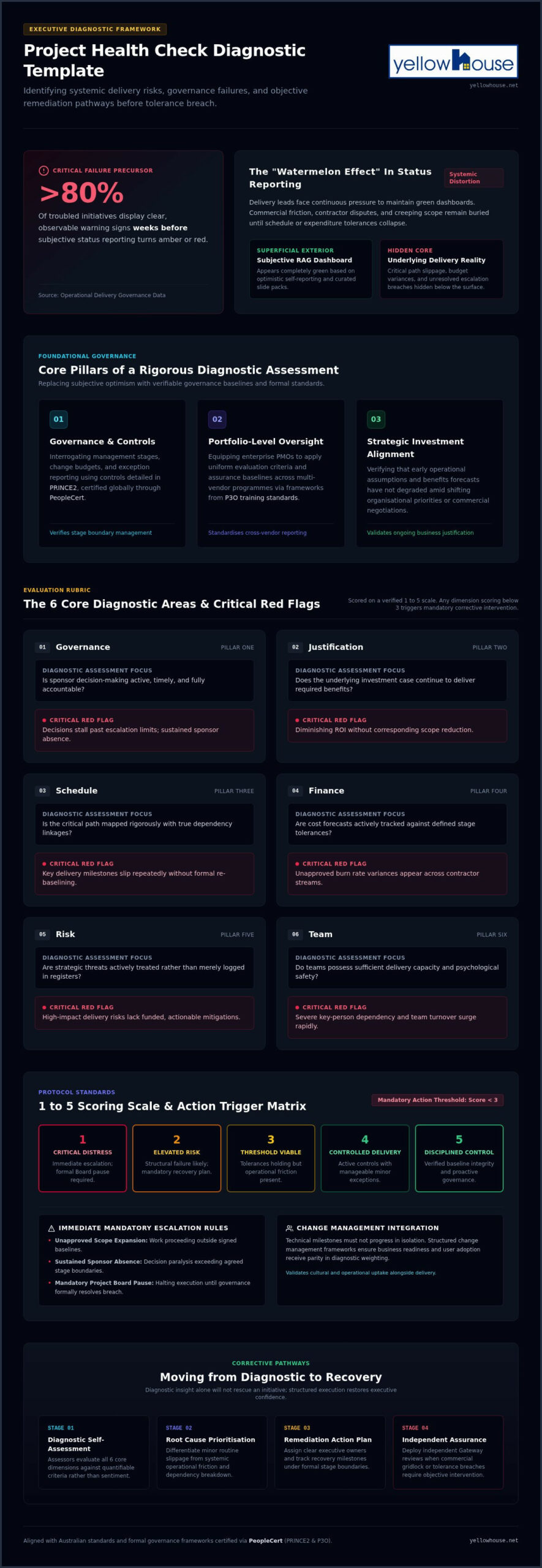
Over 80% of troubled initiatives display clear warning signs weeks before subjective reporting turns amber or red. If you’ve ever watched a supposedly green dashboard suddenly collapse into critical delay, you know how easily optimistic updates mask delivery friction across complex initiatives. A basic checklist rarely cuts through this noise; you need a robust project health check template that interrogates systemic risks rather than surface-level symptoms.
In this guide, you’ll discover how to evaluate true project status, uncover hidden multi-vendor delivery risks, and implement an actionable template aligned with Australian standards and formal governance frameworks like PRINCE2. We’ll unpack the core diagnostic dimensions that separate minor schedule slippage from systemic failure, giving you clear corrective pathways to safeguard your outcomes.
Key Takeaways
- Look beyond superficial RAG reporting to uncover hidden delivery risks before milestones and budgets collapse.
- Deploy a structured project health check template across six foundational dimensions, spanning governance alignment to team sentiment.
- Use objective diagnostic rubrics to quickly separate routine schedule adjustments from systemic operational failure.
- Translate assessment findings into targeted remediation plans and recognise precisely when initiatives require independent Gateway assurance.
Why Standard Project Status Reports Hide Critical Delivery Risks
Conventional status reporting often fosters an illusion of stability. Delivery leads frequently face subtle pressure to maintain green dashboards, so they don’t always surface commercial disputes, creeping scope, or contractor friction in agreeable monthly summaries. This dynamic creates the familiar “watermelon effect”, where systemic distress stays buried until a critical schedule or expenditure tolerance collapses. A project health check serves as an objective, point-in-time diagnostic assessment designed to interrogate true delivery viability. Rather than relying on curated slide packs, a rigorous project health check template examines structural delivery health, helping Australian corporate and government entities catch failure patterns early to avert costly mid-stage cancellations.
The Core Pillars of a Rigorous Health Assessment
A rigorous diagnostic moves beyond subjective optimism by testing delivery performance against verifiable baselines. Instead of accepting self-reported progress percentages, it evaluates whether active governance functions properly, dependency critical paths remain valid, and the underlying business case retains its original value.
- Governance and control mechanisms: Interrogating management stages, change budgets, and exception reporting using controls detailed in our PRINCE2 guide, certified globally through PeopleCert.
- Portfolio-level oversight: Equipping enterprise PMOs to apply uniform evaluation criteria and assurance baselines across multi-vendor programmes via frameworks from P3O training standards.
- Strategic investment alignment: Verifying that early operational assumptions and benefits forecasts haven’t degraded amid shifting organisational priorities.
Grounding your health reviews in these established governance standards ensures your project health check template uncovers actionable systemic friction rather than superficial delivery symptoms.
The Essential Project Health Check Template: 6 Core Diagnostic Areas
Objective project scoring evaluates delivery viability against quantifiable governance criteria rather than unverified operational sentiment. A robust project health check template interrogates structural integrity across six core areas, surfacing hidden delivery friction before tolerances breach.
| Dimension | Diagnostic Assessment Focus | Critical Red Flag |
|---|---|---|
| Governance | Is sponsor decision-making active and accountable? | Decisions stall past escalation limits. |
| Justification | Does the investment case deliver required benefits? | Diminishing ROI without scope reduction. |
| Schedule | Is the critical path mapped with true dependencies? | Milestones slip without formal re-baselining. |
| Finance | Are cost forecasts tracked against stage tolerances? | Unapproved burn rate variances appear. |
| Risk | Are threats actively treated rather than merely logged? | High-impact risks lack funded mitigations. |
| Team | Do teams possess sufficient capacity and psychological safety? | Key-person dependency and turnover surge. |
Executing the Health Check Scoring and Analysis
Assessors score each dimension using a 1 to 5 rubric, where 1 signals critical distress and 5 reflects disciplined, verified control. Any individual dimension scoring below 3 triggers mandatory corrective intervention. Immediate escalation rules must apply when red flags emerge, such as unapproved scope expansion or sustained sponsor absence, warranting a formal pause until the Project Board resolves the breach. Incorporating structured change management frameworks into this review ensures business readiness and user adoption receive the same diagnostic attention as technical milestones. When diagnostic scores highlight persistent operational friction, engaging experienced practitioners provides the objective perspective needed to restore executive confidence.
Moving from Self-Assessment to Independent Assurance and Capability Uplift
Completing a diagnostic self-assessment provides immediate visibility, but diagnostic insight alone won’t rescue an initiative in distress. Translating findings from your project health check template into a structured remediation plan requires prioritising root causes over surface symptoms, assigning executive owners, and tracking strict recovery milestones. Internal evaluations work well for routine monitoring. However, when complex delivery friction, commercial gridlock, or major tolerance breaches emerge, internal teams often lack the distance needed to challenge prevailing assumptions objectively.
Enhancing Project Governance with Professional Assurance
Escalating beyond an internal review becomes essential when initiatives meet high-risk criteria or major public investment thresholds. Under these conditions, engaging independent specialists for formal Gateway review advisory services delivers the unvarnished external scrutiny Senior Responsible Officials need to validate stage-gate decisions.
True operational resilience requires pairing point-in-time assurance with systemic capability uplift. Long-term recovery relies on establishing shared delivery standards, which organisations achieve by upskilling delivery teams through accredited PRINCE2 project management training, governed globally through PeopleCert. Scheduling regular, structured assurance reviews maintains transparency and protects executive investment across Brisbane, Canberra, and wider national portfolios. By bridging the gap between an internal project health check template and accredited professional practices, organisations move permanently from reactive firefighting to disciplined, confident project delivery.
Transform Diagnostic Insights into Delivery Certainty
Sustainable project recovery demands more than just identifying delivery friction on paper. While deploying a comprehensive project health check template provides the unvarnished clarity needed to expose critical risks, lasting success comes from decisive governance and structured delivery discipline.
Whether your initiative warrants an independent stage-gate evaluation or your team needs to embed proven methodologies, expert partnership makes all the difference. As an accredited PeopleCert training organisation and trusted advisor delivering independent Gateway assurance across major Australian public and corporate programmes, we help teams turn diagnostic findings into enduring capability. Book a Gateway Assurance Review or upskill with Yellowhouse today to protect your strategic investments and deliver with total confidence.
Frequently Asked Questions
How often should an organisation conduct a project health check?
Organisations should conduct a project health check at planned stage boundaries, before major investment approvals, or whenever significant variance appears. For multi-year initiatives across Brisbane and regional centres, quarterly reviews prevent delivery blind spots. This rhythm ensures emerging commercial disputes, scope adjustments, or technical bottlenecks surface well before formal stage tolerances suffer irreparable damage.
What is the difference between a project health check and a project audit?
A health check functions as a forward-looking diagnostic that assesses future delivery viability and team capability, whereas an audit focuses retrospectively on historical compliance. Deploying an actionable project health check template helps leaders uncover hidden friction and implement rapid course corrections, rather than simply issuing pass-or-fail verdicts against administrative checklists.
Who should lead the project health check assessment?
An independent practitioner, PMO lead, or qualified external assurance advisor should lead the review to avoid delivery bias. Having someone outside direct reporting lines guarantees objective scrutiny of sponsor engagement and vendor performance. For high-risk public or corporate initiatives in Brisbane or Canberra, independent facilitators deliver the credible findings Project Boards require.
Can this template be used for agile and hybrid project delivery?
Yes, you can adapt a project health check template to agile and hybrid models by calibrating metrics to focus on sprint velocity stability, backlog health, and cross-functional collaboration. Rather than tracking rigid activity charts, the review evaluates iterative value release, product owner accountability, and ongoing strategic alignment with the broader business case.


About Post Author
