

PMO Maturity Assessment for Australian Organisations
What if a maturity score tells you where your PMO sits, but not what it should improve next? A PMO maturity assessment can provide an evidence-based view of capability, but a single score may not reflect the different responsibilities a PMO holds across an Australian organisation.
Useful findings should stand up to scrutiny and make sense to the people who will act on them. This article explains how to define an assessment, gather and test evidence, interpret results in context and turn them into a prioritised improvement plan. Frameworks such as PeopleCert’s P3M3® assess portfolio, programme and project management separately, helping stakeholders build a shared view of strengths, gaps and practical next steps.
Key Takeaways
- Use a PMO maturity assessment to build an evidence-based picture of capability, not rely on a score alone.
- Set a clear purpose and scope before gathering stakeholder input, artefacts and performance information.
- Interpret findings against your organisation’s goals and delivery context, then focus on the gaps that matter most.
- Make improvements actionable by assigning each one an owner, intended outcome, measure and review point.
What a PMO maturity assessment reveals, and what its score cannot tell you
A PMO maturity assessment is a structured review of an office’s capabilities, practices and contribution to organisational goals. It can show how consistently the PMO delivers services such as governance, portfolio oversight, reporting and delivery support. It can also reveal where those services depend on individual effort rather than established, repeatable ways of working. The findings give leaders a basis for discussing capability with evidence rather than impressions.
A maturity level indicates how developed particular practices appear against the selected model. It does not prove that projects will succeed or explain every result. Delivery also depends on factors beyond the PMO’s remit, including organisational priorities and how teams use the support available to them. This Project Management Office (PMO) overview outlines the range of functions an office may perform.
Assessment findings describe capability at a point in time; they do not guarantee future outcomes. Treat a score as a prompt for investigation, not a verdict on the PMO or a forecast of delivery performance.
How do PMO maturity models differ from project management maturity models?
A PMO maturity model examines the office’s mandate and services: what it provides, how reliably it operates and whether stakeholders find its contribution useful. A project management maturity model looks more broadly at delivery capability across the organisation, including how teams plan, govern and control projects.
The scopes can overlap, but they are not interchangeable. A PMO may have consistent reporting practices while project teams use different delivery methods. Before assessing, define the PMO’s actual remit and what its stakeholders expect. Models also differ in their dimensions and scales. PeopleCert’s P3M3®, for example, assesses portfolio, programme and project management through separate models. Its levels provide one framework’s perspective, not a universal standard. Choose the scope that answers an organisational decision rather than pursuing a score for its own sake.
How to conduct a PMO maturity assessment using evidence and stakeholder input
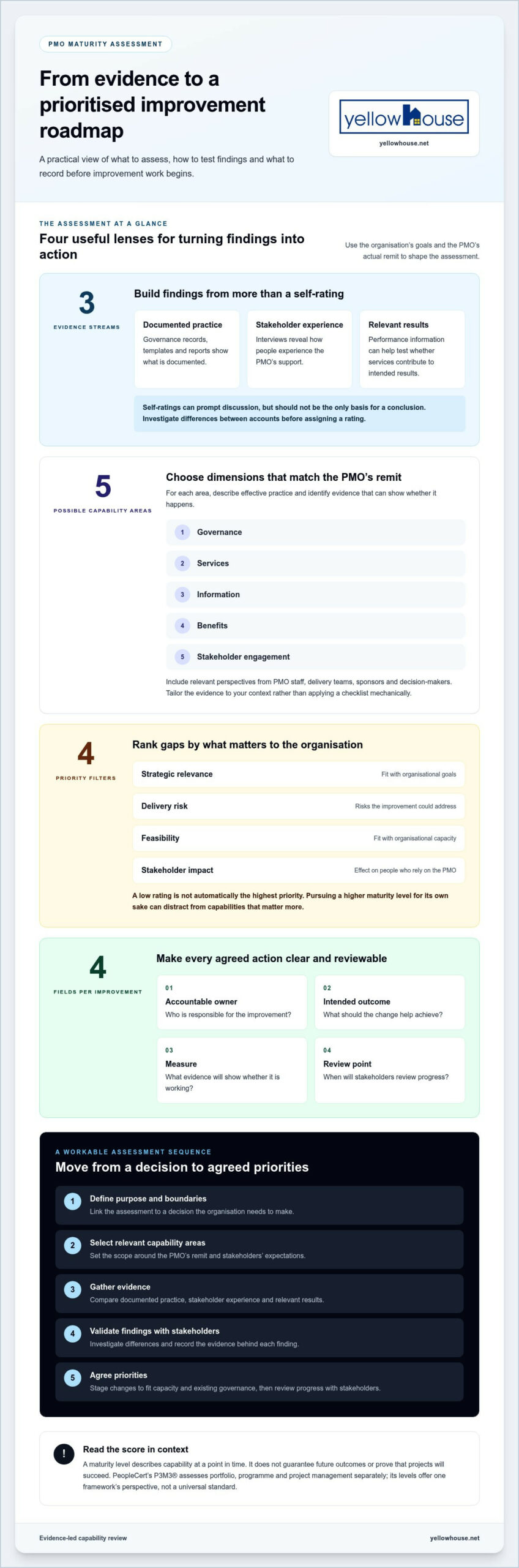
Make the assessment useful by linking its scope to a decision the organisation needs to make. Define the purpose and boundaries first, select relevant capability areas, gather evidence, validate findings with stakeholders, then agree priorities. For example, an assessment intended to improve portfolio decisions may focus on how options are assessed, information is reported and decisions are recorded. The PMO maturity assessment model from the Project Management Institute provides further context on assessment approaches.
Gather evidence that shows both what the PMO intends to do and what happens in practice. Interviews can reveal how people experience its support. Governance records, templates and reports show documented practice. Relevant performance information can help test whether services are contributing to intended results. Self-ratings can prompt discussion, but should not be the only basis for a conclusion.
Stronger findings combine documented practice, stakeholder experience and relevant results. If accounts differ, investigate why before assigning a rating. A formal process that teams do not use may point to an adoption issue, rather than simply a missing procedure. Record the evidence behind each finding so stakeholders can understand how the assessment reached its conclusions.
Which PMO capabilities and evidence should the assessment cover?
Choose dimensions that reflect the PMO’s remit. These may include governance, services, information, benefits and stakeholder engagement. For each area, clarify what effective practice would look like, then identify evidence that can demonstrate whether it happens. For governance, for instance, review how decisions are prepared, recorded and communicated, rather than relying only on a description of the process.
Include PMO staff, delivery teams, sponsors and decision-makers with relevant perspectives. Their different needs can show whether a service works consistently across teams or only in some parts of the organisation. For portfolio, programme and project office capability, P3O training can build understanding of office structures and practices. It complements, but does not replace, an organisational assessment. Tailor the dimensions and evidence to your context instead of applying a checklist mechanically.
Turn PMO maturity assessment findings into a prioritised improvement roadmap
Findings create value when they lead to practical changes with clear ownership. Rank gaps by strategic relevance, delivery risk, feasibility and stakeholder impact. A low rating is not automatically the highest priority. Nor should the PMO pursue the highest maturity level for its own sake if that effort would draw attention from capabilities that matter more to the organisation.
For each agreed improvement, record an accountable owner, intended outcome, measure and review point. If decision-makers need clearer portfolio information, for example, specify what better information should help them decide, who will improve it and how stakeholders will review progress. This makes responsibility visible and gives the PMO a way to adjust the work if it is not delivering the intended benefit.
How can a PMO sustain improvement after the assessment?
Stage the roadmap to fit organisational capacity and existing governance. Begin with changes that address material risks or enable later improvements, rather than launching every action at once. At agreed governance points, review progress with stakeholders and use evidence to decide whether actions are working or need adjustment as priorities change.
Where developing office capability is a goal, P3O training in Australia supports structured learning about portfolio, programme and project offices. Yellowhouse provides P3O training as part of its project, programme and portfolio management training. This supports capability development alongside an improvement plan, rather than substituting for an assessment of the organisation.
Independent oversight can help test whether governance and improvement actions are working as intended. Explore how a Gateway assurance review can complement your oversight approach.
Make your next PMO improvement deliberate
A useful PMO maturity assessment does more than assign a level. It brings evidence and stakeholder perspectives together to clarify current capability, while keeping the score in context. Focus on gaps linked to organisational priorities, then give each improvement an owner, intended outcome, measure and review point.
Progress does not require chasing the highest maturity rating. A staged roadmap that fits your capacity and governance can turn findings into practical, sustained change. Yellowhouse provides P3O, MoP and project management framework training, as well as strategic change consulting and Gateway assurance. Its training is available across Australia, including Brisbane, Sydney, Melbourne, Canberra, Adelaide, Perth, Cairns, Townsville, Hobart, Darwin, Mackay, the Gold Coast, Logan, Ipswich and Toowoomba.
Explore Yellowhouse project, programme and portfolio management support to plan a considered next step towards stronger PMO capability.
Frequently Asked Questions
What is a PMO maturity assessment?
A PMO maturity assessment is a structured review of a project management office’s capabilities, practices and contribution to organisational goals. Its scope should reflect the office’s actual remit, since a PMO may focus on governance, reporting, portfolio support or other services. The result provides a diagnostic view of capability at a point in time, not a guarantee of project success or a universal rating.
How do you assess PMO maturity?
Start by agreeing the assessment’s purpose and scope, then choose capability dimensions that fit the PMO’s responsibilities. Gather documented evidence and stakeholder perspectives, validate the findings together, and agree priorities. Interviews and self-ratings can reveal useful views, but should not be conclusive on their own. Compare them with work artefacts, such as governance records and reports, and relevant performance information.
What areas should a PMO maturity assessment cover?
Coverage depends on the PMO’s remit and organisational context, rather than a universal checklist. Adaptable dimensions include governance, services, information, benefits and stakeholder engagement. Include people who use or oversee the PMO, such as delivery teams, sponsors and decision-makers. For organisations with operations across Sydney, Melbourne, Brisbane, Canberra, Adelaide, Perth, Cairns, Townsville, Hobart, Darwin, Mackay, the Gold Coast, Logan, Ipswich and Toowoomba, consider whether practices and stakeholder needs vary between teams.
What should you do after a PMO maturity assessment?
Validate the findings with stakeholders, then select improvements according to strategic relevance and feasibility. Give each agreed action an accountable owner, an intended outcome, a measure and a review point, so responsibility and progress are clear. Revisit the roadmap as evidence or organisational priorities change. This keeps the assessment connected to ongoing improvement, rather than leaving its findings in a report that is filed and forgotten.


About Post Author
