

Project vs programme management: understand the difference
What if the clearest way to distinguish project and programme management is to look beyond the work being done and ask what change it must create? That’s the difference between project and programme management: projects organise work to deliver a defined output, while programmes coordinate related projects to achieve broader outcomes and realise benefits. Yet workplaces often use the terms inconsistently, and the line between an output, an outcome and a benefit can feel abstract when initiatives overlap.
If you’re weighing whether related projects need programme-level coordination, this guide will help you make that call. You’ll learn how responsibilities differ, how projects and programmes work together, and how to connect delivery with strategic change. It also explores PRINCE2® and MSP® as complementary learning pathways for building capability at the project or programme level.
Key Takeaways
- Understand the difference between project and programme management by looking at whether the work is focused on a defined output or broader change and benefits.
- Use shared outcomes, dependencies and the need for coordinated change to judge whether programme-level oversight could help.
- Don’t assume several projects automatically need a programme; consider how closely their work and intended outcomes rely on one another.
- Explore PRINCE2® training for project responsibilities and MSP® training for coordinating programme work towards strategic change.
Project vs programme management: what each is responsible for
A project is a temporary effort organised to deliver specified outputs. Its manager focuses on defining the work, coordinating resources and keeping delivery aligned with agreed objectives. A programme brings related projects and other activities together when they contribute to broader outcomes and benefits. The difference between project and programme management is therefore not simply the number of tasks involved, but the level of coordination and the change being pursued.
Projects deliver defined outputs; programmes coordinate related work to realise outcomes and benefits. The distinction is explored in this Program management vs project management overview.
| Dimension | Project management | Programme management |
|---|---|---|
| Purpose | Deliver a defined output | Enable broader change and benefits |
| Scope | A temporary, bounded effort | Related projects and activities |
| Coordination | Manage delivery within the project | Coordinate dependencies across the programme |
| Outputs | Specific products or deliverables | Combined outputs that support change |
| Outcomes | May contribute to a wider outcome | Focus on achieving intended outcomes and benefits |
How do outputs, outcomes and benefits separate the two?
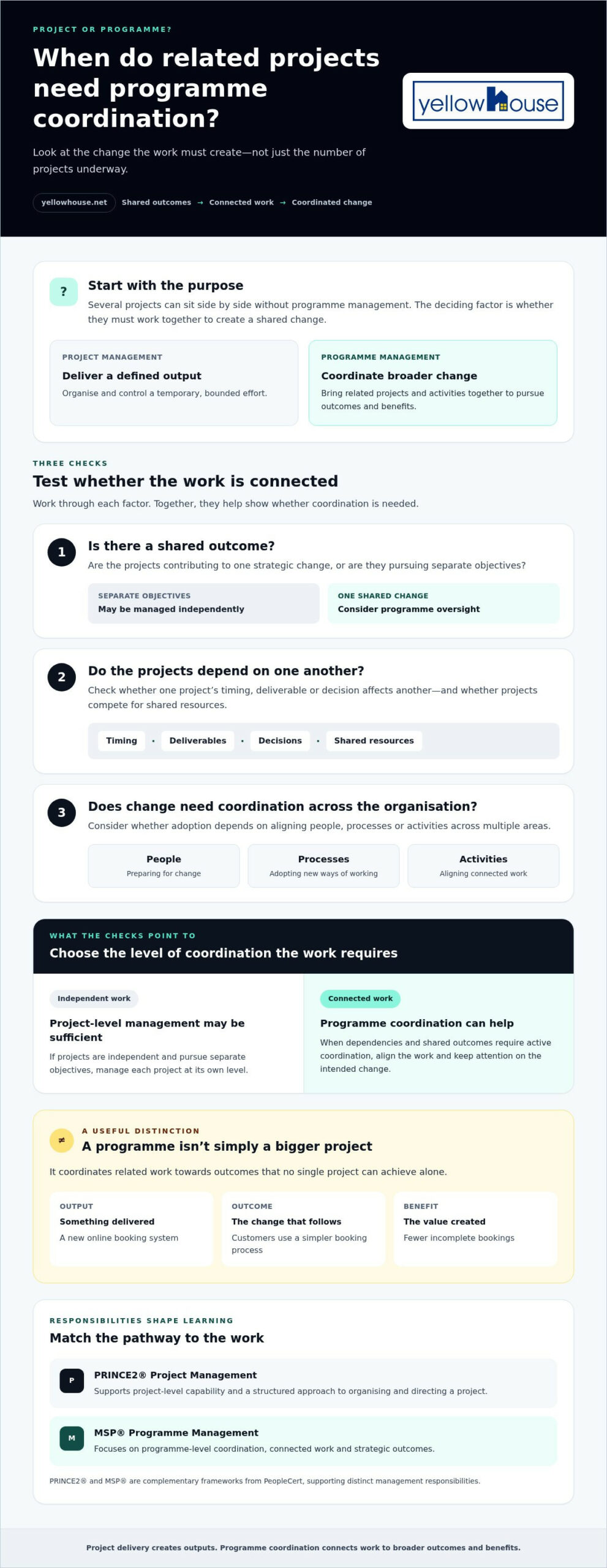
An output is something delivered, such as a new online booking system. An outcome is the change that follows, such as customers using a simpler booking process. A benefit is the measurable value created, for example fewer incomplete bookings.
Illustrative example: A business runs separate projects to introduce the booking system, update staff procedures and prepare customer communications. Each project delivers its own outputs; programme coordination aligns the work so the business can adopt the new process and track the intended value. For project-level capability, explore PRINCE2 project management training.
How to tell when project or programme management fits
Several projects can sit side by side without needing programme management. The deciding factor is whether they must work together to create a shared change, not simply how many projects are under way. Use this quick test:
- Check the shared outcome. Are the projects contributing to one strategic change, or are they pursuing separate objectives?
- Map the dependencies. Does one project’s timing, deliverable or decision affect another? Do they compete for shared resources?
- Assess the change across the organisation. Will adoption depend on coordinating people, processes or activities across multiple areas?
If the projects are independent, managing each at project level may be sufficient. If their dependencies and connected outcomes require active coordination, programme management can help align the work and keep attention on the intended change. For further context, see the guide Managing Successful Programmes (MSP): The Complete Guide to the MSP Framework.
What signals that related projects need programme coordination?
Programme coordination is useful when interdependent projects must contribute to shared outcomes. That may mean sequencing work, managing shared resources or helping different areas prepare for connected changes. A programme isn’t simply a bigger project: it coordinates related work towards outcomes that no single project can achieve alone. This distinction is also outlined in this Managing Successful Programmes (MSP®) reference.
If the decision points towards programme-level responsibilities, explore MSP® programme management training as a relevant learning pathway.
How PRINCE2® and MSP® support project and programme responsibilities
Choosing a learning pathway starts with the responsibilities you hold, not just the title on your business card. The difference between project and programme management helps clarify which skills to develop: project roles centre on organising and controlling defined delivery, while programme roles involve coordinating connected work towards strategic change.
PRINCE2® Project Management training supports project-level capability, including a structured approach to organising and directing a project. It can be relevant if you’re responsible for a discrete piece of delivery, though the most suitable approach depends on your organisation and the work involved. Yellowhouse offers PRINCE2 project management training. Its PRINCE2 project management guide can provide further context on the framework.
Which management learning pathway aligns with your role?
If your responsibilities span related projects, shared dependencies and coordinated organisational change, MSP® Programme Management training offers a relevant pathway focused on programme-level coordination and strategic outcomes. Explore Yellowhouse’s MSP programme management page for details, and use the MSP framework guide to build your understanding of its approach.
PRINCE2® and MSP® are complementary frameworks from PeopleCert, but they support distinct management responsibilities. Some professionals may benefit from understanding both levels, particularly when their work connects project delivery with wider change.
As a practical next step, match your learning to the work you manage now and the responsibilities you want to take on next. Focus on project-level learning for defined delivery roles, or programme-level learning if you’re preparing to coordinate interdependent work and contribute to broader change.
Build the capability for your next change
The difference between project and programme management comes down to the level of responsibility: projects organise delivery of defined outputs, while programmes coordinate connected work towards broader outcomes and benefits. Several projects don’t automatically need programme management; shared outcomes and interdependencies help signal when coordination matters.
Your learning pathway can reflect the work you do now and the direction you want to grow. PRINCE2® project management training supports project responsibilities, while MSP® programme management training is relevant to coordinating strategic change. Yellowhouse provides Australian professional training and management consulting, with learning in both frameworks.
Ready to build your programme management capability? Explore MSP programme management training with Yellowhouse and take a considered next step towards your professional goals.
Frequently Asked Questions
Is a programme just a larger project?
No. A programme isn’t simply a larger project. Size alone doesn’t determine the management approach. A project has its own defined scope and delivery objectives; a programme coordinates related projects and other work towards a shared change. It needs coordination across workstreams, not just a bigger budget, longer timeline or larger team. This distinction helps avoid adding programme oversight where projects can be managed independently.
Can a project be part of a programme?
Yes. A project can sit within a programme if its outputs contribute to the programme’s intended outcomes. For example, a project might deliver a new process, while other coordinated projects prepare systems and staff for the broader change. The project retains its own objectives and management, while programme coordination aligns its work with related activities and the shared direction.
How do project and programme managers differ?
Project managers lead delivery within a project’s agreed scope, coordinating work, resources and progress towards specified outputs. Programme managers focus on how related projects and activities fit together, manage dependencies and support the intended outcomes and benefits. The difference between project and programme management is reflected in these distinct responsibilities: one directs a defined delivery effort, while the other coordinates connected work and change.
When should an organisation use programme management instead of separate projects?
Use programme management if projects depend on one another, compete for shared resources, or must combine to achieve a shared outcome and coordinated change. If projects have separate goals and can succeed independently, individual project management may be sufficient. For organisations in Brisbane, Sydney, Melbourne, Canberra, Adelaide, Perth, Cairns, Townsville, Hobart, Darwin, Mackay, Gold Coast, Logan, Ipswich and Toowoomba, assess actual dependencies and shared outcomes before adding programme coordination.


About Post Author
