

The ITIL Career Path in Australia: A 2026 Checklist for Service Management Success
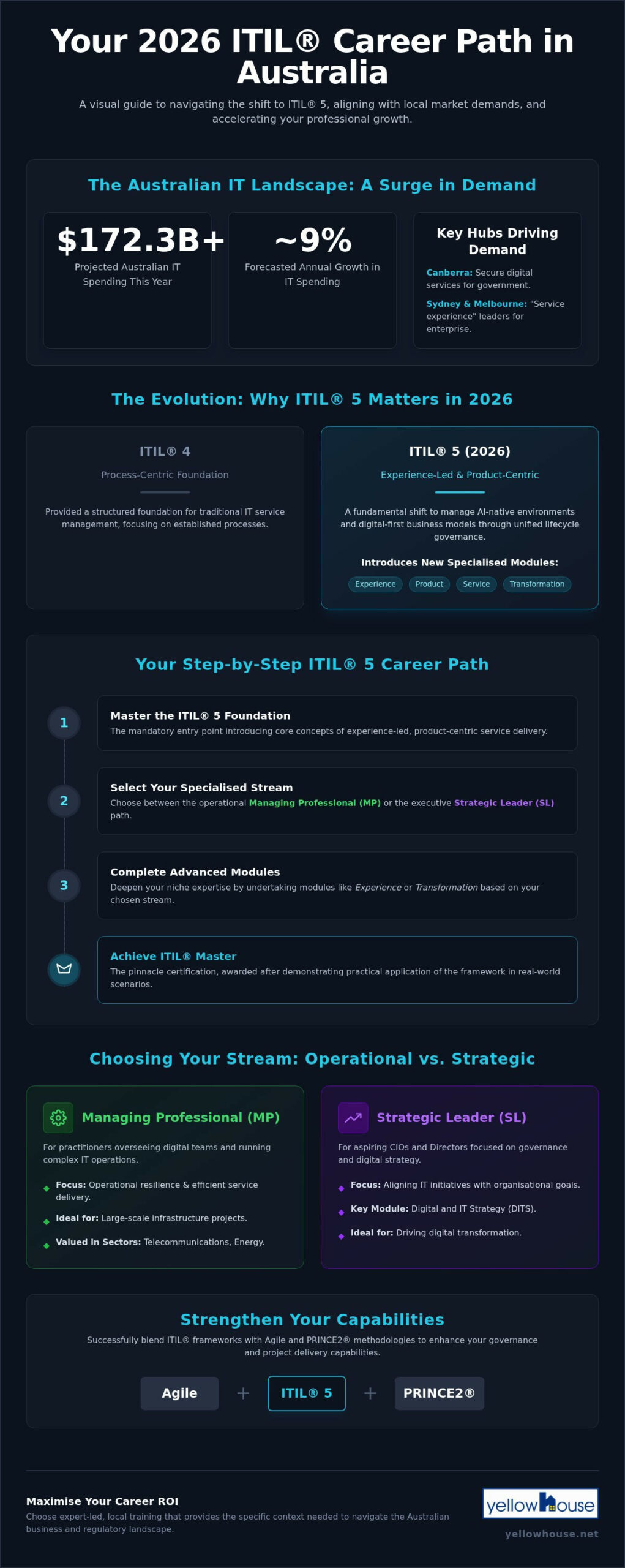
With Australian IT spending projected to exceed $172.3 billion this year, the demand for sophisticated service management has reached a critical peak. You’ve likely noticed that the bar for senior roles has shifted, making a well-defined ITIL career path can rely on more essential than ever. It’s a complex time to advance, especially with the 2026 rollout of ITIL 5 and the need to integrate these frameworks with established PRINCE2 practices.
We understand the uncertainty that comes with these transitions, particularly when deciding between the Strategic Leader and Managing Professional streams. You need certifications that carry weight with Australian government departments and major enterprise sectors. This article provides a definitive checklist to help you navigate the updated certification landscape and accelerate your trajectory in the local market. You’ll gain a clear roadmap of the new ITIL 5 modules and learn how to align your training with Agile methodologies. We’ll also help you find the confidence to choose an accredited provider that understands the nuances of the Australian corporate environment.
Key Takeaways
- Understand why ITIL 5 has become the definitive standard for Australian government and finance sectors managing AI-integrated service models.
- Map out your professional growth using a clear checklist for the ITIL career path, starting with the 2026 ITIL 5 Foundation.
- Determine whether the Managing Professional or Strategic Leader stream best aligns with your long-term operational or executive objectives.
- Learn how to successfully blend ITIL frameworks with PRINCE2 and Agile methodologies to strengthen your governance and project delivery capabilities.
- Recognise the benefits of choosing local, expert-led training that provides the specific context needed to navigate the Australian business and regulatory landscape.
Evolution of IT Service Management: Why ITIL 5 Matters
ITIL 5 represents a fundamental shift from traditional process management to an experience-led, product-centric approach. While the ITIL framework has always provided a structured foundation, the 2026 release directly addresses the complexities of AI-native environments and digital-first business models. In Australia, this evolution is particularly relevant as organisations move beyond simple service delivery toward creating seamless digital experiences. Transitioning from ITIL 4 to ITIL 5 isn’t just about a new certificate; it’s about remaining competitive in a market that demands agility and strategic foresight.
The State of the Australian ITSM Job Market
The demand for certified professionals is surging across major hubs. In Canberra, government agencies require robust governance to manage secure digital services, while in Sydney and Melbourne, enterprise sectors are seeking "service experience" leaders rather than traditional technical support. We’ve seen a clear shift where employers now prioritise candidates who can lead digital transformation initiatives. With Australian IT spending forecast to grow by nearly 9% this year, the opportunities for those with the right credentials have never been more significant.
ITIL 5 vs ITIL 4: Key Differences for Your Career
The 2026 ITIL Career Path Checklist: Step-by-Step Progression
Building a successful ITIL career path requires more than just passing an exam; it involves a strategic commitment to continuous professional development. This framework provides a clear hierarchy of credentials designed to validate your expertise at every level of the service lifecycle. Aligning your certifications with in-demand skills in Australia ensures your profile remains competitive for high-level roles in the public and private sectors.
- Step 1: Master the ITIL 5 Foundation. This is the mandatory entry point that introduces the core concepts of experience-led, product-centric service delivery.
- Step 2: Select Your Stream. You’ll need to decide between the operational focus of the Managing Professional (MP) stream or the executive-level Strategic Leader (SL) path.
- Step 3: Complete Specialised Modules. Depending on your goals, you’ll undertake modules such as Experience or Transformation to deepen your niche expertise.
- Step 4: Achieve ITIL Master. The pinnacle of the path, this status is awarded after demonstrating practical application of the framework in real-world scenarios.
Managing Professional (MP) Stream Checklist
The Managing Professional stream is tailored for practitioners who oversee digital teams and run complex IT operations. If you already hold an ITIL 4 Managing Professional designation, you can utilise specific transition modules to upgrade your credentials for 2026 without starting from scratch. These roles are pivotal in large-scale infrastructure projects where operational resilience and efficient service delivery are top priorities. Professionals in this stream often find that their expertise is highly valued in telecommunications and energy sectors across the country.
Strategic Leader (SL) Stream Checklist
For aspiring CIOs and Directors, the Strategic Leader stream offers a focus on high-level governance and digital strategy. The "Digital and IT Strategy" (DITS) module is the cornerstone of this path, teaching you how to align IT initiatives with broader organisational goals. As you plan your progression, partnering with an expert ITIL training provider can help you select the modules that best support your executive ambitions.
Maximising Your ROI: Your Training Partner Matters
Your return on investment isn’t merely the cost of an exam; it’s the tangible value you bring back to your organisation. While self-paced, generic modules might get you through a test, they rarely provide the depth needed to navigate the Emerging Trends in IT Service Management that define the current market. Choosing an accredited partner ensures you’re learning from practitioners who have actually implemented these frameworks within complex Australian enterprise environments.
A successful ITIL career path professionals pursue often involves a multi-framework approach. Understanding how ITIL 5 integrates with PRINCE2 project management allows you to bridge the gap between service operations and project delivery. The "Yellowhouse Advantage" is found in our commitment to quality through seasoned practitioners who bring real-world Australian case studies into the classroom. We focus on the "why" behind the process, ensuring you can apply your knowledge to specific local regulatory and business contexts.
Preparing for the ITIL 5 Foundation Exam
Success starts with a solid foundation. Enrolling in a structured ITIL 5 Foundation Course provides the clarity required to grasp new concepts like experience-led delivery and unified governance. For busy professionals, balancing study with a full-time role requires a methodical approach. We recommend setting aside dedicated time each week and leveraging expert-led sessions to clarify complex topics rather than relying on guesswork. This disciplined approach ensures you’re not just memorising terms, but mastering the framework.
Next Steps: Enrolling for Success
Identifying the right delivery format is crucial for your individual learning style. Whether you prefer the collaborative energy of in-person sessions or the flexibility of virtual classrooms, ensure your provider offers accredited materials and ongoing support. Your ITIL career path journey is a long-term investment in your professional potential. Partner with a team that views your success as a collaboration, providing the seasoned wisdom and practical tools needed to reach your career goals in the 2026 landscape.
Securing Your Future in Service Management
The landscape of service management in 2026 is defined by rapid AI integration and a relentless focus on the user experience. By following a structured checklist and selecting the stream that aligns with your specific career goals, you can effectively navigate the transition from ITIL 4 to the new ITIL 5 modules. Establishing a clear ITIL career path you can trust is the surest way to secure senior leadership roles in our evolving digital economy. Success in this field requires more than just passing an exam; it demands a deep understanding of how these frameworks apply to local business and regulatory environments.
We are here to support your progression. As a PeopleCert accredited training organisation, our sessions are delivered by seasoned Australian practitioners who provide comprehensive guidance from Foundation through to Master level. We invite you to View our 2026 ITIL 5 Course Schedule and Book Your Spot to begin the next chapter of your professional development. Your future in service management starts with a single, strategic decision.
Frequently Asked Questions
Is ITIL 4 still relevant in Australia in 2026?
ITIL 4 remains highly relevant in 2026 as it provides the foundational logic for the ITIL 5 evolution. Most Australian enterprise and government sectors still recognise ITIL 4 certifications, especially as they remain valid for three years from the date of issue. While transitioning to ITIL 5 is essential for staying competitive, your existing ITIL 4 knowledge continues to serve as the baseline for modern service management practices across the country.
What is the average salary for an ITIL-certified professional in Australia?
The average salary for an ITIL 4 Foundation certified professional in Australia is approximately AUD 103,709 per year. For those who progress further along the ITIL career path, such as IT Specialists or Service Managers, salaries typically range between $105,000 and $125,000. These figures reflect the high value local employers place on professionals who can manage complex digital transformations and AI-integrated services in a credential-driven market.
Do I need to retake the Foundation exam if I am ITIL 4 certified?
You don’t necessarily need to retake the Foundation exam if you are already ITIL 4 certified, as PeopleCert has established clear transition pathways for existing practitioners. For instance, those who have achieved the ITIL 4 Managing Professional designation can take a specific transition module to achieve the ITIL 5 Managing Professional status. However, if you are just beginning your journey in 2026, the ITIL 5 Foundation is the mandatory entry point for all advanced modules.
How long does it take to complete the ITIL Managing Professional stream?
Completing the ITIL Managing Professional stream usually takes between six to twelve months, depending on your professional commitments and chosen study pace. This stream requires mastering several specialised modules that focus on running digital teams and complex IT operations. We recommend planning your training schedule around key project milestones to ensure you can apply your learnings directly to your current workplace scenarios while working through the ITIL career path. Check out our courses.
Can I combine ITIL with PRINCE2 Agile training?
Combining ITIL with PRINCE2 Agile training is a highly effective strategy for professionals who want to lead both service operations and project delivery. While ITIL focuses on the governance and lifecycle of services, PRINCE2 Agile provides the methodologies needed to deliver projects within those service frameworks. This combination is particularly valued in Australian government and finance sectors where rapid delivery must be balanced with robust service stability and long-term operational resilience. For those looking to further strengthen their governance capabilities, exploring P3O training Australia offers a structured pathway to building high-performing PMOs that align project delivery with executive strategy.


About Post Author
