

ITIL 5 Foundation Course: The 2026 Professional Guide
With Gartner forecasting Australian IT spending to reach A$172.3 billion this year, is your service management framework robust enough to handle this 8.9% surge in demand? You’re likely grappling with the recent release of ITIL Version 5 and wondering how it sits alongside your existing ITIL 4 knowledge. It’s a common challenge to align technical IT services with broader corporate governance while trying to find an ITIL foundation course that offers more than just a certificate.
This guide provides the clarity you need to master the essentials of the updated framework and demonstrates how these global standards drive service excellence across the Australian business landscape. You’ll discover how to implement the Service Value System in an AI-driven environment and learn why an expert-led approach to training is the key to improving long-term delivery efficiency. We’ll move beyond the basics to ensure your professional growth translates into a genuine competitive advantage for your organisation.
Key Takeaways
- Understand how ITIL Foundation serves as the essential governance standard for standardising service delivery across Australian government and private sectors.
- Navigate the 2026 framework updates to understand how ITIL 4 remains a valid foundation alongside the new AI-native and product-centric Version 5.
- Discover the strategic advantage of an ITIL foundation course when integrating service management with PRINCE2 projects and MSP programmes.
- Gain clarity on the certification path, including the 60-minute examination format and the practical requirements for maintaining your professional credentials.
- Learn why expert-led training from seasoned practitioners ensures you can apply the Service Value System to your unique organisational context.
Table of Contents
What is the ITIL Foundation Course in the Australian Context?
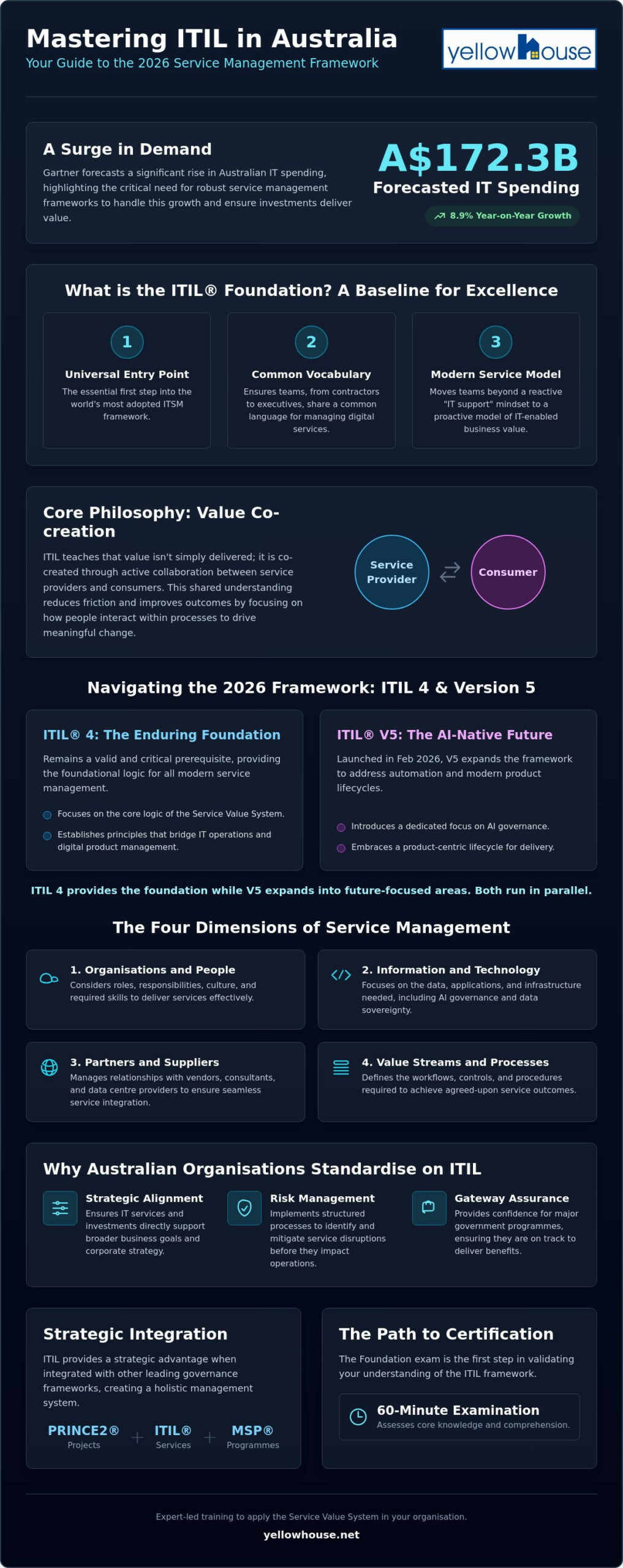
The ITIL Foundation certification serves as the universal entry point for the world’s most widely adopted Information Technology Service Management (ITSM) framework. In the Australian market, this qualification acts as a professional baseline, ensuring that teams share a common vocabulary and methodology for managing digital services. With the February 2026 launch of ITIL Version 5 (V5), the ITIL Framework has evolved to address an AI-native environment, yet the Foundation level remains the essential first step for any practitioner. Enrolling in an **ITIL foundation course **allows professionals to move beyond traditional "IT support" mindsets and embrace a modern model of IT-enabled service value.
This shift is significant. In 2026, IT is no longer a back-office function; it’s the engine of business value. As Gartner forecasts Australian IT spending to reach A$172.3 billion this year, the demand for professionals who can manage these investments through structured governance is at an all-time high. While ITIL 4 remains a valid and foundational prerequisite, the transition to V5 introduces a product-centric lifecycle and dedicated AI governance. This ensures the framework remains relevant as Australian organisations standardise their operations around automation and experience management.
The Core Philosophy: Value Co-creation
Value is not a product that a provider simply "delivers" to a customer. Instead, ITIL teaches that value is co-created through active collaboration between service providers and consumers. This philosophy is vital for reducing friction in large-scale Australian organisations where silos often hinder progress. When both parties understand their roles in the service relationship, outcomes improve. We emphasise the human element in every training session at Yellowhouse. We don’t just teach processes; we focus on how people interact within those processes to drive meaningful change.
Why Australian Organisations Standardise on ITIL
A common language is the greatest asset of any large project. Australian government departments and private sector leaders use ITIL to ensure that everyone, from contractors to executives, is on the same page. This standardisation is particularly important for compliance with Australian governance standards and regulatory requirements.
-
Strategic Alignment: It ensures IT services support the broader goals of the business.
-
Risk Management: Structured processes identify and mitigate service disruptions before they impact the bottom line.
-
Gateway Assurance: For major government initiatives, ITIL-aligned practices are often a critical component of successful Gateway assurance reviews, providing confidence that a programme is on track to deliver its intended benefits.
By adopting these global best practices, local organisations transform their IT departments from technical cost centres into strategic partners. It’s a disciplined approach that balances the need for stability with the Australian appetite for innovation.
Navigating the 2026 Framework: ITIL 4 and Version 5
The release of ITIL Version 5 in February 2026 has introduced significant updates to the framework, yet it’s important to understand that ITIL 4 remains a critical component of the professional ecosystem. Both versions currently run in parallel; ITIL 4 provides the foundational logic while V5 expands into AI-native automation and product-centric delivery. For those seeking an ITIL foundation course, the focus is now on mastering the enduring principles of service management while preparing for this technological shift. The core logic of the Service Value Chain remains as relevant as ever, acting as the bridge between traditional IT operations and modern digital product management. You’ll find that the Foundation curriculum covers the essential logic required for all certification paths, regardless of which version your organisation currently prioritises.
The Four Dimensions of Service Management
Balanced service delivery requires more than just technical proficiency. The Four Dimensions framework ensures that practitioners consider the broader organisational context to avoid narrow, siloed thinking. For example, when an Australian financial institution migrates to a hybrid cloud, they must address Organisations and People by upskilling staff for new roles. They manage Information and Technology by ensuring data sovereignty and AI governance. They coordinate with Partners and Suppliers, such as local data centre providers or specialist consultants. Finally, they refine Value Streams and Processes to ensure the migration actually delivers business benefits. Value Streams are the sequence of activities an organisation undertakes to create value. By considering all four dimensions, you ensure that your service management strategy is resilient and holistic.
The Service Value System (SVS)
The Service Value System acts as the overarching architecture that prevents organisational silos. It coordinates various inputs and activities to ensure that value is consistently co-created with stakeholders through a unified approach. At the heart of this system are the Guiding Principles, which serve as a practical compass for decision-making. In the Australian business environment, these principles are the "secret sauce" for successful change because they encourage practitioners to "Start Where You Are" and "Progress Iteratively with Feedback" rather than attempting high-risk, radical overhauls. This pragmatic approach mirrors many IT Project Management Best Practices, ensuring that service management isn’t just a theoretical exercise but a driver of real-world efficiency. Understanding these frameworks is the first step toward professional mastery; you might consider how expert-led coaching can help you translate these concepts into your specific business environment.
With 36% of the content in Version 5 being entirely new, the SVS now incorporates a stronger focus on experience management and AI governance. This ensures that the **ITIL foundation course **remains the most relevant starting point for professionals looking to lead in a digital-first economy. Whether you’re managing a small internal team or a large-scale government programme, the SVS provides the structure needed to turn opportunity and demand into actual value.
Integrating ITIL with PRINCE2 and MSP Governance
ITIL doesn’t exist in a vacuum. For an **ITIL foundation course **to provide genuine value, it must be understood as part of a broader management ecosystem. While ITIL focuses on the lifecycle of services, it relies on robust project and programme management to deliver the changes that those services require. This is where the synergy between ITIL, PRINCE2, and MSP becomes critical for organisational success. ITIL acts as the operational backbone, ensuring that once a project concludes, the resulting service is sustainable, supported, and aligned with business needs. Yellowhouse specialises in teaching these frameworks as an integrated whole, helping practitioners see the connections rather than just the individual parts.
Strategic change initiatives often fail because of a disconnect between the "build" and "run" phases of a lifecycle. By positioning ITIL as the foundation for service excellence, MSP (Programme) leaders can ensure that new capabilities transition smoothly into "business as usual" (BAU). This integrated approach reduces the risk of service disruption during major upgrades. It’s a disciplined way to manage the human element of change while maintaining technical stability. When your team speaks the same language across projects and operations, the path to achieving a competitive advantage becomes much clearer.
Project vs. Service: The Perfect Partnership
A project is a temporary endeavour designed to produce a specific output, whereas a service is an ongoing means of delivering value. This distinction is fundamental. If a PRINCE2 practitioner understands ITIL service design, they can ensure that the project’s outputs are actually "fit for purpose" and "fit for use" in a live environment. This prevents the common "throw it over the wall" syndrome where projects deliver products that the operations team cannot effectively support. For those looking to unify these management standards, the Praxis Framework offers a consolidated approach to project, programme, and portfolio management that complements ITIL’s service-centric logic. It’s about creating a seamless flow from the initial idea to the final service retirement.
Governance and Gateway Assurance
In the Australian public sector, major initiatives are subject to Gateway assurance reviews. These reviews examine programmes and projects at key decision points to ensure they are on track to deliver their intended benefits. ITIL practices provide the necessary evidence of operational readiness required to pass these gates with confidence. When service management processes are standardised through accredited training, teams become "review-ready" by default. This high-level oversight is further strengthened by P3GP Governance, which provides the principled structures needed to oversee the entire service and project portfolio. Many organisations find that establishing a dedicated project office setup consulting engagement is the most effective way to embed these governance standards across their portfolio from the outset. Enrolling in an ITIL foundation course Australia is the first step in building this governance capability, ensuring your organisation meets both local and global standards for excellence.
The Path to Certification: What to Expect in 2026
Achieving your certification involves a structured learning journey that typically spans two to three days of intensive study. While self-paced options are available, most professionals find that an instructor-led **ITIL foundation course **provides the depth needed to understand complex concepts like the Service Value System. This format allows for the exploration of real-world Australian case studies, such as how local government agencies manage service transitions or how national retailers handle peak demand. In 2026, PeopleCert continues to facilitate the examination process through a secure online proctoring system, ensuring that candidates can complete their assessment from any professional environment. Upon success, you receive a digital badge that serves as a verifiable, global record of your expertise.
The examination itself remains a closed-book, 60-minute assessment consisting of 40 multiple-choice questions. To succeed, you must achieve a score of at least 65%, which equates to 26 correct answers. This rigorous standard ensures that every certified professional possesses a genuine grasp of the framework’s logic. By participating in a live session, you gain the advantage of immediate feedback from experts who have implemented these practices in the field. This interactive environment is where the "human element" of service management truly comes to life, turning theoretical principles into practical workplace tools.
Choosing Your Learning Format
The choice between virtual instructor-led training and a traditional classroom setting often depends on your organisational needs and personal learning style. Virtual sessions offer the flexibility of remote participation while maintaining the interactive collaboration that is a hallmark of the Yellowhouse approach. You might encounter "Fast Track" options in the market, but these are generally reserved for practitioners with a solid baseline of experience in formal service management. It’s vital to ensure you select an AXELOS accredited training provider to guarantee that your course materials and exam vouchers are authentic and reflect the latest 2026 standards.
Preparing for the Foundation Exam
Your preparation should focus on a core checklist: the 7 Guiding Principles, the SVS, and essential ITIL Practices. Understanding the nuance between similar practices is often the key to answering exam questions correctly. For instance, Incident Management focuses on restoring service as quickly as possible following a disruption, whereas Service Request Management handles pre-defined, user-initiated requests like password resets or hardware upgrades. When taking the PeopleCert online exam, ensure your environment is quiet and your system meets the technical requirements well before the start time. If you’re ready to take the next step in your professional journey, you can enrol in an accredited ITIL Foundation course and benefit from the insights of seasoned expert practitioners.
Why Choose Yellowhouse for Your ITIL Journey?
Yellowhouse stands as a principled, Australian-owned firm dedicated to elevating professional capability through accredited training. Choosing an **ITIL course **with us means you’re partnering with a team that values substance over mere certification. We don’t operate as a high-volume training factory; instead, we function as a trusted advisor, ensuring that every session is tailored to the unique organisational contexts our clients face. Our "Expert Practitioner" approach ensures that your trainer has actually implemented these frameworks in complex, real-world scenarios, providing you with insights that go far beyond the standard textbook definitions.
This hands-on experience allows us to bridge the gap between theoretical knowledge and practical application. We understand that the Australian business landscape requires more than just a pass mark; it requires the ability to drive service excellence in an increasingly automated environment. By focusing on the "human element" within technical frameworks, we help you understand how to navigate organisational change and build a culture of value co-creation. It’s a disciplined, results-oriented approach that respects your time and your professional goals.
Beyond the Certificate: Building Capability
Our commitment to your success extends well beyond the final exam. We view the Foundation level as the first step in a comprehensive career path, offering follow-on courses like MSP® Programme Management or P3O® training to help you build a complete professional toolkit. This focus on long-term capability allows you to transition from a technical contributor to a strategic leader who understands the "why" behind the "what." It’s this quiet expertise and supportive partnership that defines the Yellowhouse experience, ensuring you’re equipped to handle the shifting demands of the 2026 digital landscape.
National Reach, Personalised Delivery
We provide expert-led training across the entire Australian landscape, from major capital centres to regional hubs. Our delivery is methodical, composed, and tailored to achieve the specific results your organisation requires. We believe the human element is the most critical factor in any technical framework, which is why we focus on collaboration and active involvement. By choosing to work with us, you’re collaborating with a partner who understands the Australian market intimately and possesses the tools to help you reach your full potential. We invite you to experience a disciplined approach to professional growth that places your goals at the centre of the narrative.
Advancing Your Career in a Digital-First Landscape
The evolution of service management in 2026 demands a shift from technical maintenance to strategic value co-creation. By mastering the updated framework, you position yourself to lead in an environment increasingly shaped by AI and product-centric delivery. You’ve seen how integrating these practices with project and programme governance creates a robust operational backbone for any Australian organisation. Whether you’re navigating the transition from ITIL 4 to Version 5 or starting your journey from scratch, the right guidance is essential for translating theory into real-world success.
Yellowhouse provides the expertise required to turn these sophisticated concepts into practical business results. As an AXELOS Accredited Training Organisation, we offer a supportive partnership led by seasoned Australian practitioners who understand the complexities of modern corporate governance. Our approach ensures that your **ITIL foundation course **is a catalyst for long-term professional capability rather than just a step toward an exam. We invite you to enrol in an accredited ITIL Foundation course with Yellowhouse today and begin driving genuine service excellence within your team.
Frequently Asked Questions
Is ITIL 4 Foundation still valid with the release of ITIL Version 5?
Yes, ITIL 4 Foundation certifications remain fully valid and continue to serve as a recognised prerequisite for advanced modules. While ITIL Version 5 was released in February 2026, the two frameworks currently run in parallel. Professionals aren’t required to upgrade immediately, although new candidates often prefer the latest version to align their skills with modern AI-native and product-centric practices.
How much does the ITIL Foundation course cost in Australia for 2026?
Market rates for an accredited **ITIL foundation course **typically range from approximately A$1,400 to A$2,000 depending on the delivery format and the depth of study materials provided. These fees generally cover both the training and the mandatory PeopleCert exam voucher. We recommend verifying whether GST is included in any quoted price, as many professional training providers list their costs on an exclusive basis.
Can I take the ITIL Foundation exam without attending a training course?
You can technically purchase an exam voucher directly from PeopleCert to sit the assessment without formal training. However, this "exam-only" path lacks the practical context and expert insights provided by an accredited training organisation. Most Australian professionals choose instructor-led sessions to ensure they understand the Service Value System and its real-world application rather than just memorising definitions for the test.
What is the difference between ITIL Foundation and PRINCE2 Foundation?
The primary difference lies in their operational focus; ITIL governs ongoing service delivery while PRINCE2 manages projects. ITIL Foundation provides the framework for maintaining and improving existing services to create value over time. In contrast, PRINCE2 offers a structured methodology for delivering a specific product or change within a set timeframe. Both frameworks are complementary and are frequently used together in Australian governance models. Organisations seeking to maximise the value of both disciplines often benefit from professional project office setup consulting to ensure their PMO is structured to support both service management and project delivery standards simultaneously.
How long does the ITIL Foundation certification last?
ITIL Foundation certificates are issued with a three-year renewal date under PeopleCert’s continuing professional development requirements. To maintain the "current" status of your digital badge, you’ll need to earn and record professional development points or retake the exam before the expiry date. This requirement ensures that practitioners stay updated with the latest industry shifts, such as the 2026 transition to AI-driven service management.
Is the ITIL Foundation exam difficult for non-IT professionals?
The exam is highly accessible for non-technical professionals because it focuses on business logic and service value rather than technical coding or hardware. The curriculum covers universal concepts like customer experience, risk management, and collaboration. Many individuals in human resources, procurement, and general management find the framework provides a valuable common language for interacting with their organisation’s technology departments effectively.
Does the ITIL Foundation course include the official exam voucher?
Yes, your booking includes the official PeopleCert exam voucher and the eBook as a standard part of the package.
What are the career benefits of ITIL certification in the Australian public sector?
ITIL certification is highly regarded in the Australian public sector because it aligns with standard governance and Gateway assurance reviews. Holding this qualification demonstrates that you understand the disciplined processes required to manage taxpayer-funded digital services. It provides a competitive advantage for those seeking roles in state or federal departments where standardised service delivery and risk mitigation are mandatory operational requirements.


About Post Author
