

PRINCE2 vs Praxis Framework: Navigating the 2026 Project Management Landscape in Australia
The most prestigious certification on your CV might be the very thing limiting your ability to manage complex, multi-level change in the current Australian market. We understand the frustration of framework fatigue, particularly when you are expected to navigate the overlap between project, programme, and portfolio levels without a cohesive map. Choosing between PRINCE2 vs Praxis Framework isn’t just about picking a badge; it’s about deciding whether you need a refined delivery method or a comprehensive management ecosystem to support your professional growth.
You will discover the critical differences between these two standards to determine which path provides the best return on investment for your specific role and organisational objectives in 2026. We’ve seen how the right choice can transform a career, especially as Australia faces a projected shortage of 37,000 project professionals by 2027. This article provides a clear comparison of the ‘Method vs Ecosystem’ debate and explains how these frameworks integrate with local governance standards. By the end, you’ll have a definitive strategy for your next certification move and the confidence to lead your team through an increasingly complex landscape.
Key Takeaways
- Understand why PRINCE2 7th Edition continues to lead the way for process rigour and controlled delivery in Australia’s complex infrastructure and public sectors.
- Discover how the Praxis Framework offers a ‘total ecosystem’ by consolidating project, programme, and portfolio management into one integrated, community-driven standard.
- Analyse the direct comparison of PRINCE2 vs Praxis Framework across scope, governance, and maturity to identify which path delivers the highest value for your professional goals.
- Learn how to align your chosen methodology with Australian Gateway assurance reviews to ensure robust governance and successful delivery outcomes.
- Utilise a practical decision framework to determine if your organisation requires project-level precision or a broader transformation of its management maturity.
The Evolution of Best Practice: Why Australia is Comparing PRINCE2 and Praxis in 2026
Australian organisations are currently re-evaluating how they deliver value in a market defined by rapid digital shifts and increased public scrutiny. The 2026 corporate landscape demands a level of transparency and strategic alignment that traditional, siloed methods often struggle to provide. Consequently, the debate regarding PRINCE2 vs Praxis Framework has moved from the training room to the executive board. This isn’t just a choice between two certificates; it’s a fundamental decision between a refined project delivery method and a comprehensive management ecosystem.
Modern boards are prioritising strategic oversight over simple task completion. In this environment, a disconnected approach to project management creates blind spots in resource allocation and risk visibility. The transition toward integrated best practice project management frameworks reflects a desire for a single source of truth across the entire delivery pipeline, from individual tasks to broad portfolio objectives.
The Enduring Legacy of PRINCE2 in Australian Governance
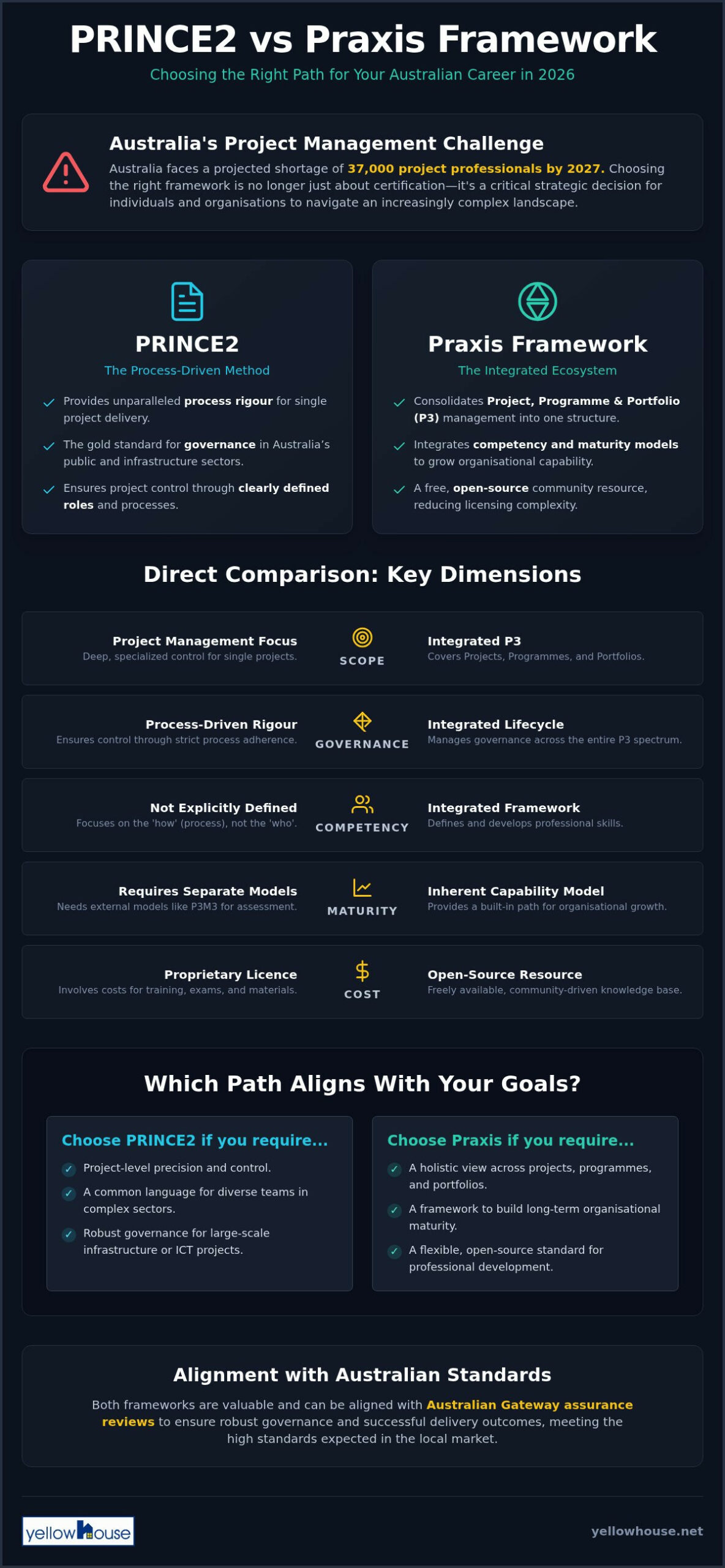
PRINCE2 remains the gold standard for project-level delivery across Australian industries. Its strength lies in its process rigour and clearly defined roles, which ensure that every stage of a project is justified and managed. By using the PRINCE2 project management method, diverse teams across different states or agencies can speak a common language. This consistency is vital for maintaining the high standards of accountability expected in modern Australian governance, particularly for large-scale infrastructure and government ICT projects.
The Praxis Framework: A Holistic Shift for Modern Organisations
The Praxis Framework offers a different value proposition by acting as a total ecosystem. It’s gaining significant traction among Australian organisations that want to manage projects, programmes, and portfolios within a single, integrated structure. Praxis doesn’t just tell you how to deliver; it incorporates competency frameworks and capability maturity models to help an organisation grow. Because it’s an open-source resource, it appeals to firms looking to reduce the complexity of managing multiple, often conflicting, proprietary licences. It provides a unified path for professional development that covers the entire P3 spectrum. This makes the comparison of PRINCE2 vs Praxis Framework essential for any leader planning a long-term professional development strategy.
Structural Rigour vs. Integrated Versatility: A Direct Comparison
Understanding the structural differences between PRINCE2 vs Praxis Framework is essential for any professional aiming to optimise their delivery standards. While PRINCE2 provides an unparalleled depth of process for single projects, Praxis represents the evolution of project management best practice by offering a broader, integrated scope from the outset.
| Dimension | PRINCE2 (Method) | Praxis Framework (Framework) |
|---|---|---|
| Scope | Project Management focus | Integrated Project, Programme, Portfolio (P3) |
| Governance | Process-driven rigour | Integrated lifecycle management |
| Competency | Not explicitly defined | Integrated competency framework |
| Maturity | Requires separate models (e.g. P3M3) | Inherent capability maturity model |
| Cost | Proprietary licensing and exams | Open-source community resource |
Deciding between Praxis Framework vs PRINCE2 significantly influences your long-term career trajectory. PRINCE2 certifications follow a traditional Foundation and Practitioner path. In contrast, the Praxis professional route integrates these levels with programme and portfolio management, providing a more versatile toolkit for senior leadership roles within the Australian market.
Process vs. Competence: How They Measure Success
PRINCE2 ensures project-level control through strict adherence to its seven processes. It’s about the ‘how’ of the method. Praxis shifts the focus toward the ‘who’ and the ‘where’. It measures success through individual competence and the overall maturity of the organisation. This distinction is critical for Australian firms facing current skills shortages, as it allows them to benchmark their team’s actual capabilities rather than just their process knowledge.
Scalability and Tailoring in the Australian Context
For teams requiring more flexibility, a PRINCE2 Agile implementation guide Australia approach can bridge the gap by blending rigour with responsiveness. However, Praxis is inherently designed for large-scale Australian infrastructure and IT programmes where tailoring across multiple levels is mandatory. If you’re looking to enhance your organisation’s delivery standards, our strategic change consulting services can help you align these frameworks with your specific business context.
Choosing the Right Path for Your Australian Organisation
Selecting the appropriate path depends on your current organisational maturity and strategic goals. If your focus is on refining project-level delivery with high process rigour, sticking with PRINCE2 remains a sound investment. Conversely, if you aim for a total organisational transformation that unifies different management levels, the Praxis Framework offers a more holistic solution. We’ve helped many partners find that the choice between PRINCE2 vs Praxis Framework isn’t always binary; it’s about matching the tool to the specific challenge.
Both methodologies are exceptionally well-suited to meet the requirements of a Gateway assurance review Australia. These reviews demand evidence of robust governance and clear justification at every stage of the investment. PRINCE2 provides the specific process evidence required for project-level gates, while Praxis demonstrates the broader competency and maturity context that reviewers often look for in high-value, complex programmes.
Many successful Australian firms adopt a hybrid approach to gain the best of both worlds. They utilise PRINCE2 for day-to-day delivery while leveraging Praxis for tracking maturity and individual competency across the business. Regardless of the technical choice, the real key to success is the human element. Expert-led training ensures that these frameworks aren’t just theoretical manuals but practical tools that your team can actually use to drive results. We believe that professional growth is best managed when practitioners have a deep understanding of the “why” behind the “what.”
When to Prioritise PRINCE2 Certification
This path is ideal for individuals who need immediate, globally recognised credentials to boost their career mobility. It’s particularly effective for organisations that currently operate with established, siloed project structures and need to introduce better process control. PRINCE2 provides a stable foundation for those who need to ensure project-level justification remains consistent and transparent across diverse teams.
When the Praxis Framework Training Wins
Praxis is the superior choice for PMO leads who want to unify project, programme, and portfolio standards under one roof. It provides the necessary context to justify a higher PRINCE2 Agile practitioner salary Australia by showing how agile delivery fits into the wider organisational strategy. It’s about moving from being a delivery specialist to a strategic leader who can manage the entire management ecosystem.
Securing Your Strategic Advantage in 2026
The decision regarding PRINCE2 vs Praxis Framework ultimately rests on the specific maturity of your organisation and your personal career aspirations. Whether you require the established process rigour of PRINCE2 to navigate complex project environments or the integrated versatility of the Praxis Framework to unify your programme and portfolio standards, the priority remains the same: delivering measurable value. Both paths offer robust alignment with Australian governance and Gateway assurance requirements, ensuring your delivery is both defensible and high-performing.
At Yellowhouse, we provide the seasoned wisdom and accredited expertise needed to make these methodologies work in the real world. As an accredited training provider for both AXELOS and APMG International, our expert Australian trainers bring genuine governance experience to every session. We specialise in customised training solutions tailored specifically for the Australian government and corporate sectors, ensuring your team is equipped for the challenges of 2026. Enrol in an accredited PRINCE2 or Praxis Framework course with Yellowhouse today and take the next step in your professional journey. Your growth is a long-term investment, and we’re here to partner with you at every stage.
Frequently Asked Questions
Is Praxis Framework better than PRINCE2 for Australian project managers in 2026?
Neither framework is objectively superior; rather, the choice depends on whether you require a specialised project method or a broad management ecosystem. PRINCE2 remains the established standard for project-level delivery within the Australian public sector and many corporate environments. Praxis offers a consolidated approach that integrates project, programme, and portfolio levels into a single framework, making it ideal for those managing complex, multi-level change.
Can I use the Praxis Framework if my organisation already uses PRINCE2?
Yes, the Praxis Framework is specifically designed to be compatible with other best practice standards like PRINCE2. You can continue using PRINCE2 for your project-level delivery while adopting Praxis to provide a unified structure for programme and portfolio management. This hybrid approach allows you to maintain existing process rigour while introducing a more integrated view of organisational capability and governance.
How do PRINCE2 and Praxis differ in their approach to organisational maturity?
The primary difference lies in the fact that Praxis includes an inherent capability maturity model, whereas PRINCE2 focuses on project-level processes. While PRINCE2 ensures that an individual project is managed with rigour and justification, Praxis provides the tools to measure and improve how the entire organisation delivers change over time. This makes Praxis a powerful option for PMO leads focused on long-term strategic growth.
Which certification has a higher ROI for my career in Australia?
The return on investment for PRINCE2 vs Praxis Framework depends on your specific career trajectory and the industries you target. PRINCE2 often provides an immediate advantage for those seeking project manager roles in established government or infrastructure sectors. Praxis offers a significant long-term return for professionals aiming for senior leadership or PMO roles, as it covers the full P3 spectrum in a single, integrated qualification.
Does the Praxis Framework cover programme and portfolio management like MSP and MoP?
Yes, the Praxis Framework integrates the knowledge and methods found in MSP and MoP into one cohesive, community-driven structure. It removes the need for multiple, separate certifications by providing a unified lifecycle that spans project, programme, and portfolio levels. This integration helps Australian organisations reduce framework fatigue and simplify their professional development pathways by using a single source of truth for all delivery levels.
How does PRINCE2 Agile fit into the PRINCE2 vs Praxis debate?
PRINCE2 Agile acts as a bridge between the governance of PRINCE2 and the responsiveness of agile delivery techniques. In the comparison of PRINCE2 vs Praxis Framework, PRINCE2 Agile is a specialised solution for project-level flexibility. Praxis remains the broader choice for those needing to integrate these agile projects into a wider programme or portfolio governance structure, ensuring that agile delivery still aligns with strategic objectives.


About Post Author
