

Portfolio Management Best Practices 2026: A Practical Guide
A portfolio can be full of green project reports and still fail to deliver the strategy it was meant to serve. The problem is often not a lack of activity, but difficulty deciding which initiatives deserve limited people, funding and leadership attention. Effective portfolio management best practices make those trade-offs visible and connect choices to outcomes.
If proposals are hard to compare, capacity is stretched and reporting focuses on milestones rather than benefits, you’re not alone. Portfolio management is a continuous cycle of selecting, balancing and learning, not a one-off planning exercise.
This practical guide explains how to set clear assessment criteria, prioritise work against strategic objectives, balance investment with real capacity, and review risks, progress and benefits. You’ll find a practical approach to explaining decisions and adjusting the portfolio when priorities or conditions change.
Key Takeaways
- Use portfolio management best practices to connect initiative choices to organisational strategy, not just project status.
- Assess proposals against shared criteria to compare expected benefits, risks, dependencies and capacity consistently.
- Clarify who makes portfolio decisions, when issues need escalation and how often the portfolio should be reviewed.
- Track delivery confidence and emerging risks alongside benefits, so reviews can prompt timely, evidence-informed decisions.
Portfolio management best practices start with strategy, not project status
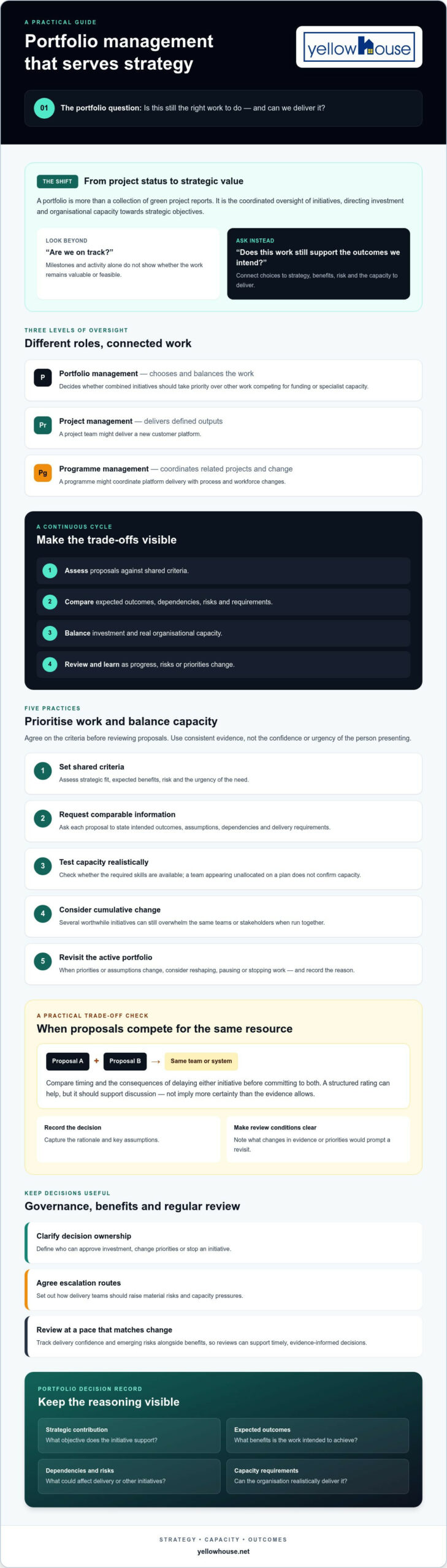
A portfolio is more than a collection of projects with green status reports. It is the coordinated oversight of initiatives, helping decision-makers direct investment and organisational capacity towards strategic objectives. Ask not only whether work is progressing, but whether it remains valuable, feasible and connected to the outcomes the organisation intends to achieve.
This matters for Australian organisations balancing priorities across teams, budgets and business areas. Without a shared view, initiatives may compete for the same specialists, depend on the same systems or pursue overlapping outcomes. A portfolio view helps leaders see these pressures together and decide what to start, continue, defer or stop. These portfolio management best practices build on sound management principles, including setting direction and organising resources to support objectives.
How does portfolio management differ from project and programme management?
Portfolio management chooses and balances the work; project management delivers defined outputs; programme management coordinates related projects and change. A project team might deliver a new customer platform, while a programme coordinates that work with process and workforce changes. At portfolio level, leaders decide whether the combined effort should take priority over other initiatives competing for funding or specialist capacity.
Portfolios group work around strategic objectives, not a single delivery method. Projects using different approaches can sit in the same portfolio if they contribute to shared goals. To develop a consistent approach to portfolio decisions, explore MoP® Portfolio Management Training.
For each initiative, maintain a clear record of its strategic contribution, expected outcomes, dependencies, risks and capacity requirements. This shifts reporting from “Are we on track?” to “Is this still the right work to do, and can we deliver it?”
Five portfolio management practices for prioritising work and balancing capacity
Good portfolio management best practices make trade-offs explicit. Agree on a small set of strategic criteria before reviewing proposals, then compare initiatives using consistent evidence rather than the confidence or urgency of the person presenting them.
- Set shared criteria. Assess strategic fit, expected benefits, risk and the urgency of the need.
- Request comparable information. Ask each proposal to state its intended outcomes, assumptions, dependencies and delivery requirements.
- Test capacity realistically. Check whether the required skills are available, rather than relying on whether teams appear unallocated on a plan.
- Consider cumulative change. Several worthwhile initiatives can still overwhelm the same teams or stakeholders when run together.
- Revisit the active portfolio. If priorities or assumptions change, consider reshaping, pausing or stopping work, and record the reason.
How can leaders prioritise initiatives when resources are constrained?
Use a structured discussion, not a universal scoring formula that implies more certainty than the evidence supports. A simple rating against agreed criteria can help compare options, but leaders should also discuss trade-offs. One initiative may offer strong benefits while relying on the same specialist or system as another. The CFA Institute portfolio management overview provides context on portfolio processes, while organisational initiatives need criteria suited to strategic change and delivery capacity.
For example, if two proposals depend on the same team, compare their timing and the consequences of delaying either one before committing to both. Record the decision, its rationale, key assumptions and the conditions that would prompt a review. This helps stakeholders understand the choice and allows leaders to revisit it when evidence or priorities shift.
Organisations looking for a consistent method to support these decisions can explore MoP® Portfolio Management Training.
Keep portfolio management effective with governance, benefits and regular review
Portfolio decisions need clear ownership. Define who can approve investment, change priorities or stop an initiative. Agree how delivery teams should escalate material risks and capacity pressures. Set a review cadence that matches the pace of change: frequent enough to act on emerging issues, without creating reporting that takes time but supports no decision.
Keep reviews focused on whether the portfolio can still deliver its intended outcomes. The Standard for Portfolio Management offers a reference point for aligning portfolio governance with organisational strategy.
What should a useful portfolio review include?
Use concise information to guide decisions, not collect status for its own sake. Compare current conditions with the assumptions made when initiatives were approved, and ask what has changed since the last review.
- Does each initiative still support strategic priorities?
- Can teams meet upcoming demands, including shared skills and dependencies?
- Have risks, delivery confidence or expected benefits changed?
- What decision is needed, who owns it, and by when?
Track leading indicators alongside delivery progress. For example, check whether a critical dependency remains unresolved or whether a measure of expected benefit is moving in the right direction. Record decisions and follow-up actions, then use review findings to improve future selection and planning. If an initiative no longer justifies the resources it requires, consider reshaping or stopping it rather than letting previous investment alone determine its future.
These portfolio management best practices become more consistent when people share a common approach. For a practical learning pathway, explore Yellowhouse’s MoP® Portfolio Management Training.
Turn portfolio decisions into a stronger review cycle
Effective portfolio management is an ongoing discipline: connect investment choices to strategy, make trade-offs visible and use review findings to guide what happens next. The most useful portfolio management best practices help leaders make decisions they can explain, revisit and learn from as organisational priorities evolve.
Build capability across the people and structures that support those decisions. Yellowhouse offers MoP® Portfolio Management Training and P3O® training, alongside Gateway assurance for independent review where appropriate. These services can support a more consistent approach while portfolio governance and decision ownership remain with your organisation.
Ready to develop your team’s portfolio management capability? Explore Yellowhouse portfolio management training and take a practical next step towards clearer, more confident portfolio decisions.
Frequently Asked Questions
What are the best practices in portfolio management?
Portfolio management best practices connect initiative choices to strategy and make trade-offs clear. Agree on how proposals will be assessed, compare expected value and risks, check capacity and dependencies, and define who can make decisions. Then review progress against outcomes, not just delivery milestones. Use what you learn to update priorities and improve future planning.
How do you prioritise projects in a portfolio?
Prioritise projects by comparing their strategic contribution, expected benefits, risks, dependencies and demands on available people and skills. Apply the same criteria to each proposal, then discuss where evidence is uncertain or initiatives compete for the same resources. Record why work was selected, deferred or declined so stakeholders can understand the decision and revisit it if circumstances change.
How often should a portfolio be reviewed?
Set a regular review cadence that suits the pace and risk of your organisation’s work, rather than relying on a universal timetable. Review sooner if strategy, delivery confidence, capacity, dependencies or expected benefits change materially. Each review should lead to clear decisions or actions, such as escalating a risk, adjusting an initiative or confirming that its original rationale still holds.
What is the difference between project and portfolio management?
Project management guides a defined piece of work towards agreed outputs; portfolio management oversees a group of initiatives and decides whether their combined direction supports organisational strategy. For example, a project manager tracks delivery of a new system, while portfolio decision-makers consider its priority alongside other initiatives. This distinction is useful for organisations with teams across Brisbane, Sydney, Melbourne, Canberra, Adelaide, Perth, Cairns, Townsville, Hobart, Darwin, Mackay, the Gold Coast, Logan, Ipswich and Toowoomba.


About Post Author
