

Introduction to Portfolio Management: Aligning Work with Strategy
What if the hardest part of delivering strategy isn’t doing the work, but deciding which work deserves investment? When projects and programmes compete for people, time and funding, the trade-offs can be difficult to see. It’s also reasonable to ask whether portfolio management adds useful perspective or simply another layer of reporting. This introduction to portfolio management explains how the discipline helps organisations make choices with strategic priorities in view.
You’ll learn how projects, programmes and portfolios differ, and how portfolio decisions connect proposed work with organisational goals. We’ll also cover practical ways to get started, from clarifying priorities to creating a consistent approach to assessing initiatives. Finally, we’ll outline relevant learning pathways, including MoP® Portfolio Management Training. The aim is to give you a clear starting point for aligning investment decisions with the outcomes your organisation is working towards.
Key Takeaways
- This introduction to portfolio management explains how organisations manage a collection of initiatives to support strategic priorities.
- Compare proposals by considering strategic fit, expected benefits, risk, dependencies and available capacity, rather than treating each initiative in isolation.
- Use a clear sequence to assess proposals, weigh trade-offs, authorise work and review results.
- Start with a defined strategic purpose, a visible list of initiatives and agreed decision responsibilities. Review these regularly as circumstances change.
Introduction to portfolio management: what decisions does it support?
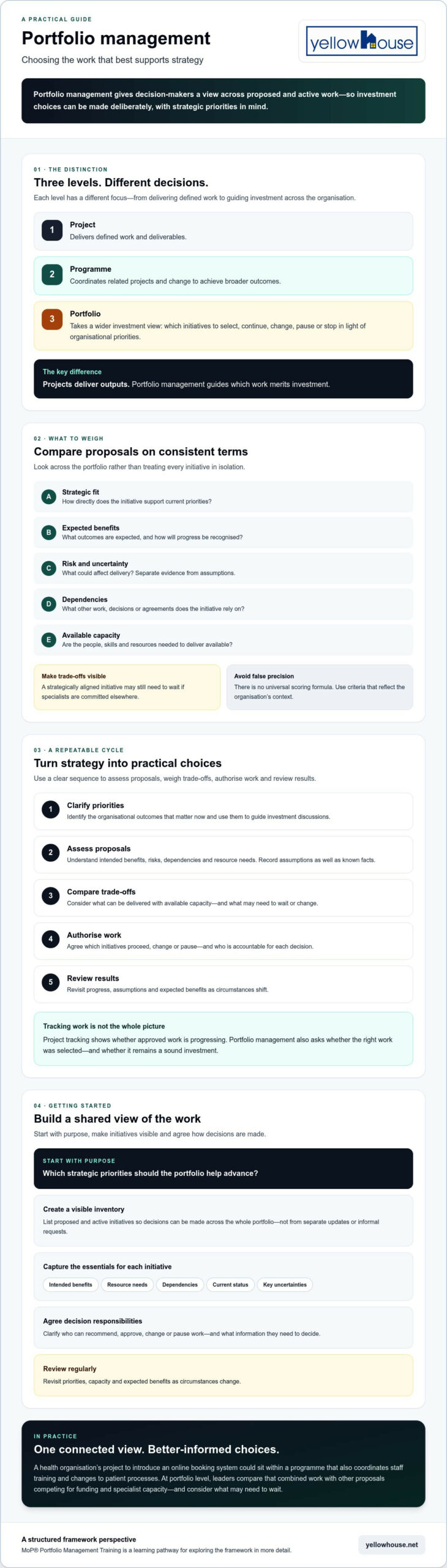
Put simply: projects deliver outputs, while portfolio management guides which work merits investment. A portfolio view helps leaders consider whether initiatives still fit current priorities, whether the organisation has the people and resources to deliver them, and what trade-offs accepting new work may require. For a foundational overview, see Project portfolio management.
How portfolios differ from projects and programmes
Hypothetical example: A health organisation might run a project to introduce an online booking system. A programme could coordinate that project with staff training and changes to patient processes. At portfolio level, leaders would compare this combined work with other proposals competing for funding and specialist capacity. They could then decide whether it fits current priorities and what other work might need to wait.
If you’re looking for a structured framework perspective, Yellowhouse offers MoP® Portfolio Management Training. This introduction to portfolio management covers the core concepts before you explore the framework in more detail.
How does portfolio management turn strategy into practical choices?
Strategy becomes actionable when leaders use it to guide a repeatable set of decisions, rather than treating every proposal as equally urgent. A practical portfolio cycle is to:
- Clarify priorities: identify the organisational outcomes that matter now and use them to guide investment discussions.
- Assess proposals: understand the intended benefits, risks, dependencies and resource needs. Record important assumptions as well as known facts.
- Compare trade-offs: consider what can be delivered with available capacity, and what may need to wait or change.
- Authorise work: agree which initiatives proceed, change or pause, and who is accountable for each decision.
- Review results: revisit progress, assumptions and expected benefits as circumstances shift.
What should teams weigh when prioritising initiatives?
For each proposal, teams can ask: how directly does it support current priorities? What benefits are expected, and how will the organisation recognise progress towards them? Are the necessary people and skills available? What dependencies or risks could affect delivery? These questions help decision-makers compare proposals on consistent terms.
For example, a strategically aligned initiative may still need to wait if it relies on specialists already committed elsewhere. Decision-makers should also separate evidence from assumptions, such as an unconfirmed benefit or a dependency that has not yet been agreed. There’s no universal scoring formula. Criteria should reflect the organisation’s context and make trade-offs clear, rather than create a false sense of precision. Regular review helps leaders respond when capacity, priorities or expected benefits change. For more on defining and tracking expected outcomes, see Yellowhouse’s guide to managing benefits.
How can an organisation get started with portfolio management?
Start with a clear purpose: which strategic priorities should the portfolio help advance? Then build a visible inventory of proposed and active initiatives. For each one, capture its intended benefits, resource needs, dependencies, current status and key uncertainties. This shared picture gives decision-makers a basis for discussing the whole portfolio, rather than relying on separate updates or informal requests.
Agree who can recommend, approve, change or pause work, and what information they need to make those decisions. Keep governance proportionate to the organisation’s scale and complexity. Useful oversight clarifies accountability and supports timely choices. Extra forms or approval steps add little if they don’t improve a decision.
When is MoP training a useful next step?
MoP® Portfolio Management Training may suit people building their portfolio management knowledge or seeking a structured way to explore the discipline. If you’re moving from an introduction to portfolio management towards practical understanding, you could also read a strategic guide to MoP certification for broader context. Yellowhouse offers MoP® Portfolio Management Training as part of its project, programme and portfolio management training. Consider whether this pathway matches your learning needs and the decisions you want to support in your role.
Put strategic priorities at the centre of your next decision
Portfolio management gives organisations a way to view initiatives together, assess competing demands and make investment choices with strategy in mind. The key distinction is that projects deliver defined work, while portfolio management helps leaders decide which work to pursue, adjust or pause. A clear purpose, visible initiative inventory and agreed decision responsibilities provide a practical starting point.
This introduction to portfolio management is a first step towards building that capability. Regular reviews can help teams respond to changing priorities, capacity constraints and benefit expectations. For those ready to deepen their knowledge, Yellowhouse offers MoP® Portfolio Management Training alongside training across project, programme and portfolio management frameworks. Explore Yellowhouse’s portfolio management training to find a learning pathway relevant to your goals.
Frequently Asked Questions
What is portfolio management?
Portfolio management is the coordinated oversight of an organisation’s collection of proposed and active initiatives. It helps decision-makers choose where to direct investment by considering strategic priorities alongside expected benefits, risk and available capacity. In this introduction to portfolio management, the focus is on whether the organisation is pursuing the right work together, not just tracking individual projects.
What is the difference between portfolio, programme and project management?
A project delivers a defined piece of work, while a programme coordinates related projects and change towards broader outcomes. Portfolio management looks across initiatives to guide investment choices. For example, a project might implement an online booking system; a programme could coordinate it with staff training and process changes; the portfolio view compares that effort with other proposals competing for organisational capacity and funding.
Why is portfolio management important to an organisation?
Portfolio management helps an organisation prioritise work against its strategic goals and make competing demands more visible. Leaders can consider whether capacity is available, what trade-offs accepting an initiative would involve, and whether existing work still aligns with priorities. This supports informed decisions about what to proceed with, adjust or pause, but it can’t guarantee that anticipated benefits will be achieved.
How can an organisation start using portfolio management?
Start by stating strategic priorities and listing current and proposed initiatives in one visible inventory. Agree who can recommend, approve, pause or change work, and what information they need. Review the inventory regularly to identify shifts in priorities, constraints or expected benefits. This approach can support Australian teams in Brisbane, Sydney, Melbourne, Canberra, Adelaide, Perth, Cairns, Townsville, Hobart, Darwin, Mackay, Gold Coast, Logan, Ipswich and Toowoomba.


About Post Author
