

Managing Successful Programmes (MSP): The Complete Guide to the MSP Framework
Does your leadership team view "MSP" as a technical support desk or as the strategic engine driving your organisation’s future? While the acronym is often mistaken for IT managed services, the Managing Successful Programmes framework is actually the gold standard for navigating complex, large-scale change. You’ve likely felt the frustration of managing multiple projects that seem to pull in different directions, leaving strategic goals unfulfilled and resources stretched thin.
We understand that aligning tactical delivery with corporate vision is one of the greatest challenges for Australian executives today. This complete guide provides clarity on the MSP 5th Edition principles and the specific certification paths available to advance your career. You’ll discover how a structured approach to governance, combined with a focus on the human element of change, ensures your programme’s benefits are actually realised rather than just promised.
Key Takeaways
- Distinguish between technical IT services and the Managing Successful Programmes framework to ensure your leadership team adopts the correct methodology for strategic change.
- Explore how the msp framework uses its core architecture of Principles, Governance Themes, and Transformational Flow to align multiple projects with a single corporate vision.
- Gain a clear understanding of how standardised governance structures help your organisation realise tangible benefits during large-scale organisational shifts.
- Determine the most effective certification path to bolster your professional standing within the Australian Public Service or the corporate enterprise sector.
What is the MSP Framework? Defining Managing Successful Programmes
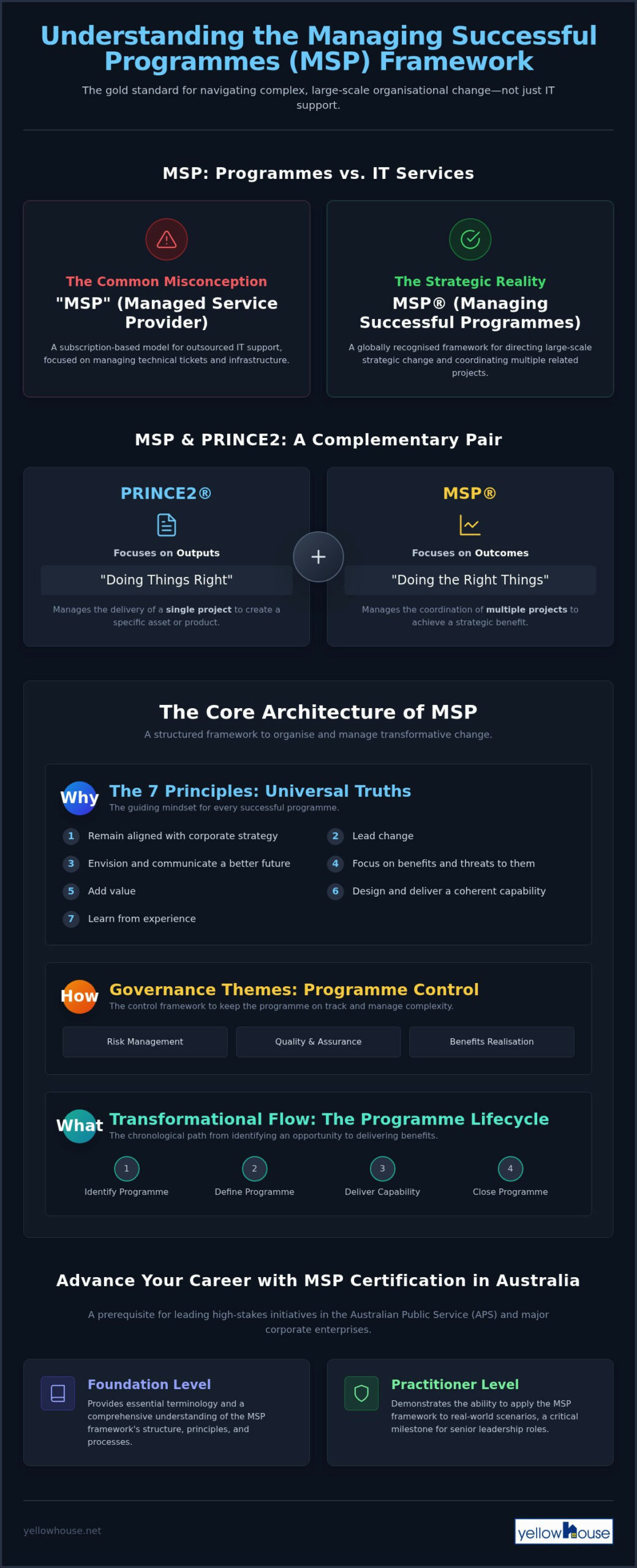
While many search results might point you toward a subscription-based IT model, the msp framework discussed here is something entirely different. It represents a globally recognised methodology for directing large-scale change within complex environments. Instead of managing technical tickets, this framework coordinates multiple related projects to ensure they collectively deliver a specific strategic benefit. It’s the architecture used by seasoned leaders to maintain control when an organisation undergoes a fundamental shift in how it operates.
MSP is a framework designed to manage the complexity of transformative organisational change. It provides the vital bridge between a business’s high-level strategic vision and the tactical, day-to-day delivery of individual projects. Without this layer of programme management, organisations often find themselves with a collection of finished projects that fail to move the needle on actual corporate goals. It ensures that every activity remains aligned with the intended future state of the business.
MSP vs PRINCE2: Understanding the Difference
In the Australian public and private sectors, these two frameworks are frequently used in tandem to achieve excellence. While PRINCE2 focuses on outputs, or "doing things right" at a project level, the msp framework focuses on outcomes, which is "doing the right things" for the whole organisation. One manages the creation of a new asset; the other manages the transition and the realisation of its value. They are naturally complementary rather than competitive. Choosing the best starting point depends on whether you are managing a single delivery or a broad shift in capability. You can explore this comparison further in our guide on MSP vs PRINCE2.
The Core Architecture: How the MSP Framework Organises Change
To manage the inherent uncertainty of large-scale initiatives, the msp framework employs a highly structured architecture. It’s built on three essential pillars: Principles, Governance Themes, and the Transformational Flow. Principles serve as the "why", acting as universal truths that guide every decision throughout the journey. Governance Themes provide the "how", offering specific control areas such as risk, quality, and benefits management to keep the programme on track. Finally, the Transformational Flow outlines the "what", mapping the entire lifecycle from the initial identification of an opportunity through to the formal closure of the programme.
The 7 Principles of Effective Programme Management
These principles are the universal truths that underpin every successful programme. They include:
- Remaining aligned with corporate strategy
- Leading change
- Envisioning and communicating a better future
- Focusing on the benefits and threats to them
- Adding value
- Designing and delivering a coherent capability
- Learning from experience
For Australian organisations, the most vital driver is realising measurable benefits. Without a relentless focus on the value being created, a programme risks becoming a costly exercise in activity rather than a driver of genuine growth. Mastering these pillars is a significant step in Advancing Your Career with Program Management Certification. If you’re looking to transition from project delivery to strategic leadership, exploring our accredited training options can provide the practical tools needed to apply these principles in your unique business context.
Advancing Your Career: MSP Certification in Australia
Within the Australian Public Service (APS) and major enterprise sectors, holding an msp certification is often a prerequisite for leading high-stakes initiatives. It signals to stakeholders that you possess the disciplined, principled mindset required to manage complex change across various departments. The Foundation level provides the essential terminology and framework structure, while the Practitioner level is where theory meets reality through rigorous, scenario-based application. For those aiming for executive or senior leadership positions, achieving MSP Practitioner status is a critical milestone that demonstrates your ability to apply the methodology to real-world business challenges.
Yellowhouse provides accredited training that bridges the gap between theoretical knowledge and practical Australian application. We understand that your professional growth is a serious investment, which is why our courses focus on the "why" behind the "what". This ensures that the human element of change management remains central to your learning journey, preparing you to lead with confidence in any organisational context.
Choosing the Right MSP Course and Provider
Moving from Foundation to Practitioner requires a significant shift in thinking. The Foundation exam is a 60-minute, closed-book test with a 60% pass mark, while the Practitioner exam is a more rigorous 150-minute open-book session. Selecting an accredited Australian provider is vital because local trainers understand the specific governance nuances and regulatory environments of the Australian market. Yellowhouse offers expert-led training that ensures you aren’t just learning for an exam, but for your long-term success. For a detailed breakdown of investment and scheduling, refer to our MSP Certification: 2026 Programme Guide. Partnering with a team that has faced these same hurdles ensures you receive the seasoned wisdom needed to overcome them. Many senior leaders also find that complementing their MSP qualification with P3O training Australia offers provides the structural governance knowledge needed to build high-performing PMOs that translate programme outcomes into boardroom-level decisions.
Mastering the Future of Strategic Delivery
Adopting the msp framework is more than a professional certification; it’s a commitment to driving genuine value within your organisation. By bridging the gap between tactical project delivery and high-level strategy, you ensure every change initiative remains aligned with the broader corporate vision. Whether you’re navigating the complexities of the Australian Public Service or leading a large-scale corporate shift, these principles provide the governance needed to realise measurable benefits.
Yellowhouse offers the seasoned wisdom required to help you transition to true programme leadership. As an organisation accredited by PeopleCert on behalf of AXELOS, we provide expert-led training delivered by Australian practitioners with real-world experience. Our comprehensive support for both Foundation and Practitioner levels ensures you have the tools to succeed. Enrol in Accredited MSP Training with Yellowhouse today and begin mastering strategic change with confidence. Your professional growth is our priority.
Frequently Asked Questions
Is MSP better than PRINCE2 for my career in Australia?
Neither is "better" in isolation; they address different levels of professional responsibility. PRINCE2 is the standard for project-level delivery, whereas an msp qualification is highly regarded for senior roles overseeing complex, strategic change. In the Australian Public Service and large enterprises, possessing both certifications demonstrates a comprehensive ability to manage both tactical outputs and long-term strategic outcomes.
What are the prerequisites for the MSP Practitioner exam?
You must successfully pass the Foundation exam before you’re eligible to sit the Practitioner exam. This requirement ensures that every candidate has a solid understanding of the framework’s terminology and principles before they’re tested on practical, scenario-based application. This progression is standard for the current 5th Edition of the framework provided through accredited training organisations in Australia.
How long does an MSP certification last before it needs renewal?
Can I apply MSP to small-scale organisational changes?
Yes, the framework is inherently scalable and can be tailored to suit smaller organisational shifts. While it’s built to handle high-level complexity, the core focus on benefits realisation and stakeholder engagement remains effective for any programme of change. You can adapt the governance themes to be less formal for smaller initiatives while still maintaining a disciplined approach to strategic delivery.


About Post Author
