

Improving Project Delivery: Strategic Guide for 2026
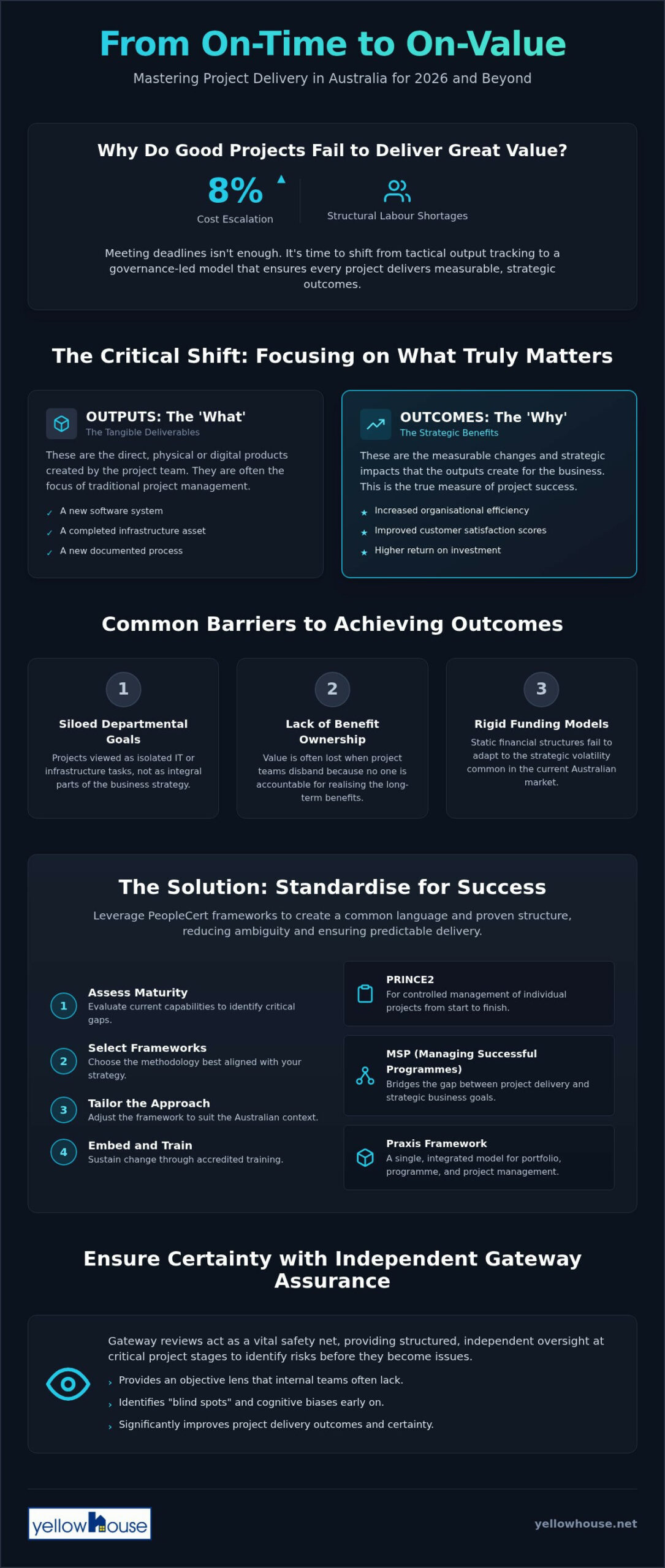
Why are so many Australian projects meeting their deadlines but failing to deliver their promised value? You’ve likely experienced the frustration of a digital transformation that finishes on time, yet leaves your team without the strategic benefits you expected. To improve project delivery outcomes in 2026, especially as cost escalation reaches 8% and structural labour shortages tighten, organisations must shift their focus from tactical output tracking to a governance-led model.
This guide provides a strategic framework to help you achieve high-impact delivery through integrated assurance and independent oversight. We’ll examine how to align project execution with your overarching strategy and use PeopleCert methodologies to ensure every investment yields a measurable return. By the end, you’ll have the tools to move from simple task completion to genuine organisational excellence and long-term success.
Key Takeaways
- Shift focus from tracking tangible outputs to measuring the strategic outcomes that drive genuine value for your organisation.
- Leverage PeopleCert frameworks like PRINCE2 and MSP to improve project delivery outcomes through structured methodologies and better strategic alignment.
- Implement independent Gateway assurance reviews to identify blind spots and provide the oversight necessary for complex digital transformations.
- Move beyond the traditional triple constraint of time, cost, and scope to ensure your projects deliver lasting benefits in the 2026 market.
Distinguishing Outputs from Outcomes to Drive Organisational Value
Traditional project management often focuses on the “what” rather than the “why”. Outputs are the tangible deliverables your team builds, such as a new software system or a physical infrastructure asset. Outcomes, by contrast, represent the actual changes and strategic benefits those outputs create for your business. Project delivery outcomes are the measurable impact a project has on strategic objectives.
- Siloed departmental goals: Projects are often viewed as isolated IT or infrastructure tasks rather than strategic business drivers.
- Lack of benefit ownership: Without a clear “owner” for the outcome, benefits are frequently lost once the project team disbands.
- Rigid funding models: Static financial structures often fail to account for the strategic volatility seen in the current Australian market.
Defining Success Criteria Beyond the Triple Constraint
Shifting your focus to improve project delivery outcomes requires a disciplined approach to value. By adopting the Managing Benefits framework, you can map every deliverable directly to a strategic gain. Engaging stakeholders early allows you to define success in their terms, ensuring the project remains relevant as market conditions change. Using a Better Business Cases approach helps secure funding based on projected outcomes rather than just technical specifications, providing a stronger foundation for long-term organisational growth.
Leveraging PeopleCert Frameworks to Standardise Project Success
Standardisation is the bedrock of predictable delivery. Using PeopleCert frameworks provides a common language and a proven structure that reduces ambiguity in complex environments. PRINCE2 project management ensures a controlled start, middle, and end, while MSP (Managing Successful Programmes) bridges the gap between individual deliverables and broader strategic goals. Organisations often struggle with fragmented approaches. Adopting recognised Project Management Methodologies & Frameworks helps align technical work with business value. To improve project delivery outcomes, you should follow a structured four-step process:
- Assess maturity: Evaluate your current organisational capabilities to identify critical gaps.
- Select frameworks: Choose the methodology that best aligns with your strategic objectives and culture.
- Tailor the approach: Adjust the framework to suit the specific Australian regulatory and market context.
- Embed and train: Sustain the change through consistent, accredited training and mentorship.
The Praxis Framework offers a single, integrated platform that simplifies this journey by combining portfolio, programme, and project management into one cohesive model. This integration is vital to improve project delivery outcomes across diverse portfolios, as it removes the friction often found between disparate methodologies.
Integrating PRINCE2 and MSP for Seamless Delivery
Ensuring project outputs feed directly into programme-level benefits requires clear oversight. This is where P3GP governance training becomes essential. It establishes a robust decision-making hierarchy that empowers leaders to make informed choices. By implementing a P3O structure, you create a centre of excellence that supports consistent delivery across the entire organisation. If you’re looking to refine your approach, our PeopleCert accredited courses provide the practical skills needed to lead with confidence.
Ensuring Certainty Through Independent Gateway Assurance
Gateway assurance acts as a vital safety net for complex initiatives, providing a structured series of independent reviews at critical project stages. These reviews offer an objective lens that internal teams often lack due to project proximity or cognitive bias. By identifying these “blind spots” early, organisations can significantly improve project delivery outcomes. Expert Gateway review consultants offer feedback that is both impartial and rooted in deep industry experience. This level of oversight ensures that governance is not just a checkbox exercise but a dynamic tool for strategic decision-making.
Robust governance provides leaders with the evidence needed to make difficult calls. Whether it’s the decision to pivot a strategy or stop a failing project before costs spiral, assurance provides the necessary clarity. In the current Australian climate, where construction input prices saw a 12.6% increase in early 2026, the ability to reallocate resources early is a distinct competitive advantage. Independent oversight ensures that only projects with a clear, verified path to value continue to receive investment.
Preparing Your Organisation for a Gateway Review
Maximising the value of a Gateway review requires intentional preparation. Start by ensuring all documentation is current and stakeholders are briefed on the review’s purpose. It’s vital to shift the internal culture from “audit anxiety” to viewing assurance as a supportive partnership. When teams see reviewers as collaborators rather than critics, they share information more transparently. Findings from an independent gateway assurance review should be treated as a roadmap for success. Using these insights to course-correct in real-time is the most effective way to improve project delivery outcomes and guarantee that your project remains aligned with its original strategic intent.
Securing Future Success Through Governance and Assurance
Achieving excellence in 2026 requires more than just technical proficiency; it demands a cultural commitment to value. By shifting your focus from tangible outputs to strategic outcomes and standardising your approach with PeopleCert frameworks, you build a foundation for reliable success. Integrating independent Gateway assurance provides the final layer of certainty, identifying risks before they impact your bottom line. As a PeopleCert Accredited Training Provider with expert reviewers and a proven track record across Australian Government departments, we are here to help you improve project delivery outcomes.
Our team acts as a collaborative partner, ensuring your complex transformations remain aligned with organisational goals. We invite you to enquire about our Strategic Change Consulting and Gateway Assurance services to see how we can support your next initiative. Your journey toward high-impact delivery starts with a single, well-governed step.
Frequently Asked Questions
What is the difference between a project output and a project outcome?
An output is the tangible product created by a project, such as a new hospital wing, while an outcome is the actual benefit derived from that product, like improved patient recovery rates. This distinction is vital to improve project delivery outcomes. It ensures that teams don’t just focus on building the asset but also on delivering the strategic value that justifies the initial investment.
How can PeopleCert frameworks like PRINCE2 help improve project outcomes?
PeopleCert frameworks like PRINCE2 provide a structured methodology that ensures every project phase remains aligned with the original business case. By using a consistent set of processes and roles, organisations can reduce ambiguity and improve project delivery outcomes across their entire portfolio. This standardisation allows teams to manage risks effectively and ensures that resources are allocated to the most valuable initiatives.
What is a Gateway assurance review and when should it be conducted?
A Gateway assurance review is an independent, point-in-time assessment conducted at key decision points throughout a project’s lifecycle. These reviews typically occur at six critical stages, from the initial business case through to post-implementation benefits realisation. By providing objective feedback before a project moves to the next phase, these reviews help senior leaders confirm that the initiative remains viable and strategically aligned.
Why is organisational governance critical for project delivery success?
Organisational governance is critical because it establishes the accountability and decision-making framework required to manage complex change. Without robust governance, projects often drift from their strategic intent, leading to wasted resources and failed benefits. Effective governance ensures that there is a clear purpose behind every investment and provides the oversight necessary to pivot or stop projects when they no longer serve business needs.


About Post Author
