

MSP Practitioner Australia: The Definitive Guide to Programme Management Excellence
What if the ceiling on your career isn’t your project management skills, but your inability to translate those outputs into board-level outcomes? It’s a common frustration for senior professionals across the country who feel trapped in tactical delivery while the long-term business benefits remain elusive. Becoming an MSP practitioner in Australia represents a fundamental shift in mindset, moving you from managing tasks to orchestrating strategic change. We understand that aligning a suite of projects with a complex corporate strategy is one of the most significant challenges you’ll face in a leadership role.
By mastering this framework, you’ll gain the recognised credentials needed to step into senior government or corporate positions with confidence. This definitive guide provides a clear roadmap for achieving programme management excellence through the latest 5th Edition standards. We’ll examine the practical application of the framework, detail the specific exam requirements, and explain how this certification empowers you to manage stakeholder expectations at the highest levels of your organisation. Whether you’re seeking to break through to executive leadership or simply want a more structured approach to complex change, this resource serves as your professional foundation.
Key Takeaways
- Learn how to transition from managing project outputs to orchestrating the strategic programme outcomes that define true organisational success.
- Examine the seven core principles of MSP and how they provide a disciplined framework for keeping complex change aligned with corporate strategy.
- Discover how robust governance themes can help you organise leadership and track benefit realisation more effectively across the programme lifecycle.
- Clarify the essential steps to becoming a certified MSP practitioner in Australia, including the Foundation level prerequisites and the current PeopleCert exam standards.
- Gain the confidence to manage complex stakeholder expectations at the executive level by applying a proven methodology to real-world scenarios.
What is an MSP Practitioner in the Australian Context?
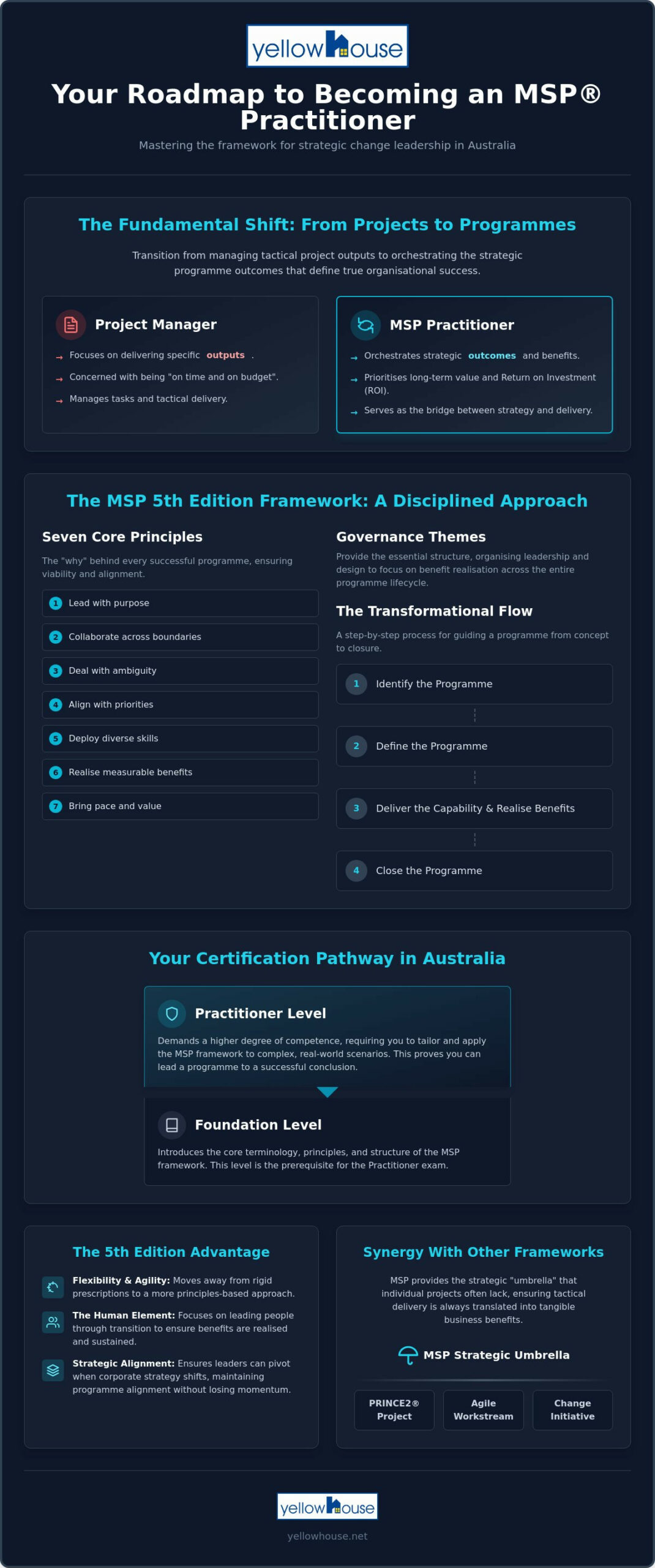
An MSP (Managing Successful Programmes) Practitioner is a professional capable of applying the MSP framework to real-world, complex change initiatives. In the local business environment, this role transcends traditional project management by focusing on Program management as a vehicle for long-term strategic value. While project managers often focus on delivering specific outputs "on time and on budget", the **MSP practitioner **prioritises strategic benefit and return on investment (ROI).
This framework has become the gold standard for state and federal government departments and large-scale infrastructure organisations. It provides a disciplined approach to managing risk across multiple workstreams. The MSP Practitioner serves as the vital bridge between high-level corporate strategy and tactical project delivery.
Foundation vs. Practitioner: Understanding the Hierarchy
The hierarchy begins with the Foundation level, which introduces the core terminology and structure. However, the Practitioner level demands a higher degree of competence. It requires you to tailor the framework to a specific business case or scenario. During the exam, you’ll need to demonstrate an ability to apply governance themes and processes to solve complex programme hurdles; this proves you can handle the unpredictability of large-scale change. Being an **MSP practitioner **means moving beyond knowing the theory to proving you can lead a programme to its successful conclusion.
The 5th Edition Advantage for Modern Leaders
The MSP Framework: Core Principles and Governance
The MSP framework is built upon seven core principles that provide the "why" behind every successful programme. These include remaining aligned with corporate strategy, leading change, and learning from experience. By adhering to these principles, an **MSP practitioner **ensures that the programme remains viable even when the external environment shifts. Governance themes then provide the structure, organising leadership and design to focus on benefit realisation across the entire lifecycle. This methodical approach is supported by the transformational flow, a step-by-step process of identifying, defining, and delivering the programme to its final closure. Ultimately, MSP governance ensures that every dollar spent on a project contributes to a measurable business outcome.
Strategic Alignment and Benefit Realisation
In the Australian model, the relationship between the Senior Responsible Owner (SRO) and the Programme Manager is critical. While the SRO is accountable for the programme’s success, the Programme Manager handles the day-to-day orchestration of complex workstreams. Training to become an **MSP practitioner **equips you to identify "dis-benefits", which are unintended negative consequences of change, and manage risk at a portfolio level. This high-level perspective is often endorsed by the Australian Institute of Project Management (AIPM) as essential for senior leadership roles.
Synergy with PRINCE2 and Other Frameworks
MSP acts as an "umbrella" framework, providing the strategic context that individual projects often lack. This is particularly effective when integrating MSP with PRINCE2 project management, as it allows for a seamless flow between tactical delivery and strategic goals. If you’re unsure which methodology best suits your leadership role, understanding the key differences when comparing MSP vs PRINCE2 Australia can help you make a more informed decision about your certification pathway. If you’re looking to refine these connections within your own team, our Strategic Change Consulting can help align your governance structures for maximum impact. By combining these methodologies, organisations can ensure that project outputs are always translated into tangible business benefits.
Achieving Your MSP Practitioner Certification in Australia
The journey to becoming a certified **MSP practitioner **follows a structured roadmap designed to validate your ability to lead complex change. It begins with selecting an accredited training provider that understands the nuances of the local corporate and government sectors. Before you can attempt the Practitioner level, you must hold a valid MSP Foundation certificate. This prerequisite ensures you have a firm grasp of the basic terminology and framework structure before moving into practical application.
The Practitioner exam follows an objective-testing format, consisting of 70 scenario-based questions. You’ll need to achieve a pass mark of 60%, which equates to 42 correct answers, within the two-and-a-half-hour time limit. Before committing to a training provider, it’s worth reviewing a detailed breakdown of MSP certification cost Australia wide to ensure you’re budgeting accurately for exam fees, course materials, and any potential re-sits. At Yellowhouse, we move beyond simple exam coaching. We act as your collaborator, focusing on the human element of programme leadership to ensure you can master the methodology in a real-world context rather than just memorising theory.
Preparing for the Practitioner Exam
Career Outcomes for MSP Practitioners
Earning the **MSP practitioner **designation significantly enhances your professional standing in a competitive market. It opens doors to high-level roles such as Programme Director, PMO Lead, or Strategic Change Consultant. Organisations across the country value this certification because it proves you can manage stakeholder expectations at the board level while delivering tangible strategic benefits. It’s a clear signal to employers that you possess the seasoned wisdom required to lead their most critical and complex initiatives. For professionals still weighing their options, a detailed comparison of MSP vs PRINCE2 Australia frameworks can clarify which certification will have the greatest impact on your career trajectory.
Elevate Your Strategic Leadership Capability
Mastering programme management is more than just a box-ticking exercise; it’s a deliberate step toward becoming a trusted advisor in your organisation. You’ve explored how the 5th Edition framework provides the agility needed to align multiple projects with shifting corporate goals while keeping the human element at the centre of change. By focusing on benefit realisation and robust governance, you ensure that every initiative delivers genuine value rather than just technical outputs.
This principle of strategic alignment applies across all sectors; for example, in the performing arts, using a dedicated management platform like paritor.com ensures that every activity supports the broader goals of the service.
Achieving your status as an **MSP practitioner **validates your ability to lead these complex transformations with confidence. Yellowhouse is here to support your journey as a collaborator rather than just a vendor. Our training is accredited by PeopleCert and delivered by expert practitioners with deep experience in the Australian landscape. We provide a comprehensive 5th Edition curriculum that bridges the gap between theoretical knowledge and real-world application. Enrol in an Accredited MSP Practitioner Course with Yellowhouse to take the next step in your professional growth. We’re ready to help you unlock the next level of your career.
Frequently Asked Questions
Is the MSP Practitioner exam difficult for someone with project management experience?
The exam is often considered a significant step up for project managers because it requires a shift from delivering outputs to orchestrating strategic outcomes. While your project experience provides a solid base, the Practitioner level tests your ability to apply the framework to complex, often ambiguous scenarios. Success as an **MSP practitioner **depends on your capacity to think beyond tactical delivery and focus on how a programme creates long-term value for the organisation.
How long does the MSP Practitioner certification remain valid in Australia?
Your certification is current for three years from the date you pass your exam. To maintain your professional standing, you’ll need to renew your certificate through PeopleCert before the expiry date. You can achieve this by retaking the exam, completing a higher-level certification within the same suite, or by logging Continuing Professional Development (CPD) points through a MyAXELOS subscription. This ensures that Australian leaders remain aligned with the latest global standards in programme governance.
What are the main differences between MSP 4th Edition and 5th Edition?
The 5th Edition represents a move toward greater flexibility and agility, making it more suitable for modern organisations facing rapid change. It simplifies many of the processes from the 4th Edition and introduces a stronger focus on the "human element," such as leadership, culture, and stakeholder engagement. This version is designed to be more accessible and easier to tailor, ensuring the framework supports strategic goals without becoming a bureaucratic burden.
Can I take the MSP Foundation and Practitioner exams at the same time?
You can certainly complete both levels in a single intensive week by choosing a combined training course. This approach allows you to build a foundational understanding of the terminology before immediately applying that knowledge to complex scenarios. However, you must pass the Foundation exam first, as it’s a mandatory prerequisite for anyone seeking to become a certified MSP practitioner. Taking them together is a popular choice for senior professionals looking to fast-track their career progression. https://yellowhouse.net/prince2-programme-management/


About Post Author
