

Gateway Review Consultants: Independent Assurance for Major Projects
What if a ‘Red’ status on your next Gateway review wasn’t a signal of project failure, but the most valuable strategic asset your team ever received? Most Senior Responsible Owners view the assurance process with a sense of trepidation, fearing that a negative report will stall funding or be treated as a mere compliance tick-box. It is understandable to feel frustrated by the varying financial thresholds and specific requirements that apply across different government agencies and project types nationwide. Engaging expert gateway review consultants Australia helps you move beyond these anxieties, transforming independent assurance into a proactive tool for project success.
Key Takeaways
- Understand that the Gateway process is a peer-led advisory mechanism designed to provide Senior Responsible Owners with independent, confidential insights at critical project decision points.
- Identify the specific financial thresholds and risk assessment tools that trigger mandatory assurance for high-risk projects.
- Discover how engaging experienced gateway review consultants Australia transforms a compliance requirement into a strategic opportunity for genuine project improvement and risk mitigation.
- Master the preparation phase by establishing a ‘Gold Standard’ for project documentation and framing the review as a constructive tool for your delivery team rather than a threat.
- Strengthen your project governance by bridging the gap between accredited training frameworks and real-world application to ensure long-term strategic alignment.
What is the Gateway Review Process in Australia?
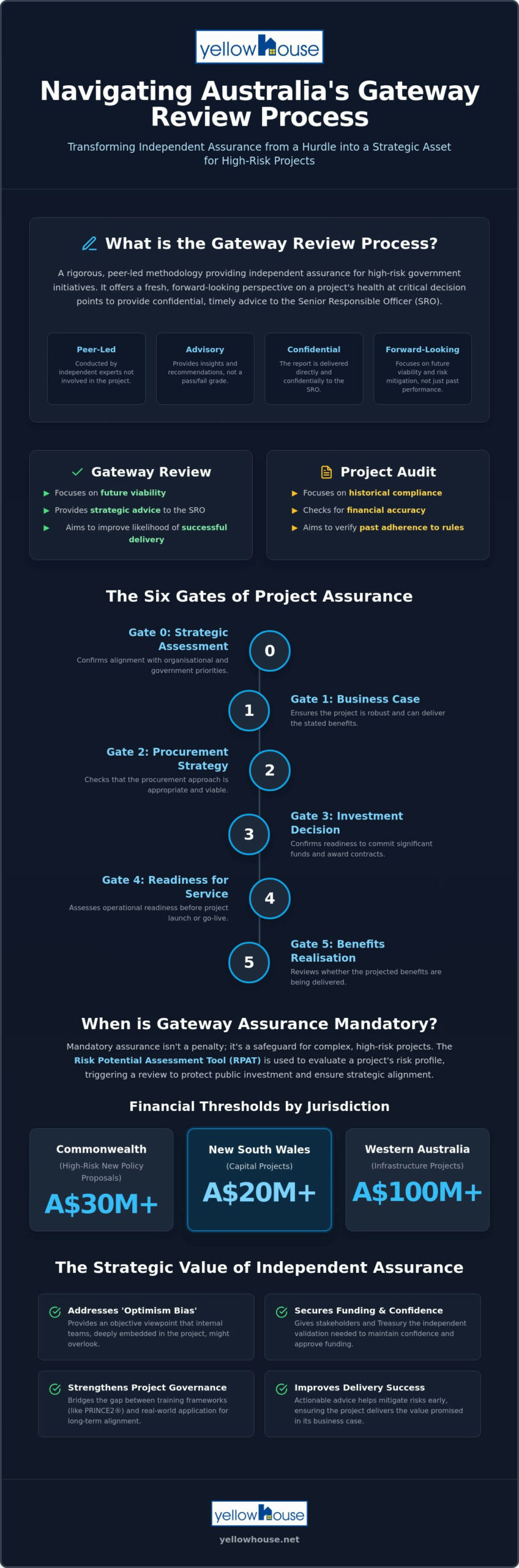
The Gateway Review Process is a rigorous, peer-led methodology designed to provide independent assurance for high-risk initiatives. It isn’t a simple compliance exercise or a bureaucratic hurdle. Instead, it involves a series of short, intensive reviews conducted by independent experts who haven’t been involved in the project’s day-to-day operations. These experts offer a fresh perspective on the project’s health at critical decision points. By integrating these reviews into your broader project management framework, you gain a level of oversight that internal reporting often misses.
The Six Gates of Project Assurance
The process is structured around six distinct ‘Gates’ that align with the project lifecycle. For complex initiatives, it begins with Gate 0, the Strategic Assessment, which confirms that the program aligns with broader organisational goals and government priorities. At Project level, Gates 1 through 3 focus on the Business Case, Procurement Strategy, and the Investment Decision. These stages are critical for ensuring the project is set up for success before significant funds are committed. Finally, Gates 4 and 5 address Readiness for Service and Benefits Realisation. This ensures the project doesn’t just ‘finish’ but actually delivers the value and outcomes promised in the original business case. For a comprehensive breakdown of how each gate functions under the 2026 updates, the gateway review process for government projects Australia governance guide provides detailed insight into every assurance checkpoint.
Key Jurisdictions and Frameworks
In Australia, the application of Gateway reviews varies across different jurisdictions. At the Commonwealth level, the Department of Finance mandates reviews for high-risk New Policy Proposals. These typically include procurement or infrastructure projects with a total estimated cost of A$30 million or more. State policies differ slightly; for example, New South Wales requires mandatory registration for capital projects valued at A$20 million and above, while Western Australia focuses on infrastructure projects over A$100 million. In Queensland, all Digital and ICT-enabled initatives must use an assurance profiling tool to determine their level of complexity.
Expert gateway review consultants Australia help teams navigate these differing thresholds while ensuring alignment with best-practice frameworks like PRINCE2® and MSP®. This structured approach ensures that governance isn’t just about following rules, but about driving genuine strategic change and delivery excellence.
Why High-Risk Projects Mandate Independent Gateway Assurance
Mandatory assurance isn’t a penalty for high spending; it’s a safeguard for high complexity. In the Australian public sector, the decision to trigger a review isn’t arbitrary. It relies heavily on the Risk Potential Assessment Tool (RPAT), which evaluates a project’s inherent risks across dimensions like procurement complexity, inter-agency dependencies, and organisational impact. When a project is flagged as high-risk, the requirement for independent oversight becomes a formal necessity to protect public investment and ensure strategic alignment. Pairing this with structured organizational governance advisory Australia services ensures that your decision-making frameworks are resilient enough to withstand the scrutiny of independent reviewers.
The Australian National Audit Office (ANAO) has frequently examined the Administration of the Gateway Review Process, highlighting that while the process is robust, its success depends on early and honest engagement. Securing ongoing funding often hinges on this independent validation. Stakeholders and Treasury officials need more than internal reports to maintain confidence in a project’s trajectory. They require the objective assurance that only a peer-led, independent team can provide, especially when navigating the shifting landscape of government priorities.
Addressing the ‘Optimism Bias’ in Major Projects
Internal project teams often develop a natural ‘optimism bias’. Because they’re deeply embedded in the day-to-day delivery, they can inadvertently overlook emerging risks or underestimate the impact of subtle delays. Complexity invites risk. That’s a simple reality of major project delivery. Independent reviewers act as a ‘fresh set of eyes’, identifying blind spots that internal reporting might miss. These reviewers are typically expert practitioners who have managed similar programmes in other sectors, bringing a wealth of ‘lessons learned’ to the table. This peer-to-peer dialogue is far more valuable than a standard audit because it focuses on future success rather than past compliance.
Thresholds and Triggers for 2026
As of July 2026, financial thresholds remain a primary trigger for mandatory reviews, though they vary significantly across jurisdictions. At the Commonwealth level, procurement or infrastructure projects exceeding A$30 million, or programs over A$50 million, must undergo the process. New South Wales maintains a lower threshold for capital projects at A$20 million, while Western Australia focuses on larger infrastructure works valued at A$100 million and above. However, financial value isn’t the only trigger. Political sensitivity and high inter-agency dependency can also mandate a review. Engaging with expert gateway review consultants early in the piece allows SROs to align their delivery frameworks, such as PRINCE2® or MSP®, with these assurance requirements long before the first ‘Gate’ is reached. Understanding the full scope of these 2026 jurisdictional changes is made easier with a dedicated gateway review process for government projects Australia reference that maps each threshold against the relevant state and Commonwealth frameworks.
The Strategic Value of Engaging Gateway Review Consultants
Engaging gateway review consultants is a strategic choice that moves your project beyond simple compliance. While the formal requirement for assurance might be triggered by a financial threshold, the real benefit is the injection of external wisdom into your project environment. These consultants aren’t just checking boxes; they’re expert practitioners who have faced the same hurdles your team is currently navigating. This lived experience allows them to offer insights that a standard internal audit would likely miss. Independence breeds clarity.
A successful review requires a team with a balanced mix of technical, commercial, and leadership expertise. If the review team lacks this balance, the advice given to the SRO may be skewed or impractical. The Gateway process relies on this diversity of thought to challenge assumptions and identify hidden risks. By working with specialised gateway review consultants, you ensure that the assurance process is a constructive dialogue rather than a one-sided interrogation. This partnership ensures that the review is tailored to your specific needs rather than being a generic exercise.
Internal vs. External Reviewers: Finding the Balance
A Partnership Approach to Assurance
The best consultants act as collaborators, not auditors. They understand the human element and the anxiety that an intensive review can cause within a project team. By framing the process as a partnership, they help the team see the review as an opportunity for improvement rather than a threat to their professional standing. This supportive approach encourages transparency, which is vital for an accurate assessment. Independent assurance is a disciplined, objective evaluation of project health that ensures every delivery milestone remains fundamentally aligned with the organisation’s long-term strategic change goals. A key part of this alignment involves implementing change management frameworks Australia-wide that address the people side of delivery, ensuring that technical milestones translate into genuine organisational outcomes.
Preparing for Success: A Roadmap for the SRO
The success of a Gateway review often hinges on the leadership and preparation of the Senior Responsible Owner (SRO). While the technical aspects of project delivery are vital, the SRO sets the cultural tone for the entire assurance process. If the review is framed as a threatening audit, the team will likely become defensive and opaque. Conversely, when an SRO positions the review as a strategic opportunity to gain expert advice, it fosters the transparency required for a meaningful assessment. Engaging Yellowhouse early in the planning phase allows SROs to align their team’s expectations with the reality of the intensive 3 to 5 day interview period.
Establishing a ‘Gold Standard’ for project documentation is a non-negotiable first step. Reviewers don’t have time to sift through disorganized folders; they need a clear evidence trail that demonstrates robust decision-making. This means ensuring that the Business Case, Risk Register, and Benefits Management Plan are not only current but also internally consistent. Logistics also play a critical role. The SRO must ensure that key stakeholders and Project Board members are available and properly briefed, as their insights often carry the most weight during the interview process.
The Pre-Review Checklist
Preparation should begin several weeks before the review team arrives. A thorough checklist ensures that no critical gaps remain in the project’s narrative. Focus on these three areas:
- Strategic Alignment: Confirm that the project still aligns with the broader organisational goals and that any changes since the last Gate are documented.
- Governance Health: Ensure the Project Board is meeting regularly and that minutes clearly reflect how risks are being mitigated.
- Interview Readiness: Identify key interviewees and conduct mock sessions to ensure they can articulate the project’s status and challenges clearly.
Investing in Governance Capability
True preparation goes beyond a single checklist; it involves building a culture of governance. Accredited training, such as P3GP® Governance training, provides leaders with the specific tools needed to navigate the rigours of independent assurance. There is a direct link between a project team’s governance maturity and their ability to secure a positive Gateway outcome. By investing in these ‘power skills’, organisations reduce their project risk profiles and move closer to achieving a ‘Gold Standard’ in delivery excellence. If you are looking to strengthen your team’s governance framework before your next review, consider how organizational governance advisory Australia expertise can bridge the gap between high-level strategic intent and successful project outcomes.
Yellowhouse: Your Partners in Strategic Change and Assurance
Yellowhouse operates as a trusted collaborator rather than a distant service provider. We believe that effective assurance requires a unique blend of professional authority and empathetic support. Our ‘Expert Practitioner’ approach ensures that the advice you receive is grounded in years of practical experience across infrastructure, ICT, and policy implementation. As prominent gateway review consultants Australia, we help you translate complex governance requirements into clear, actionable steps that your team can actually implement. We understand that project success is as much about the human element of leadership as it is about technical frameworks.
Our methodology bridges the gap between accredited training and real-world delivery. While frameworks like PRINCE2®, MoP® and MSP® provide the structure, our consultants provide the nuance required to apply these tools in high-pressure environments. This hands-on involvement allows us to act as an extension of your own team, sharing the burden of complex decision-making. We don’t just identify gaps; we work alongside you to build the capability needed to close them, ensuring your project remains on a steady path toward its strategic objectives.
Accredited Excellence in Governance
Our commitment to excellence is reflected in our status as an accredited training provider for P3GP® Governance and MSP®. This deep expertise allows us to offer a sophisticated perspective on strategic change that few others can match. We focus heavily on P3GP® and MoP® frameworks to support robust portfolio governance, helping leaders understand how to manage risk at scale. Australian government entities trust Yellowhouse because we provide a seamless link between professional certification and practical application. This synergy between our national training programmes and our consulting services ensures that your governance structures are both defensible and effective.
Ready to Secure Your Project’s Future?
Success in the Gateway process is rarely accidental. It’s the result of disciplined preparation and a willingness to address risks head-on. As we move through the 2026 regulatory landscape, the complexity of major projects continues to increase, making independent validation more important than ever. Our national reach allows us to support organisations across Australia, providing bespoke advisory that respects the specific policy nuances of each jurisdiction. Engaging with our team early in the project lifecycle is the most effective way to ensure your delivery remains fundamentally aligned with your long-term goals. Organise a consultation with Yellowhouse’s Gateway assurance experts today.
Securing Your Project Delivery with Confidence
Successful major project delivery in Australia requires more than just following a methodology; it demands a commitment to transparency and rigorous oversight. By understanding the triggers of independent assurance and preparing your team for the intensive review period, you transform a potential hurdle into a clear roadmap for success. The value of engaging specialised **gateway review consultants **lies in their ability to offer objective, peer-led insights that bridge the gap between policy requirements and real-world outcomes.
As a PeopleCert Accredited Training Provider and specialised P3GP governance experts, Yellowhouse brings a wealth of national strategic consulting experience to every engagement. We work alongside your leadership to ensure that your governance structures are robust and your delivery teams are empowered. Success is achieved when independent assurance becomes a catalyst for genuine improvement rather than a mere compliance exercise.
Partner with Yellowhouse for Expert Gateway Assurance and Governance today to secure your project’s future and drive lasting strategic change. Your path to delivery excellence starts with a trusted advisor who understands the unique challenges of the Australian public sector.
Frequently Asked Questions
What is a Gateway review and why is it mandatory for some Australian projects?
A Gateway review is an independent, peer-led evaluation conducted at critical decision points in a project’s lifecycle to provide the Senior Responsible Owner (SRO) with confidential, timely advice. It’s mandatory for high-risk Australian projects because it provides a rigorous safeguard for significant public investments. These reviews ensure that major initiatives remain strategically aligned and have robust governance in place to deliver their intended outcomes.
How much lead time is required to organise a Gateway review in Australia?
You should ideally allow two to three months of lead time to initiate and organise a formal Gateway review. This period is necessary for the relevant Gateway Unit to assess the project’s risk profile, select an appropriate team of independent experts, and finalise the administrative logistics. Engaging with **gateway review consultants **early in this window allows your team to prepare the necessary evidence trails and brief key stakeholders effectively.
What is the difference between a Gateway review and a financial audit?
A Gateway review is a forward-looking assessment of a project’s delivery confidence and future viability, whereas a financial audit is a backward-looking check on historical spending and compliance. While an audit confirms that funds were managed according to regulations, a Gateway review evaluates whether the project’s management, risk mitigation, and stakeholder engagement are strong enough to ensure successful completion.
Can a project ‘fail’ a Gateway review, and what happens next?
Projects don’t ‘fail’ in a traditional pass-fail sense; instead, they receive a delivery confidence rating, with ‘Red’ being the most critical. A Red rating indicates that the project is at high risk and requires urgent remedial action to address fundamental issues. If your project receives this status, you’ll need to develop a comprehensive action plan and typically undergo a follow-up assurance review to demonstrate that the risks are now being managed.
Who should be involved in the Gateway review interview process?
The interview process must involve the Senior Responsible Owner, the Project Manager, PMO and key members of the Project Board or Steering Committee. It is also vital to include major stakeholders, technical leads, and commercial experts who can provide a detailed and transparent account of the project’s status. Ensuring these individuals are prepared to discuss both achievements and challenges honestly is essential for a productive review.
How do Gateway reviews differ between Commonwealth and State governments?
The primary differences lie in the financial thresholds and the specific policy frameworks that trigger a review. For example, the Commonwealth mandates reviews for procurement projects over A$30 million, while Western Australia focuses on infrastructure valued at A$100 million or more. Experienced **gateway review consultants **help organisations navigate these jurisdictional variations, ensuring that the project meets the specific assurance requirements of their relevant Treasury or Finance department.
How can P3GP governance training help with Gateway review outcomes?
P3GP governance training provides project leaders with a principled framework for effective oversight, which is a key area of focus for Gateway reviewers. By completing this training, your team can demonstrate a mature understanding of roles, responsibilities, and decision-making structures. This clarity of governance often leads to higher delivery confidence ratings, as it proves the project has the leadership capability to manage complex strategic change.


About Post Author
