

How to Align Projects with Strategic Business Goals
What if a project meets its scope, schedule and budget but still moves your organisation no closer to its priorities? Aligning projects with strategic business goals takes more than a strategy document. It means maintaining a clear line from priorities to measurable outcomes, benefit owners and day-to-day delivery decisions.
If projects are progressing without that connection, or expected benefits are losing visibility, the answer is a practical method, not another layer of paperwork. This guide explains how to translate strategic priorities into project outcomes, compare initiatives, set governance and review whether benefits remain achievable. It also shows how project, programme and portfolio practices can support alignment while keeping decisions responsive as organisational needs change.
Key Takeaways
- Trace each project from an organisational priority to a measurable outcome and intended benefit, rather than relying on a persuasive business case alone.
- Use five practical steps for aligning projects with strategic business goals, from clarifying priorities to assigning accountability.
- Set proportionate review points so sponsors and delivery teams can test whether assumptions, risks and expected benefits still hold.
- Use evidence and strategic fit to decide whether to continue, adjust, pause or stop a project as priorities change.
Why aligning projects with strategic business goals takes more than a business case
Strategic alignment is a traceable connection between an organisational priority, the outcomes a project will deliver and the benefits those outcomes are expected to create. For example, if a priority is improving customer experience, a project outcome might be a simpler service process, with reduced customer effort as an intended benefit. Make the link specific enough that sponsors and delivery teams can explain why the work matters and what evidence would show progress.
A business case and strategic fit support different decisions. The business case helps decision-makers assess whether an investment is justified by examining its rationale, options, costs, risks and expected benefits. Strategic fit asks whether the project still advances the organisation’s priorities. A persuasive case can support approval, but it can’t guarantee that the rationale remains relevant as circumstances change. This distinction is central to better business cases and to strategic alignment, which connects an organisation’s resources and activities with its strategy.
Strategic alignment is the continuing link between organisational priorities, project outcomes and intended benefits, tested throughout delivery as conditions and evidence change. That ongoing test is essential to aligning projects with strategic business goals, not just securing initial approval.
How to recognise a project with weak strategic alignment
Look for objectives that describe activity, such as implementing a system, without specifying the organisational outcome it should enable. Other warning signs include a sponsor who can’t explain the project’s strategic contribution, benefits without an accountable owner, or success measures that track delivery outputs but not results related to the priority.
Approval isn’t permanent proof of fit. A change in organisational needs, assumptions or available resources may weaken a project’s contribution. At review points, ask whether its intended outcomes still address a current priority, whether the evidence supports further investment and whether key dependencies remain in place. If the connection has become unclear, revisit the rationale before committing more effort.
How to align projects with strategic business goals in five practical steps
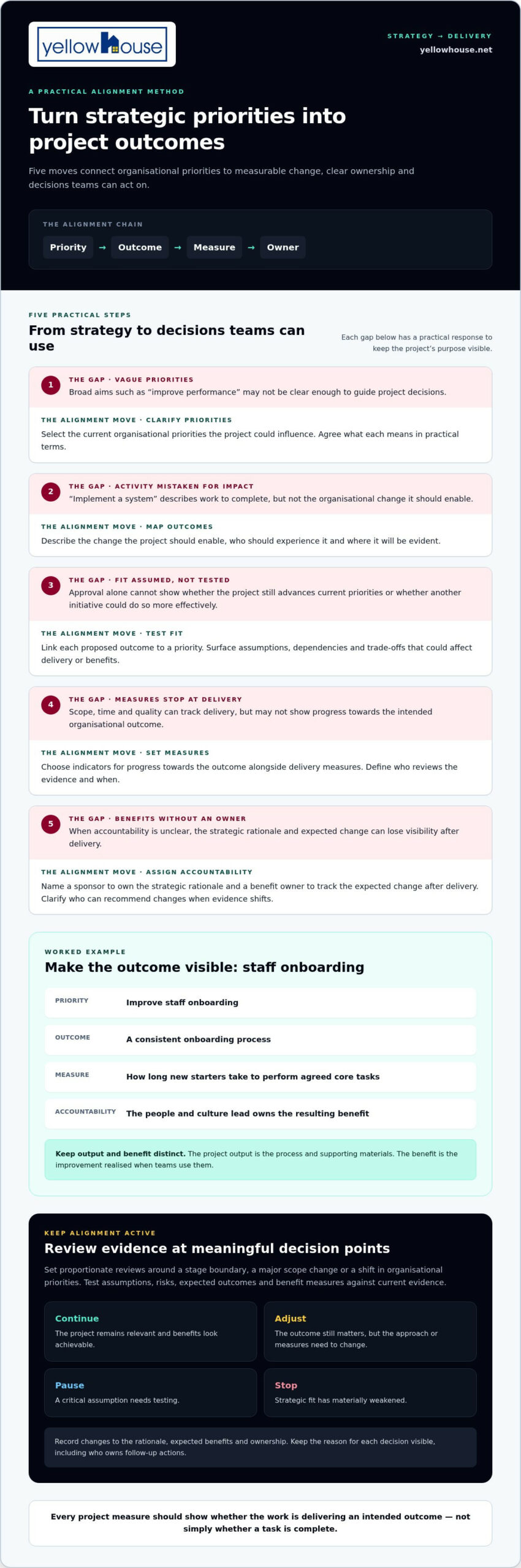
Turn strategy into decisions teams can use. Sponsors clarify the intended contribution; delivery teams translate it into outcomes they can plan, observe and report. Write the connection down in a short chain that can be revisited at each major decision point.
- 1. Clarify priorities. Select the current organisational priorities the project could influence, and agree what each means in practical terms. Avoid broad statements such as “improve performance” unless they are defined clearly enough to guide decisions.
- 2. Map outcomes. Describe the change the project should enable, not just the work it will complete. Identify who should experience that change and where it will be evident.
- 3. Test fit. Ask how each proposed outcome supports a priority, what assumptions it depends on and whether another initiative could achieve it more effectively. Note dependencies and trade-offs that could affect delivery or benefits.
- 4. Set measures. Choose indicators that show progress towards the intended outcome, alongside delivery measures such as scope, time and quality. Define who will review the evidence and when.
- 5. Assign accountability. Name a sponsor to own the strategic rationale and a benefit owner responsible for tracking the expected change after delivery. Make clear who can recommend changes if the evidence points away from the original plan.
Every project measure should show whether the work is delivering an intended outcome, not simply whether a task is complete.
Turn strategic priorities into measurable project outcomes
Suppose a priority is to improve staff onboarding. The project outcome could be a consistent onboarding process; a measure might track how long new starters take to perform agreed core tasks, with the people and culture lead accountable for the resulting benefit. The project output is the process and supporting materials. The benefit is the improvement realised when teams use them. PeopleCert’s PRINCE2® project management framework provides a structured approach to project direction and control, helping sponsors and delivery teams maintain a shared rationale while deciding how to deliver.
Use this chain to make alignment practical: priority, outcome, measure, owner. Before approving a measure, check that it reflects the intended outcome, can be reviewed using available evidence and has someone accountable for acting on what it shows. If it can’t be linked to the outcome, refine it before it becomes a reporting distraction.
Keep strategic alignment active through governance, benefits and portfolio decisions
Alignment needs to hold up as delivery unfolds. Set proportionate review points around meaningful decisions, such as a stage boundary, a major change in scope or a shift in organisational priorities. At each review, test assumptions, risks, expected outcomes and benefit measures against current evidence. The aim isn’t to add meetings, but to make timely decisions while there’s still room to respond. Record any change to the rationale, expected benefits or ownership so the team works from the same picture.
Leaders can use the evidence to choose a clear course: continue when the project remains relevant and benefits look achievable; adjust when the outcome still matters but the approach or measures need to change; pause when a critical assumption needs testing; or stop when strategic fit has materially weakened. Keep the rationale for each decision visible, including who owns follow-up actions. This makes managing benefits part of governance, rather than an activity that ends when project outputs are delivered.
Connect project reviews to programme and portfolio priorities
A project may depend on another initiative, compete for the same people or lose value when a higher-priority proposal emerges. Project-level control monitors delivery against agreed plans and resolves issues within the project’s authority. Programme coordination manages dependencies and combined change; portfolio prioritisation compares investments across the organisation and directs attention towards current priorities. MoP portfolio management provides a structured context for considering those trade-offs.
Review projects together, not only in isolation. A project that remains well managed may still need to move down the queue if its dependencies have changed or another investment offers a stronger contribution to strategy. Compare proposals against the same priorities and consider their benefits, risks, dependencies and resource demands. This portfolio view helps leaders keep aligning projects with strategic business goals as conditions evolve. Where governance needs a closer examination, Gateway assurance can provide a structured review point.
Make strategic alignment part of your next decision
Choose one upcoming investment and make its strategic contribution explicit before delivery begins. Set out the priority, intended outcome, measure and accountable owner, then revisit that connection as evidence emerges. Teams can respond to change with purpose rather than simply protect an outdated plan. This is how aligning projects with strategic business goals becomes a practical discipline, not a one-off approval exercise.
Yellowhouse helps build the capability behind that work through accredited training in PeopleCert’s PRINCE2®, MSP® and MoP® frameworks, alongside strategic change consulting and Gateway assurance. Yellowhouse supports organisations and learners across Brisbane, Sydney, Melbourne, Canberra, Adelaide, Perth, Cairns, Townsville, Hobart, Darwin, Mackay, the Gold Coast, Logan, Ipswich and Toowoomba. These services help teams develop consistent delivery practices and review governance in their organisational context.
Explore Yellowhouse project management training and advisory to take a considered next step towards connecting strategy with delivery.
Frequently Asked Questions
How do you measure whether a project aligns with strategic business goals?
Compare evidence from delivery and operations with the specific organisational result the project is meant to support. For example, if the intended result is faster customer service, track service turnaround after a new process is adopted, not just whether the process was launched. Agree review dates and a meaningful threshold in advance so decision-makers can interpret progress consistently.
What happens if a project no longer supports business strategy?
Reassess its options before committing further resources. Leaders might redirect the work towards a relevant outcome, pause while they examine changed assumptions, or close it and manage any transition responsibly. Record why the decision was made, what obligations remain and where people or resources will move. Previous effort alone isn’t a sound reason to continue.
Who is responsible for aligning projects with business goals?
Responsibility is shared, but decision rights should be explicit. The executive sponsor champions the rationale and resolves strategic questions; the project manager brings emerging delivery evidence forward; and the benefit owner monitors whether the change is producing value in operations. A governance group can arbitrate when projects compete for resources or when priorities conflict across business areas.
Can PRINCE2® help align a project with organisational strategy?
Yes. PeopleCert’s PRINCE2® framework can provide a structured way to govern a project, clarify responsibilities and keep its justification under review at decision points. Teams still need to connect that governance to their organisation’s own priorities and evidence. The method supports disciplined decisions, but it can’t determine strategic fit or guarantee that intended benefits will be achieved.


About Post Author
