

Programme Management Career Path: Roles, Skills and Training
Career progression in programme management is less about gaining a new title and more about taking responsibility for a broader set of outcomes. Project managers deliver defined initiatives, while programme and portfolio roles work across connected change and strategic priorities. If you’re planning your next step, focus on the experience employers can see: how you coordinate work, manage dependencies and contribute to outcomes beyond one project.
This guide traces the programme management career path from project delivery towards programme leadership, clarifies how responsibilities differ and outlines capabilities to build at each stage. It also explains how training can support your development without promising a role or promotion. You’ll see where MSP® Programme Management Training may fit as you prepare to lead coordinated change, and how PRINCE2® and MoP® relate to project and portfolio responsibilities.
Key Takeaways
- Use the programme management career path to identify how you want to broaden your accountability, rather than treating role titles as a fixed ladder.
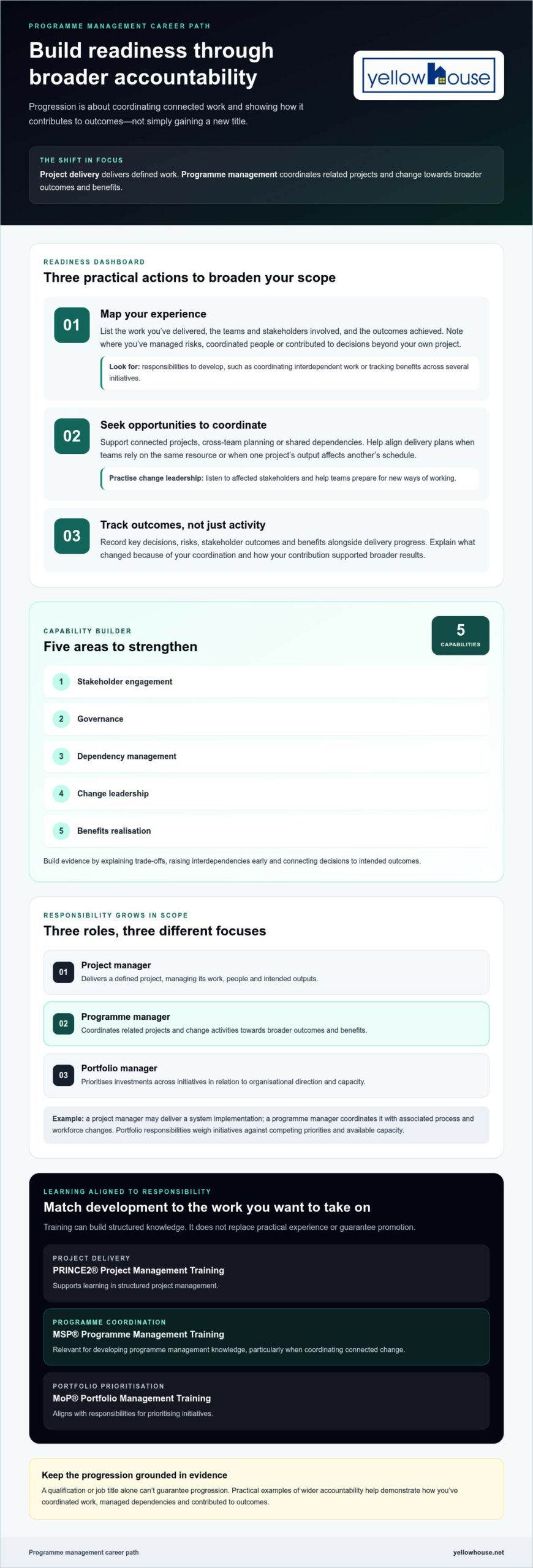
- Map your experience, then seek opportunities to coordinate connected work, manage dependencies and track outcomes.
- Build capability in stakeholder engagement, governance, dependency management, change leadership and benefits realisation.
- Choose training to match the responsibilities you want to take on, and consider MSP® learning alongside practical experience as you develop programme management knowledge.
What does a programme management career path involve?
Programme management coordinates related projects and change activities to achieve broader outcomes and benefits. A programme manager looks across connected work, aligns its direction, manages dependencies and keeps decisions focused on the results the programme is intended to deliver.
The programme management career path isn’t a compulsory ladder from project to programme to portfolio roles. In Australia, it varies with the organisation, sector, your experience and the scale of change involved. Some people build relevant experience in project delivery; others develop coordination or prioritisation responsibilities through different roles. This programme management overview provides further context on the discipline and its relationship to project management.
How programme roles differ from project and portfolio roles
The scope changes with the responsibility, not just the title. A project manager focuses on delivering defined work. A programme manager coordinates connected change. Portfolio management considers which initiatives merit attention and investment across the organisation.
| Role | Typical scope and focus |
|---|---|
| Project manager | Deliver a defined project, managing its work, people and intended outputs. |
| Programme manager | Coordinate related projects and change activities towards broader outcomes and benefits. |
| Portfolio manager | Prioritise investments across initiatives in relation to organisational direction and capacity. |
For example, a project manager may deliver a system implementation, while a programme manager coordinates it with associated process and workforce changes. Portfolio responsibilities sit at a broader decision-making level, weighing initiatives against competing priorities and available capacity. The MoP® portfolio management guide is relevant for understanding this prioritisation focus. Responsibilities can overlap, and organisations structure them differently.
How to progress towards programme management: practical career steps
Progression comes from demonstrating broader accountability, not simply holding a particular job title. Use these steps to turn your current experience into evidence of readiness for the programme management career path.
- 1. Map your experience. List the work you’ve delivered, the teams and stakeholders involved, and the outcomes achieved. Note where you’ve managed risks, coordinated people or contributed to decisions beyond your own project. Then identify the responsibilities you want to develop, such as coordinating interdependent work or tracking benefits across several initiatives.
- 2. Seek opportunities to coordinate. Volunteer to support connected projects, cross-team planning or shared dependencies when opportunities arise. For example, help align delivery plans when two teams rely on the same resource, or when one project’s output affects another’s schedule. Practise change leadership by listening to affected stakeholders and helping teams prepare for new ways of working.
- 3. Track outcomes, not just activity. Keep a record of key decisions, risks, stakeholder outcomes and benefits alongside delivery progress. Explain what changed as a result of your coordination, and how your contribution supported broader results, not only whether tasks were completed.
What experience and capabilities help build readiness?
Build capability in stakeholder engagement, governance, dependency management, change leadership and benefits realisation. Look for chances to explain trade-offs, raise interdependencies early and connect decisions to intended outcomes. A qualification or job title alone can’t guarantee progression; practical examples help demonstrate how you’ve handled wider accountability. If you’re strengthening your delivery foundation, explore PRINCE2 project management training as a structured learning option.
Which programme management training can support your next career move?
Choose learning that reflects the responsibilities you want to develop, then apply it to real work. Training can provide a structured way to build knowledge, but it doesn’t replace practical experience or guarantee promotion. On a programme management career path, consider whether your next step is to strengthen project delivery, develop programme coordination or move towards portfolio prioritisation.
| Development focus | Relevant learning |
|---|---|
| Project delivery | PRINCE2® Project Management Training can support learning in structured project management. |
| Programme coordination | MSP® Programme Management Training is relevant for developing knowledge of programme management. |
| Portfolio prioritisation | MoP® Portfolio Management Training aligns with responsibilities for prioritising initiatives. |
When is MSP® training relevant to a career path?
MSP® learning is relevant for professionals building towards programme responsibilities, particularly when their work involves coordinating connected change. It can develop structured programme management knowledge alongside practical experience, such as working across teams, managing dependencies and keeping attention on intended benefits. Consider how the learning connects to the responsibilities you’re taking on, rather than treating a qualification as proof of workplace capability.
For more background, explore a complete guide to the MSP framework. If MSP® aligns with your development goals, explore MSP programme management training as a next step.
Take the next step in your programme career
A programme management career path is shaped by broader accountability, not a fixed sequence of job titles. Build on your experience by seeking opportunities to coordinate connected work, strengthen stakeholder and governance skills, and show how your decisions contribute to outcomes. Then choose learning that fits the responsibilities you want to develop.
Yellowhouse provides accredited MSP® Programme Management Training, alongside PRINCE2® and MoP® training for project delivery and portfolio responsibilities. These learning options build structured knowledge, while practical experience remains essential to demonstrating capability in the workplace.
Explore Yellowhouse programme management training and choose a course that supports your next development goal.
Frequently Asked Questions
Do I need to be a project manager before becoming a programme manager?
No, becoming a project manager first isn’t essential. Project experience can build useful grounding in delivery, governance and stakeholder communication, but routes differ by organisation and sector. Coordination, change or business roles can also develop relevant capabilities. To progress along a programme management career path, focus on examples where you’ve managed connected work and contributed to broader outcomes, rather than relying on a particular job title.
What skills are important for a programme manager?
Programme managers bring people, decisions and connected work together. Useful capabilities include clear communication, stakeholder engagement, governance, dependency management, risk awareness, change leadership and a focus on outcomes and benefits. The balance depends on the programme and organisation. Build these skills through practical responsibilities, reflect on the results and identify where further experience or structured learning could strengthen your contribution.
Is MSP® training useful for a programme management career?
MSP® training can help develop structured programme management knowledge, particularly if you’re building towards programme leadership. Its relevance depends on your experience, current responsibilities and development goals, so connect the learning with opportunities to apply it at work. Yellowhouse provides training in Australia, including for learners in Brisbane, Sydney, Melbourne, Canberra, Adelaide, Perth, Cairns, Townsville, Hobart, Darwin, Mackay, Gold Coast, Logan, Ipswich and Toowoomba.
How do project, programme and portfolio management careers differ?
Project management centres on delivering defined work; programme management coordinates related projects and activities towards broader outcomes and benefits. Portfolio management focuses on prioritising and overseeing investments across initiatives. These responsibilities can overlap, and organisations structure roles differently. To understand a role’s scope, look at the work involved: delivering a defined initiative, coordinating connected change, or making decisions across a group of initiatives.


About Post Author
