

MoP Portfolio Management Training: Mastering Strategic Delivery in Australia (2026)
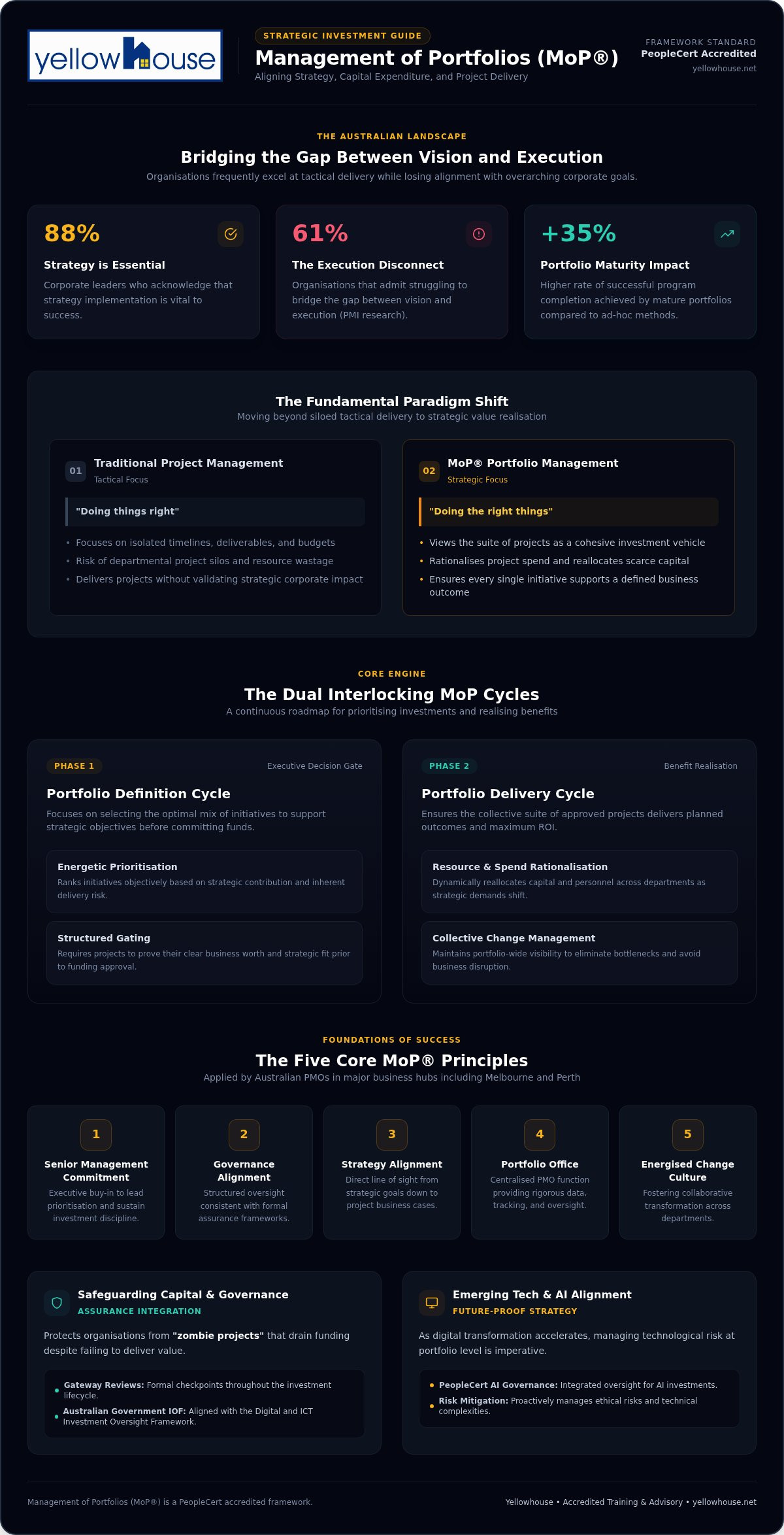
While 88% of corporate leaders acknowledge that strategy implementation is vital, PMI research shows that 61% admit their organisations struggle to bridge the gap between vision and execution. You likely recognise the frustration of project silos and resource wastage that occurs when delivery teams lose sight of overarching corporate goals in the 2026 Australian market. Enrolling in MoP portfolio management training addresses these challenges directly, providing the tools to ensure your project investments are always the right ones.
You probably agree that it’s difficult to prioritise competing initiatives when resources are stretched. We’ll show you how to align your project spend with strategy to maximise ROI through accredited PeopleCert methodologies. This article previews the essential practices of portfolio management, the path to a recognised certification, and how a structured approach to governance can turn your strategic vision into a tangible reality.
Key Takeaways
- Understand why MoP is the essential framework for ensuring your organisation’s resources are dedicated to the right initiatives rather than just managing projects correctly.
- Explore the dual cycles of Portfolio Definition and Delivery to create a transparent roadmap for investment prioritisation and benefit realisation.
- Gain a competitive edge by undertaking accredited MoP portfolio management training, which validates your ability to manage complex change through PeopleCert’s global standard.
- See how expert-led training tailored for the Australian market helps bridge the gap between executive strategy and front-line project delivery.
Why Portfolio Management is the Missing Link in Australian Corporate Strategy
In the Australian market of 2026, organisations face unprecedented pressure to justify every dollar of capital expenditure. While many teams excel at “doing things right” through established project methodologies, a critical gap remains in “doing the right things.” Management of Portfolios (MoP) serves as the essential framework to bridge this divide. It ensures that high-level strategic intent isn’t lost as it cascades down to ground-level project delivery. Without a structured approach to project portfolio management, businesses risk investing in initiatives that, while well-executed, fail to move the needle on corporate objectives.
Moving Beyond Project Delivery to Strategic Value
Traditional project management focuses on tactical delivery, such as meeting deadlines and staying within budget. In contrast, portfolio management prioritises long-term investment value and organisational impact. By undertaking MoP portfolio management training, leaders learn to view their suite of projects as a cohesive investment vehicle. This shift in perspective ensures that MoP portfolio management practices are used to validate that every initiative supports a clearly defined business outcome rather than simply ticking a box.
The current 2026 landscape demands that Australian boards rationalise project spend and maximise resource efficiency across disparate departments. This PeopleCert framework provides the necessary governance to cull redundant projects and reallocate scarce resources to high-priority goals. MoP portfolio management training empowers decision-makers to move beyond siloed thinking, fostering a culture where change is managed collectively. The Portfolio Definition cycle acts as the critical phase for executive decision-making in 2026, providing a structured gate for initiatives to prove their strategic worth before receiving funding.
The MoP Framework: A Practical Roadmap for Investment Prioritisation
MoP functions through two continuous, interlocking cycles: Portfolio Definition and Portfolio Delivery. The Definition cycle focuses on selecting the optimal mix of initiatives, while the Delivery cycle ensures these projects collectively achieve their intended benefits. A cornerstone of this framework is “Energetic Prioritisation.” This process involves ranking projects based on their strategic contribution and inherent risk. Organisations with high portfolio maturity complete 35% more programs successfully compared to those using ad-hoc methods. For Australian organisations, this rigour is essential to ensure that capital is deployed where it generates the most impact.
Effective Portfolio Governance acts as a safeguard against “zombie projects” that continue to consume budget despite providing little value. By integrating MoP with Gateway assurance, teams establish formal checkpoints throughout the investment lifecycle. This alignment mirrors the standards set by the Australian Government’s Digital and ICT Investment Oversight Framework, which mandates transparent oversight for high-value initiatives. It’s about maintaining a clear line of sight from the business case to the final outcome.
Implementing the Five Principles of MoP
The framework rests on five core principles: Senior Management Commitment, Governance Alignment, Strategy Alignment, Portfolio Office, and an Energised Change Culture. In major business hubs like Melbourne and Perth, Australian PMOs apply these principles to centralise oversight and break down departmental silos. As emerging technology becomes central to strategy, incorporating PeopleCert AI Governance within the portfolio is no longer optional. It provides a structured approach to managing the ethical risks and technical complexities of AI investments. If you’re ready to master these frameworks, our MoP portfolio management training offers the practical expertise required to lead these transformations.
MoP Certification with Yellowhouse: Advancing Your Career and Organisation
The MoP certification remains the definitive global standard for professionals balancing strategic investment with delivery capacity. At Yellowhouse, our MoP portfolio management training is led by expert practitioners who’ve applied these portfolio management framework and principles within complex Australian organisations. We avoid generic theory, instead focusing on local case studies that mirror the specific governance hurdles found in our public and private sectors. This PeopleCert qualification bridges the gap between tactical execution and executive vision, perfectly complementing frameworks like PRINCE2 and MSP for a truly holistic P3M toolkit.
Choosing the Right MoP Training Path for Your Team
Deciding between certification levels depends on your organisational goals. The Foundation course establishes a consistent vocabulary and understanding of the MoP cycles, ensuring everyone speaks the same language of value. Conversely, Practitioner training focuses on the practical application and tailoring of the framework to real-world scenarios. Yellowhouse supports your professional growth with flexible delivery models, including onsite cohorts in Brisbane and Sydney or immersive virtual classrooms for teams across Canberra and Perth. PeopleCert certifications now require renewal every three years; this ensures your skills remain current in a volatile market.
To ensure these methodologies take root, many organisations follow their MoP portfolio management training with Strategic Change Consulting. This collaborative approach helps embed the framework into your unique culture, moving beyond the classroom to deliver sustained ROI. By partnering with a seasoned Australian provider, you ensure your team isn’t just certified, but truly capable of driving meaningful strategic change.
Securing Your Organisation’s Strategic Future
Success in the 2026 Australian market requires more than just efficient project delivery; it demands a disciplined approach to investment that ensures every initiative provides measurable value. By adopting a structured framework, you move beyond tactical tracking to become a strategic partner in your organisation’s growth. We’ve explored how a robust prioritisation roadmap eliminates resource wastage and aligns ground-level actions with executive intent. As an accredited PeopleCert training provider, Yellowhouse offers the quiet expertise needed to navigate these complexities. Our courses are delivered by expert practitioners with real-world experience, ensuring the skills you gain are trusted by major Australian government departments and corporations. It’s time to advance your career and secure your organisational future. Enrol in MoP portfolio management training with Yellowhouse today and start delivering the strategic outcomes your business deserves.
Frequently Asked Questions
What is the difference between MoP and PRINCE2?
PRINCE2 focuses on the management of individual projects to ensure they’re delivered effectively, whereas MoP operates at a higher strategic level to ensure the organisation selects the right mix of initiatives. While PRINCE2 is about “doing things right,” MoP is about “doing the right things.” This framework provides the oversight needed to balance business-as-usual with the collective risk of the entire project suite.
Is MoP certification recognised in the Australian Public Service (APS)?
Yes, MoP is highly regarded within the Australian Public Service and various state government departments in cities like Canberra and Brisbane. It aligns with the Commonwealth’s requirements for robust investment oversight and Gateway assurance. Many APS agencies mandate MoP portfolio management training for senior leaders to ensure that public funds are allocated to initiatives that deliver the highest strategic value for the community.
How long does it take to complete MoP Foundation and Practitioner training?
A standard MoP portfolio management training course typically spans five days when combining both Foundation and Practitioner levels. The Foundation component usually takes three days, focusing on the five principles and two cycles. This is followed by a two-day Practitioner module that teaches you how to apply and tailor the framework to real-world organisational scenarios, concluding with the scenario-based PeopleCert examination.
Does MoP training cover AI governance and digital transformation?
While MoP provides the overarching governance structure for all organisational change, it specifically addresses the complexities of digital transformation and emerging technologies. Yellowhouse integrates PeopleCert AI Governance principles into the curriculum to help managers navigate the ethical risks and investment hurdles of AI. This ensures your portfolio remains resilient and accountable while adopting the digital tools required for a 2026 competitive advantage.


About Post Author
