

Project Management Governance Framework: The 2026 Australian Guide
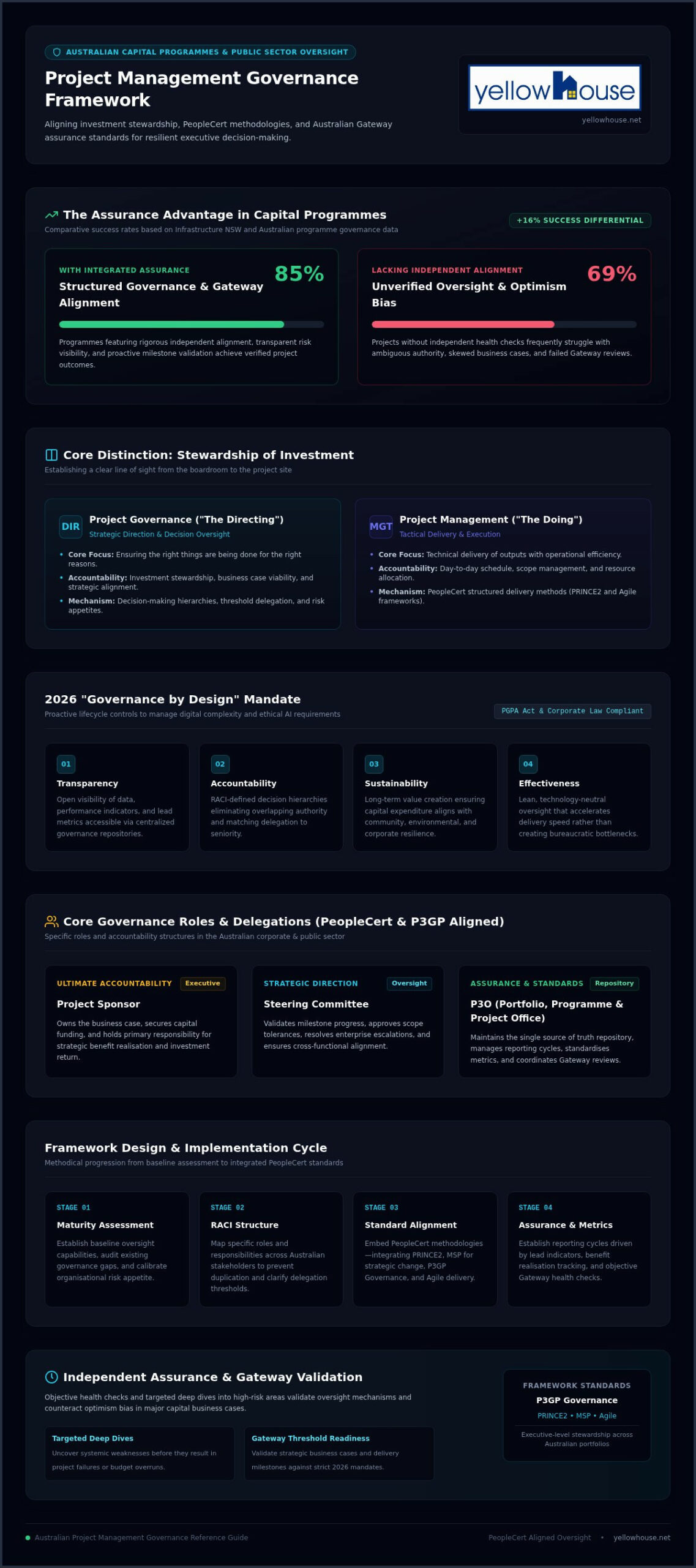
Did you know that Australian capital programmes with integrated assurance achieve an 85% success rate, while those lacking independent alignment often struggle at just 69%? It’s a sobering gap that many project leaders feel when decision-making authority becomes ambiguous or documentation fails to meet rigorous Gateway review standards. You have likely felt the pressure of aligning complex outputs with shifting strategic goals while trying to maintain clear accountability across your team. This guide will show you how to build a robust project management governance framework that satisfies both corporate needs and strict Australian government mandates. By blending PeopleCert methodologies with local assurance practices, you can transform oversight into a strategic advantage. We will examine the essential structures for accountability, the 2026 Gateway thresholds, and the practical steps to ensure your investments deliver their promised value.
Key Takeaways
- Recognise governance as the stewardship of investment, ensuring every project remains firmly aligned with your organisation’s strategic Australian business goals.
- Master the steps to design a project management governance framework, beginning with a maturity assessment to understand your team’s unique risk appetite.
- Define clear accountability structures using a RACI matrix that identifies the specific roles and responsibilities of your key Australian stakeholders.
- Discover how independent assurance and deep-dive health checks can validate your oversight and prepare your programmes for successful Gateway reviews.
Defining Project Management Governance in the Australian Context
In the Australian corporate and public sectors, we define governance as the professional stewardship of investment. It’s the essential mechanism that ensures every dollar spent remains firmly aligned with strategic business goals. While project management focuses on the technical delivery of outputs, project governance provides the necessary direction and oversight. Establishing a robust project governance framework allows organisations to separate the “doing” from the “directing,” creating a clear line of sight from the boardroom to the project site. This distinction is critical; management is about efficiency, while governance is about ensuring the right things are being done for the right reasons.
By 2026, Australian organisations are moving toward “governance by design” to manage escalating digital complexity and ethical AI requirements. This proactive approach embeds a project management governance framework into the project lifecycle, focusing on transparency, accountability, sustainability, and effectiveness. It isn’t just about checking boxes or satisfying auditors. It’s about building a resilient system where risks are visible and decisions are data-driven, ensuring long-term value for stakeholders and the community alike.
The Core Components of an Australian Governance Framework
A functional project management governance framework requires clearly defined roles that prevent overlapping authority. Within a PeopleCert aligned environment, the Project Sponsor holds ultimate accountability for the business case, supported by a Steering Committee and a Portfolio, Programme, and Project Office (P3O). To remain compliant with Australian corporate law and the PGPA Act, you must define specific financial delegation thresholds and decision-making hierarchies. Centralising these controls in a project governance repository provides a “single source of truth,” which is vital for real-time reporting and preparing for independent assurance reviews.
Designing and Implementing Your Governance Framework
Designing a project management governance framework isn’t a one-size-fits-all task. It requires a methodical approach that respects your organisation’s unique culture and risk appetite. Start by conducting a maturity assessment to identify gaps in your current oversight. Once you understand your baseline, you can define a structure using a RACI matrix. This ensures every Australian stakeholder knows exactly where they sit in the decision-making chain. Clear roles prevent the duplication of effort and ensure that accountability remains at the correct level of seniority.
Integrating these structures with PRINCE2, a core PeopleCert methodology, ensures your delivery remains structured and predictable. You’ll need to establish performance metrics that provide genuine insights rather than just raw data. Reporting cycles should focus on lead indicators and benefit realisation, allowing boards to make informed adjustments before issues escalate. Following project governance best practices helps you move beyond compliance toward true value creation. If you’re looking to refine your approach, our P3GP Governance training provides the specific tools needed for executive-level oversight.
Aligning Frameworks with PeopleCert and P3GP Standards
The P3GP Governance framework offers a technology-neutral model focused on stewardship. It’s particularly effective when integrated with MSP Programme Management for large-scale strategic change. Your framework must be flexible enough to support both traditional and Agile delivery methods, ensuring that governance enables speed rather than hindering it. This balance is key to achieving consistent success in the 2026 landscape. By aligning these global standards with your local requirements, you create a resilient environment for project success.
Optimising Outcomes through Assurance and Gateway Reviews
Independent assurance serves as the ultimate litmus test for your project management governance framework. It moves beyond internal self-assessment to provide an objective validation that your oversight mechanisms are functioning as intended. By conducting regular health checks and targeted deep dives into high-risk areas, you can identify systemic weaknesses before they result in costly failures. This level of scrutiny is particularly vital in large-scale Australian infrastructure, where optimism bias often skews initial business cases. Data from Infrastructure NSW indicates that capital programmes with structured governance and integrated assurance achieve an 85% success rate, compared to just 69% for those lacking independent alignment. High governance maturity isn’t just a compliance goal; it’s a direct driver of benefit realisation and superior ROI.
Mastering the Gateway Assurance Process in Australia
Participating in a Gateway Review at key decision points provides the discipline needed to keep investments on track. The process typically follows six critical stages: Gate 0 (Strategic Assessment), Gate 1 (Business Need), Gate 2 (Delivery Strategy), Gate 3 (Investment Decision), Gate 4 (Readiness for Service), and Gate 5 (Operations Review and Benefits Realisation). These reviews ensure that the project management governance framework remains robust throughout the entire lifecycle. Preparing for these rigorous independent reviews requires more than just good documentation; it demands a deep understanding of PeopleCert standards and local regulatory requirements. Accredited training helps project leaders build the confidence to navigate these gates, ensuring their programmes are not just compliant, but genuinely successful.
Strengthening Your Governance for 2026 and Beyond
As the Australian corporate landscape grows increasingly complex, the role of a structured project management governance framework shifts from a compliance necessity to a strategic differentiator. You’ve explored how defining clear accountability, aligning with PeopleCert standards, and embracing independent assurance can significantly lift project success rates. These elements ensure that your investments aren’t just delivered on time but are managed with the professional stewardship required to realise genuine benefits. Yellowhouse has proudly supported Australian project professionals for over 20 years as a leader in PeopleCert accredited training. We’re here to partner with you as you navigate the rigours of modern oversight with our expert Gateway assurance consultants. Ready to master the art of project direction? Enrol in P3GP Governance Training with Yellowhouse Today and lead your organisation towards more predictable, value-driven outcomes. We look forward to helping you reach your full potential.
Frequently Asked Questions
What is the difference between project governance and project management?
Project governance focuses on the “why” and “what” of an investment, acting as a system of stewardship and oversight. In contrast, project management is about the “how,” dealing with the day-to-day delivery of specific outputs. While a manager ensures tasks are completed, the governance body ensures the project remains strategically aligned with Australian business objectives and ethical standards throughout its lifecycle.
How do I choose the right project management governance framework for my organisation?
Selecting a framework starts with a thorough assessment of your organisation’s current maturity and specific risk appetite. You should look for a model that integrates seamlessly with PeopleCert standards like PRINCE2 while remaining flexible for your local context. A robust project management governance framework should be scalable, ensuring it provides oversight for investments across Brisbane, Sydney, and other Australian centres without creating administrative hurdles.
What are the 8 components of project governance according to best practice?
Best practice typically identifies eight essential components: a clear Project Sponsor, a Steering Committee, a defined PMO, a RACI matrix for accountability, financial delegation thresholds, standardised reporting, risk management protocols, and independent assurance. Implementing these within a project management governance framework ensures that decision-making remains transparent. It provides a structured environment where every stakeholder understands their specific obligations under Australian corporate and public law.
Why are Gateway reviews important for Australian government projects?
Gateway reviews provide mandatory independent assurance for high-risk Australian government projects, such as those exceeding the $30 million federal threshold. These reviews help combat the optimism bias often found in large infrastructure business cases by providing objective “health checks” at six critical decision points. By validating that a project is ready to progress, these reviews protect taxpayer funds and significantly increase the likelihood of successful benefit realisation.
Can I use a governance framework for Agile projects in Australia?
You absolutely can and should apply governance to Agile delivery. Modern frameworks like PRINCE2 Agile and P3GP are technology-neutral; they provide oversight without stifling the speed or flexibility of iterative delivery. Effective governance in an Agile context focuses on empowering teams to make rapid decisions within a set of predefined boundaries, ensuring that speed never comes at the expense of strategic alignment or accountability.


About Post Author
