

Advancing Your Project Management Career: The 2026 Australian Strategy
What if the technical delivery skills that secured your current role are the very things holding you back from the boardroom? Many project professionals across Australia feel they’ve reached a plateau, where years of successful execution don’t seem to translate into senior leadership opportunities. You might find yourself caught between competing certification paths or feeling uncertain about how automation will reshape your value. It’s a common challenge, but advancing your project management career in 2026 requires a shift from managing tasks to mastering strategic governance.
This article provides the clear roadmap you need to unlock higher earning potential and senior leadership roles. We’ll examine how to navigate PeopleCert frameworks like PRINCE2 and MSP, while integrating essential AI governance skills that are now non-negotiable for the modern practitioner. By the end, you’ll have a structured plan to future-proof your expertise and lead with confidence in an evolving corporate landscape.
Key Takeaways
- Understand the fundamental shift from technical project delivery to strategic programme leadership by mastering the MSP framework to drive broader organisational value.
- Identify the specific PeopleCert accreditation path required for advancing your project management career, moving from the structure of PRINCE2 to the modern flexibility of PRINCE2 Agile.
- Learn how to future-proof your professional standing against automation by integrating AI governance and the latest ITIL standards into your digital product lifecycle management.
- Gain a distinct competitive edge in the Australian landscape by aligning your skills with local requirements such as Gateway assurance and senior government-facing leadership roles.
Mastering the Transition from Project Delivery to Programme Leadership
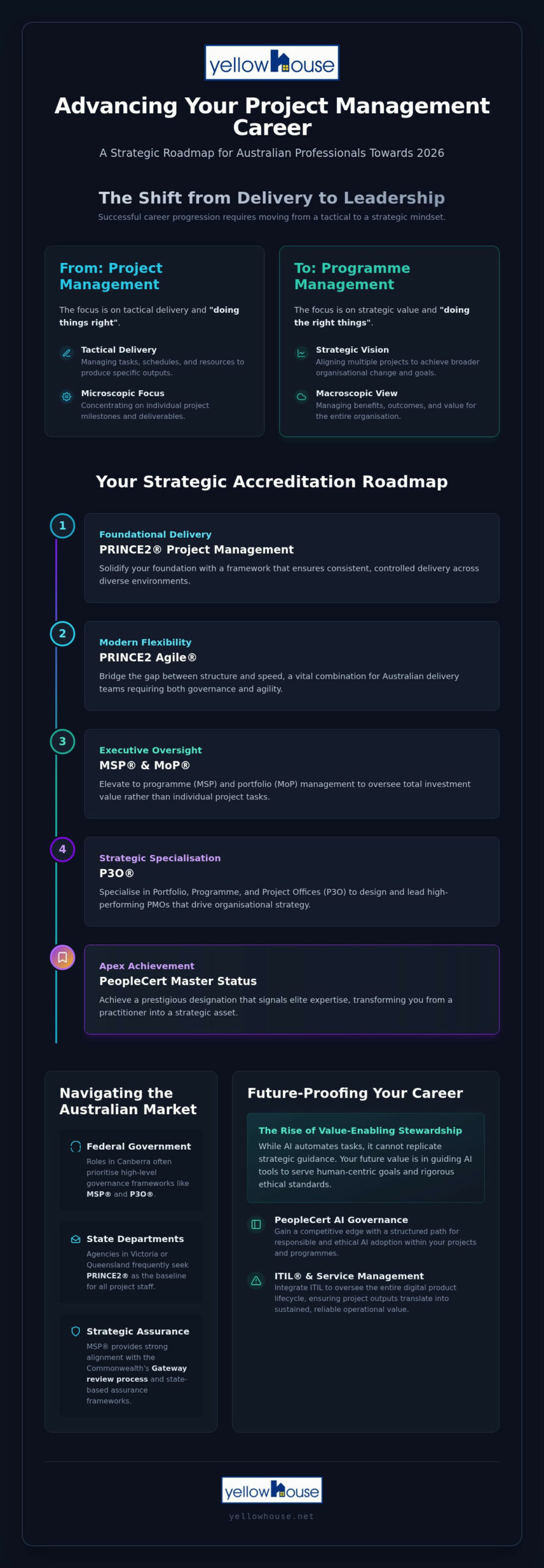
Many professionals find that advancing your project management career requires a fundamental shift in perspective. While project management focuses on tactical delivery and “doing things right,” programme management is concerned with “doing the right things.” This means moving away from a microscopic focus on specific outputs to a macroscopic view of organisational outcomes. It’s about understanding how a collection of projects combines to deliver a strategic vision.
In the Australian market, organisations increasingly demand Managing Successful Programmes (MSP) for senior leadership appointments. This preference exists because MSP bridges the gap between high-level strategy and technical delivery. By focusing on managing benefits rather than just technical milestones, you secure essential executive buy-in. It demonstrates that you aren’t just delivering a product; you’re delivering measurable value that justifies the investment.
The Role of MSP in Delivering Strategic Organisational Change
MSP provides a rigorous governance framework that ensures individual projects remain aligned with corporate goals. For professionals in the Australian public sector or large-scale infrastructure and health sectors, this is vital. These environments involve complex, multi-stakeholder landscapes where change is constant. MSP allows you to coordinate these moving parts effectively. Key advantages for Australian practitioners include:
- Strong alignment with the Commonwealth’s Gateway review process and state-based assurance frameworks.
- Enhanced risk management across multiple interdependent workstreams.
- A structured approach to the human element of transition, ensuring change is embedded and lasting.
Mastering these elements is the fastest way to prove you’re ready for the responsibility of senior leadership and advancing your project management career into the executive ranks.
A Strategic Roadmap for Professional Accreditation in 2026
Achieving senior leadership isn’t just about years on the job; it’s about the credentials that signal strategic capability. To begin, solidify your foundation with PRINCE2 Project Management. This framework ensures consistent delivery across diverse environments. Once mastered, bridge the gap between structure and flexibility with PRINCE2 Agile. This combination is particularly effective for modern Australian delivery teams that require both governance and speed.
For those advancing your project management career into executive oversight, the next steps involve elevating to MSP and Management of Portfolios (MoP). These allow you to oversee total investment value rather than individual tasks. Specialising in P3O (Portfolio, Programme and Project Offices) further enables you to design and lead high-performing PMOs. This integrated approach ensures you’re prepared for the complexities of the 2026 market.
Choosing the Right Framework for the Australian Market
Demand varies across the country. Federal government roles in Canberra often prioritise high-level governance certifications like P3O or MSP. Conversely, state departments in Victoria or Queensland frequently look for PRINCE2 as the baseline for all project staff. Stacking these certifications leads toward the prestigious PeopleCert Master status, a clear signal of elite expertise. It’s a journey that transforms you from a practitioner into a strategic asset. If you’re ready to start, consider exploring our PeopleCert training options to map out your specific path.
Future-Proofing Your Career with AI Governance and Strategic Assurance
The question isn’t whether AI will replace project managers, but how it will fundamentally augment the role. While automation handles scheduling and data entry, it cannot replicate “Value-Enabling Stewardship.” This concept represents the core competency for those advancing your project management career into the late 2020s. It involves guiding AI tools to ensure they serve human-centric goals and rigorous ethical standards. By integrating ITIL 5 and Service Management, practitioners can oversee the entire digital product lifecycle. This ensures that project outputs don’t just finish on time but translate into sustained, reliable operational value.
The PeopleCert AI Governance Edge for Senior Leaders
PeopleCert’s AI Governance certification provides a structured path for responsible AI adoption through its 6C Capability Model. This model evaluates everything from compliance to culture, ensuring AI initiatives are sustainable. For Australian leaders, understanding AI risk and ethics is now a non-negotiable skill as regulatory scrutiny increases. The training is intensive yet efficient, typically completed in 1-2 days, and requires a 70% pass mark to demonstrate true proficiency. It’s an essential credential for those who want to lead digital transformation rather than just follow it.
Transitioning into high-level advisory roles often involves moving beyond internal delivery to external oversight. Specialising in Gateway assurance services offers a prestigious career path for senior practitioners. These reviews provide critical, independent checkpoints for high-risk government projects, ensuring they remain viable and strategic. Mastering this type of strategic oversight is a definitive step in advancing your project management career toward executive consultancy and high-level board advisory roles.
Securing Your Leadership Future in the Australian Project Landscape
The path to senior leadership in 2026 requires a deliberate shift from managing technical outputs to mastering strategic value. By integrating PeopleCert frameworks like MSP and MoP into your professional toolkit, you demonstrate the governance expertise that Australian organisations demand. Embracing AI governance is no longer optional. It ensures you remain a vital steward of digital change rather than a bystander to automation.
Advancing your project management career is about partnering with experts who understand the local landscape. As an accredited PeopleCert Training Partner and Australian-based strategic change specialist, we provide the expert-led courses in PRINCE2, MSP, and MoP you need to succeed. Enrol in a Yellowhouse course today to accelerate your career progression. If you’re ready to lead, your journey to executive leadership starts with a strategic step forward.
Frequently Asked Questions
What is the best certification for advancing to a Senior Project Manager role in Australia?
Managing Successful Programmes (MSP) is the premier certification for those advancing your project management career into senior leadership. While PRINCE2 focuses on technical delivery, MSP provides the strategic governance required to manage multiple related projects. This is essential for senior roles in major hubs like Sydney and Melbourne, where organisations prioritise benefits-led management over simple output delivery.
How does PeopleCert AI Governance differ from basic AI training for PMs?
PeopleCert AI Governance differs from basic literacy by focusing on a structured 6C Capability Model for responsible adoption. This 1-2 day accredited course addresses the ethics, risk, and accountability of AI within a corporate framework. To pass, you’ll need a 70% mark on a 40-question exam, proving you have the stewardship skills to manage AI as a strategic organisational asset.
Is PRINCE2 or PMP more valuable for my career in the Australian government sector?
PRINCE2 is typically more valuable for the Australian government sector because it aligns with the Commonwealth’s Gateway review process. While PMP is a globally recognised standard, PRINCE2 provides the specific governance and process-driven methodology used by departments in Canberra and Brisbane. It’s the preferred framework for ensuring accountability and consistency across large-scale public sector projects and programmes.
What are the benefits of achieving PeopleCert Master status for my salary?
Achieving PeopleCert Master status signals elite proficiency, which often leads to significantly higher earning potential in the Australian market. This credential validates your ability to handle complex, high-risk portfolios at an executive level. It represents the pinnacle of advancing your project management career, proving you’ve mastered the strategic, digital, and AI-native capabilities required for the most senior leadership appointments in 2026.


About Post Author
