

2026 Project Management PD Guide for Australian Leaders
Did you know that while 90% of Australian organisations now use AI tools daily, fewer than one in five have implemented a formal governance framework to manage them? This gap represents a significant risk for the industry, but it offers a profound opportunity for leaders who can bridge the divide between technical delivery and strategic oversight. It’s natural to feel a sense of stagnation when deciding how to structure your project management professional development plan in such a volatile market.
This guide helps you cut through the noise to build a high-impact roadmap that secures your future. We’ll show you how to integrate PeopleCert frameworks to achieve recognised credentials that command higher salary brackets and provide a clear path for career progression. You’ll gain a comprehensive understanding of modern governance, from the human-centric focus of PRINCE2 7 to the AI-native practices within the latest ITIL standards.
Key Takeaways
- Identify how the Australian project landscape is evolving from traditional delivery toward high-value digital product and service management governance.
- Learn to structure a robust project management professional development plan by aligning your current capabilities with PeopleCert’s strategic learning paths.
- Recognise the importance of integrating modern frameworks to master AI-native governance, sustainability metrics, and value-based stewardship.
- Discover the benefits of scenario-based training with an accredited Australian partner to ensure your certifications translate into tangible organisational results.
Why Your Project Management Professional Development Plan Needs an Update for 2026
The Australian project landscape has undergone a fundamental transformation. While traditional delivery remains important, the market now prioritises digital product and service management that ensures long-term value. Organisations across Sydney, Melbourne, and Brisbane are moving away from rigid compliance; they now seek “Expert Practitioners” who can navigate complex governance frameworks with agility. Consequently, your project management professional development plan needs to reflect this shift toward strategic stewardship rather than mere task completion.
Success in 2026 requires a commitment to continuing professional development rather than relying on a single, static certification. This journey involves refining your ability to align project outcomes with broader organisational strategy. It’s about demonstrating how every milestone contributes to the bottom line while maintaining high standards of accountability. A robust project management professional development plan ensures you remain competitive as the industry adopts autonomous AI agents.
The Rise of AI Governance in Australian Project Frameworks
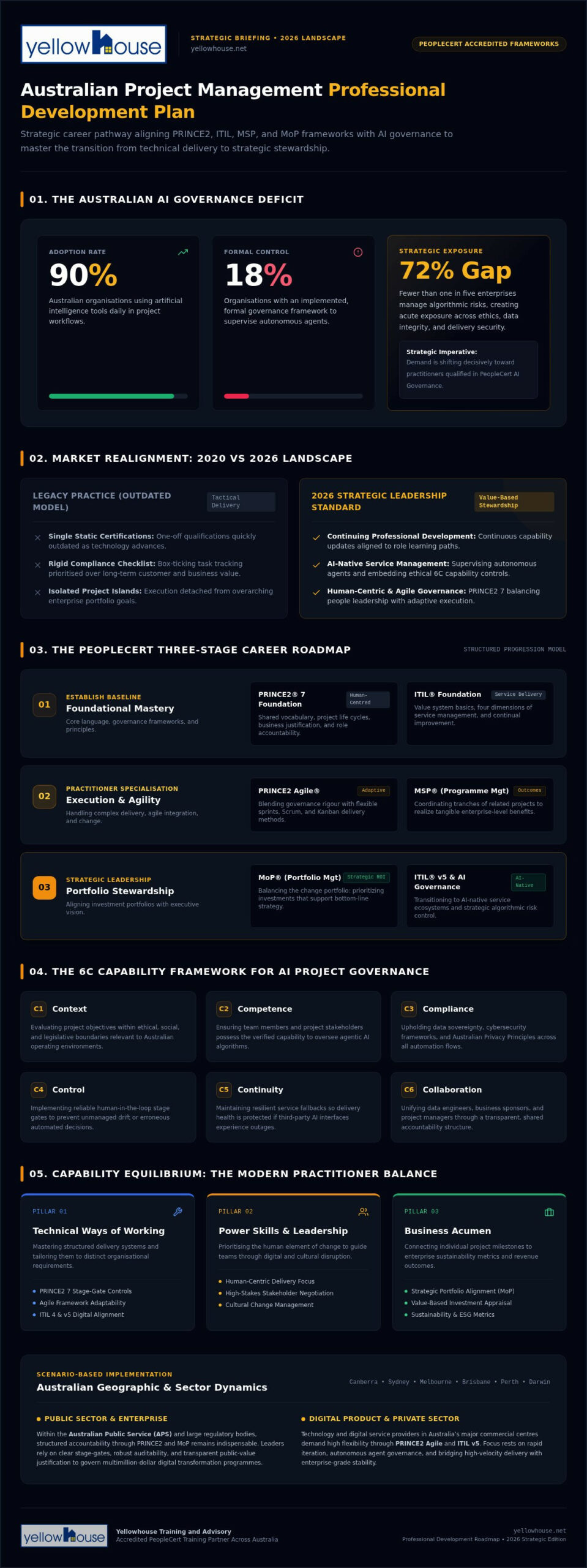
Recent research indicates that 90% of organisations use AI tools daily, yet only 18% have implemented a formal governance framework. This disparity creates significant risk for project leaders. The PeopleCert AI Governance framework addresses this by providing a structured approach to managing ethics, risk, and innovation. By adopting the 6C Capability Model, leaders can embed responsible AI practices directly into their delivery cycles. This ensures that technological advancements don’t compromise security or oversight. Mastering these ITIL-aligned practices is now a non-negotiable component of any future-proof career roadmap. It allows you to supervise agentic AI and mitigate algorithmic risks before they impact project health.
How to Structure Your Project Management Career Roadmap
Creating a robust project management professional development plan requires more than just collecting certificates. You must begin with a candid self-assessment of your current competencies against PeopleCert’s role-aligned learning paths. This clarity allows you to define a specific career goal, whether you aspire to be a Practice Manager, a Managing Professional, or a Strategic Leader. Choosing the right frameworks depends heavily on your sector. For instance, those in the Australian Public Service often find PRINCE2 indispensable, while leaders in tech-heavy environments benefit from the flexibility of PRINCE2 Agile.
Mapping the PeopleCert Journey from Foundation to Master
Your progression should follow a logical sequence that builds capability over time. Many organisations utilise a staff development and training framework to ensure these steps align with business needs. A structured journey typically includes:
- Step 1: Establish your baseline with PRINCE2 Project Management or ITIL Foundation to master core principles and shared vocabulary.
- Step 2: Specialise through core modules like PRINCE2 Agile or MSP Programme Management to handle complex delivery and agile governance.
- Step 3: Elevate to strategic levels with MoP Training, focusing on portfolio alignment with high-level organisational objectives.
For those holding older v3 or ITIL 4 credentials, the transition to ITIL Version 5 is a vital step in staying current with AI-native service management. This path ensures your skills remain relevant as digital ecosystems evolve. If you’re ready to advance, you can explore PeopleCert certification pathways to find your next step and secure your professional future.
Implementing Your Plan with Yellowhouse Training and Advisory
Execution requires more than theoretical knowledge; it demands the wisdom of experience. Yellowhouse delivers accredited training across Australia, supporting leaders in Brisbane, Sydney, Perth, and Darwin with a focus on real-world application. Our courses move beyond standard textbooks to provide scenario-based examples tailored to the unique Australian market. This practical approach aligns with the PMI Talent Triangle, which emphasises that modern leaders must balance technical ways of working with power skills and business acumen.
When refining your project management professional development plan, it’s vital to account for the human element of delivery. We prioritise leadership and strategic change because technical mastery alone doesn’t guarantee success in complex environments. Our expert-led sessions help you manage the cultural shifts and stakeholder expectations that often accompany high-stakes projects. This ensures you’re not just certified, but truly prepared to lead in a results-oriented landscape.
Advancing to Senior Roles with Gateway Assurance and PeopleCert Plus
Participating in Gateway Assurance Reviews represents a significant professional development milestone for senior leaders. These reviews offer a rare opportunity to observe high-level governance and risk mitigation in action across different sectors. Additionally, PeopleCert Plus membership provides an invaluable ongoing learning resource. It offers exclusive content and professional development tools that help you maintain your competitive edge. To ensure your team is ready for the specific challenges of 2026, you might book a Strategic Change Consulting session to align your collective development with broader organisational objectives.
Secure Your Strategic Advantage for 2026
The Australian project landscape is evolving rapidly, shifting from simple delivery toward complex, AI-native service management. To stay competitive, your project management professional development plan must prioritise high-impact governance and the human element of leadership. We’ve outlined how PeopleCert frameworks provide a clear roadmap for this progression, moving you from foundational roles toward strategic portfolio stewardship. Yellowhouse is a premier, accredited PeopleCert training provider, offering the expertise of seasoned Australian consultants to guide your growth. Our training utilises proven frameworks currently employed by 82% of the Fortune 500 to ensure global relevance and local excellence. It’s time to future-proof your career and embrace the opportunities of a digital-first economy.
Enrol in a PeopleCert Accredited Course with Yellowhouse Today and lead your organisation toward lasting success with confidence.
Frequently Asked Questions
What is the best project management certification for beginners in Australia?
PRINCE2 Foundation is widely considered the gold standard for those starting a project management professional development plan in Australia. It provides a structured methodology used extensively across the Australian Public Service and large corporate sectors in cities like Canberra and Sydney. Alternatively, ITIL Foundation is ideal for those entering digital service environments, offering a globally recognised baseline for service management.
How does ITIL Version 5 differ from previous versions for project managers?
ITIL Version 5 introduces an AI-native approach to digital product and service management, moving beyond the process-heavy focus of earlier iterations. It integrates explicit guidance for AI-enabled environments, such as the 6C Capability Model, to help leaders manage complex digital ecosystems. For project managers, this means a greater emphasis on value-enabling governance and ethical AI stewardship within their delivery cycles.
Can I transition from PRINCE2 to MSP as part of my development plan?
Transitioning from PRINCE2 to Managing Successful Programmes (MSP) is a logical progression for leaders moving from individual project delivery to overseeing multiple related initiatives. While PRINCE2 focuses on project output, MSP provides the framework for programme-level outcomes and strategic benefits. This shift is essential for professionals in Melbourne or Brisbane aiming for senior roles like Programme Director or Strategic Lead.
Is AI Governance training relevant if I am not in a technical IT role?
Absolutely, as AI governance is a cross-organisational challenge rather than a purely technical one. The PeopleCert AI Governance program is designed for business leaders, project managers, and transformation specialists who need to balance innovation with ethical risk. It provides a repeatable model for responsible AI adoption, ensuring non-technical stakeholders can supervise agentic AI and maintain robust oversight across the enterprise.


About Post Author
