

PRINCE2 Agile Implementation Guide Australia: Blending Governance with Agility
Can your project team truly deliver at pace when senior stakeholders are demanding the rigorous oversight of a traditional framework? Many project leaders across the country find themselves caught in a tug-of-war between the fluid speed of Agile and the structured documentation requirements of PRINCE2. It’s a common frustration, particularly within Australian government and corporate environments where accountability is non-negotiable but the need for rapid digital transformation is urgent. This PRINCE2 Agile implementation guide Australia offers a practical path forward, showing you how to deploy these frameworks in a way that satisfies both the “Agile” need for flexibility and the “PRINCE2” need for control.
You’ll learn how to master the specific steps required to integrate these methodologies within your unique organisational context. We’ll explore how to align your project delivery with local best practices like Gateway reviews, ensuring your senior management maintains the oversight they require without stifling the team’s momentum. This guide provides a clear roadmap for creating a more responsive, disciplined project environment that doesn’t compromise on governance. By blending these approaches, you can transform resistance into results and ensure your projects are both fast and fit for purpose.
Key Takeaways
- Discover why a hybrid approach is critical for 2026 Australian projects, blending the flexibility of Agile with the robust control of PRINCE2 governance.
- Learn to use the “Agilometer” to assess organisational maturity, ensuring your team applies the right amount of agility to every unique scenario.
- Master the practical steps found in this PRINCE2 Agile implementation guide Australia to tailor core themes like Business Case and Quality for iterative delivery.
- Integrate Gateway assurance reviews into your workflow to reassure senior stakeholders while maintaining the high-velocity output of your project team.
- Address the human element of strategic change by fostering a culture that supports collaborative, disciplined, and responsive project management.
The Australian Landscape: Why PRINCE2 Agile is Non-Negotiable in 2026
In 2026, the Australian project delivery environment has reached a tipping point. Organisations are no longer debating whether to adopt agility; they’re figuring out how to do it without compromising the structural integrity required by boards. PRINCE2 Agile represents the world’s most complete project management solution by weaving the flexibility of agile delivery into the established PRINCE2 project management method. For those seeking a PRINCE2 Agile implementation guide Australia, the focus must be on this seamless integration. Federal and State departments are increasingly moving toward hybrid frameworks to boost speed to market. This shift aligns with the Australian Public Service (APS) Program and Project Management Framework, which emphasises consistency and best practice across complex stakeholder environments.
The Hybrid Advantage for Aussie Projects
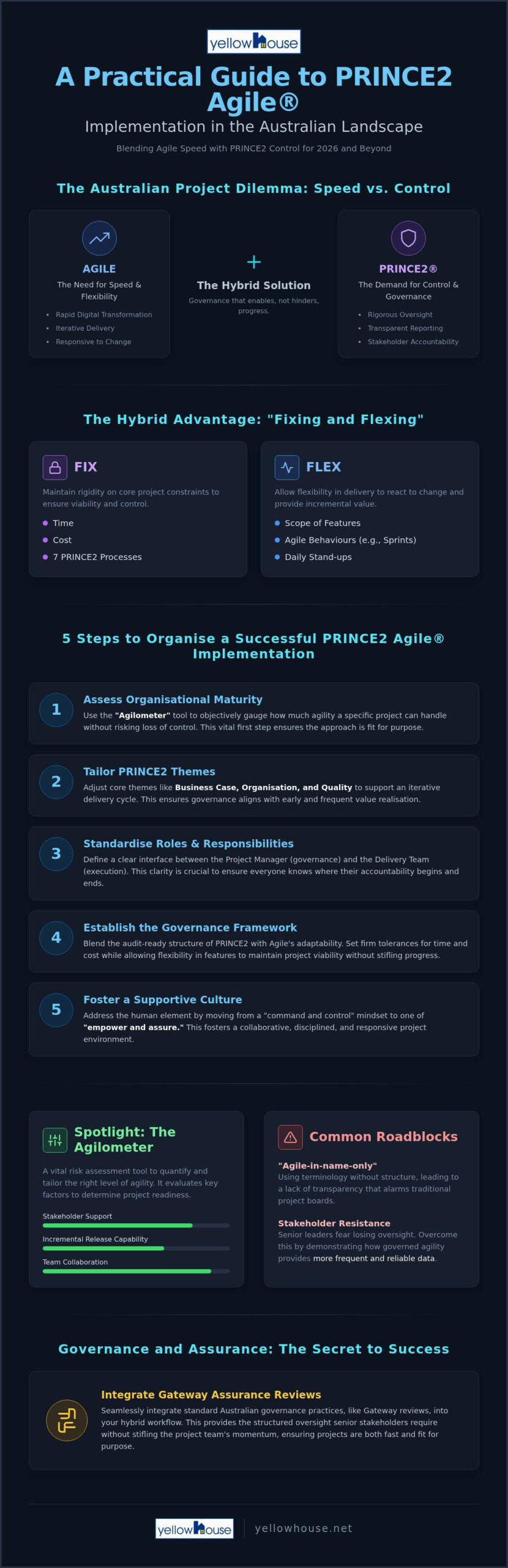
Success in the Australian corporate context often relies on the concept of “Fixing and Flexing.” This involves being rigid about project constraints like time and cost while allowing flexibility in the scope of features delivered. You maintain the 7 PRINCE2 Processes to ensure the project remains viable, but you adopt agile behaviours such as daily stand-ups and two-week sprints at the delivery level. This creates a disciplined environment that still reacts to change, ensuring that the project remains aligned with the Business Case while delivering value incrementally.
Common Implementation Roadblocks in Australia
One major trap is “Agile-in-name-only,” where teams use the terminology without the underlying structure needed to scale. This often leads to a lack of transparency that alarms traditional project boards used to rigid Waterfall milestones. Resistance frequently comes from stakeholders who fear losing oversight. Overcoming this requires demonstrating that agile delivery, when governed correctly, provides more frequent and reliable data points than traditional methods. It’s about moving from a culture of “command and control” to one of “empower and assure,” where the Project Board focuses on strategic alignment rather than micro-management. Australian project leaders who want to future-proof their credentials should also consider exploring the Praxis Framework vs PRINCE2 debate to understand which certification best supports their long-term career goals.
5 Steps to Organise a Successful PRINCE2 Agile Implementation
Transitioning to a hybrid model isn’t an overnight task. It requires a methodical approach that respects existing governance while embracing new ways of working. This PRINCE2 Agile implementation guide Australia focuses on the practical mechanics of organisational transition, ensuring your rollout is grounded in reality rather than just theory. Phase 1 begins with assessing organisational maturity. By using the “Agilometer,” you can objectively gauge how much agility a specific project can handle before it risks losing necessary control. Phase 2 focuses on tailoring the PRINCE2 Themes. You need to adjust the Business Case, Organisation, and Quality themes to support an iterative delivery cycle where value is realised early and often.
Phase 3 involves standardising roles and responsibilities. This defines the clear interface between the Project Manager and the Delivery Team, ensuring everyone knows where governance ends and delivery begins. Finally, Phase 4 establishes the governance framework. This involves blending PRINCE2 Project Management’s governance and audit-ready structure with the adaptability of agile practices. You set firm tolerances for time and cost while allowing the necessary flexibility in features. This approach ensures that the project remains viable without slowing down the delivery team.
Utilising the Agilometer for Risk Assessment
The Agilometer is a vital tool for risk assessment. It uses six sliders to evaluate factors like stakeholder support and the ability to release incrementally. By quantifying these elements, you can negotiate with senior stakeholders for the appropriate level of autonomy. It prevents the common mistake of forcing a high-agility approach on a team or environment that isn’t yet ready for it. If you’re looking to bridge the gap between theory and practice, exploring PRINCE2 Agile Training can provide the hands-on skills your team needs to lead this change effectively.
Scaling from Single Projects to the Portfolio
Scaling these practices across an organisation requires strategic alignment. Integrating your agile delivery with MoP portfolio management training ensures that every sprint contributes to the broader corporate objectives. The PMO plays a crucial role here. It supports decentralised decision-making while maintaining the “big picture” visibility that executives demand. This ensures that agility at the project level doesn’t lead to fragmentation at the portfolio level.
Governance and Assurance: The Secret to Long-Term Success
Sustainable implementation hinges on the rigour of your assurance processes. While the Agilometer helps you set the initial course, ongoing governance ensures the project doesn’t drift into chaos. Integrating Gateway Assurance is a proven way to maintain this discipline within the Australian public and private sectors. These independent reviews provide the Project Board with the confidence that agile delivery remains aligned with organisational strategy. This PRINCE2 Agile implementation guide Australia highlights that governance should be a facilitator of value, not a bottleneck for the delivery team. Measuring success in this environment requires a shift in focus. Instead of tracking rigid Waterfall milestones, teams should monitor flow metrics and the incremental delivery of business value.
The human element of implementation is just as critical as the technical process. Cultural change in Australian workplaces often meets resistance if the “why” isn’t clearly communicated. You need to foster an environment where transparency is valued and failure is seen as an opportunity for iterative improvement. Transitioning from Foundation knowledge to Practitioner expertise allows your core team to handle these cultural shifts with confidence. They become the champions of the new hybrid model, ensuring that agile behaviours are deeply embedded rather than just superficial additions to the existing workflow. For practitioners considering how their broader certification portfolio stacks up, understanding the differences in a PRINCE2 vs Praxis Framework comparison for the 2026 Australian project management landscape can help inform those strategic professional development decisions.
Ensuring Compliance through Strategic Consulting
External Gateway assurance plays a vital role in providing an unbiased perspective to senior leadership. Engaging in strategic change consulting Australia can help your organisation navigate the complexities of this transition period. These consultants act as a bridge, helping to translate agile progress into the language of corporate risk and compliance. This partnership ensures that your governance framework remains audit-ready while the team remains flexible. For those looking for more Practical Tips for Professionals, observing how other local agencies have balanced these demands can provide valuable insights.
The Path to Professional Accreditation
Leading the Future of Australian Project Delivery
The requirement for Australian organisations to deliver results at pace while maintaining strict accountability has never been more pressing. By following this PRINCE2 Agile implementation guide Australia, you can move beyond the friction of traditional versus agile delivery and create a unified, high-performing environment. Success lies in the careful calibration of the Agilometer and the integration of robust governance through independent Gateway reviews. These steps ensure that your projects remain viable while your teams stay responsive to change. It’s about creating a culture where discipline and flexibility coexist to drive meaningful business value.
Yellowhouse is committed to being your partner in this strategic transition. As an AXELOS Accredited Training Organisation, we provide the seasoned wisdom needed to bridge the gap between certification and practical organisational success. Our expert consultants bring real-world Gateway assurance experience to every engagement, offering customised in-house training options that suit the unique needs of your corporate or government team. Take the next step in your professional journey and Enrol in Accredited PRINCE2 Agile Training with Yellowhouse to lead your organisation with confidence. Your path to a more disciplined yet adaptive future starts here.
Frequently Asked Questions
Can PRINCE2 Agile be used for projects that are not IT-related in Australia?
Absolutely, PRINCE2 Agile is highly effective for non-IT projects across various Australian sectors such as construction, business transformation, and government policy development. The framework is designed to manage any project where requirements might evolve, but delivery must remain within structured boundaries. It provides a disciplined way to manage change in complex environments, ensuring that non-technical teams can still benefit from iterative delivery while maintaining the rigorous governance required by their organisations.
What is the difference between PRINCE2 Agile and traditional AgilePM?
PRINCE2 Agile is specifically designed to integrate agile delivery with the established PRINCE2 governance framework, whereas AgilePM is a standalone method based on the DSDM Agile Project Framework. For many organisations, this PRINCE2 Agile implementation guide Australia is the preferred choice because it leverages existing PRINCE2 investments while adding flexibility. While AgilePM offers a complete lifecycle for agile projects, PRINCE2 Agile excels in environments that require high levels of corporate oversight and audit-ready documentation. Those weighing their options may also benefit from reading a detailed PRINCE2 vs Praxis Framework analysis for Australian professionals in 2026 to understand whether a broader management ecosystem better suits their organisational needs.
How does PRINCE2 Agile fit with Australian Government Gateway reviews?
PRINCE2 Agile aligns seamlessly with the Australian Government Gateway review process by providing the structured evidence and documentation required for independent assurance. It ensures that agile projects maintain a clear Business Case and defined stages, which are essential for passing Gateway reviews at critical decision points. This framework allows government agencies to demonstrate that they’re managing risks effectively while still reaping the benefits of iterative delivery and rapid stakeholder feedback.
Do I need to be PRINCE2 Foundation certified before implementing PRINCE2 Agile?
You don’t necessarily need a PRINCE2 Foundation certificate to start learning, but you must hold a recognised prerequisite before sitting the PRINCE2 Agile Practitioner exam. These prerequisites include either the PRINCE2 Foundation or the PRINCE2 Agile Foundation certification. For a successful PRINCE2 Agile implementation guide Australia, we recommend that core team members hold at least one of these certifications to ensure they understand the fundamental principles of governance and agile delivery before attempting to lead a rollout.


About Post Author
