

MoP Certification Australia: The Strategic Guide to Portfolio Management in 2026
Did you know that inefficient project management processes can lead to a wastage of nearly 12% of an organisation’s total resources? For many executives and change leaders across Australia, the challenge isn’t just delivering projects on time; it’s ensuring those projects should have been started in the first place. You likely feel the constant pressure of balancing demanding “Business as Usual” tasks with the need for transformative change, often while lacking the visibility required to see which investments truly move the needle. We understand that this lack of clarity can lead to frustrated stakeholders and missed strategic targets.
Securing your MoP certification Australia allows you to master a proven framework that ensures your organisation prioritises the right initiatives to achieve its long-term goals. This strategic guide provides everything you need to know about the updated PRINCE2 Portfolio Management® (MoP) standards and the current certification landscape. We will explore how this accreditation improves organisational governance, streamlines investment appraisal, and sets you up for consistent success during Gateway reviews. By the end of this guide, you’ll have a clear roadmap for aligning your change portfolio with the strategic vision of your business.
Key Takeaways
- Understand the critical distinction between project delivery and strategic portfolio management to ensure every investment aligns with your organisation’s long-term goals.
- Navigate the two-tier journey to MoP certification Australia, progressing from foundational terminology to the practical application of the framework in complex environments.
- Learn how to bridge the gap between high-level strategy and project execution, providing the visibility needed to prioritise high-value initiatives over low-impact activities.
- Discover how to transition from theoretical knowledge to real-world organisational capability, improving governance standards and success rates in Gateway reviews.
- Master the balance between “Business as Usual” and transformative change to protect your organisation’s resources and maximise the strategic impact of your change portfolio.
What is MoP & Why it Matters for Australian Governance
Management of Portfolios (MoP) isn’t just another set of rules; it’s the strategic engine that drives effective governance within complex organisations. While many professionals pursue MoP certification Australia to bolster their career standing, the true value lies in mastering a framework designed for strategic investment and change management. Unlike delivery-focused methodologies such as PRINCE2 or MSP, MoP provides a “Strategic Viewpoint” that allows leaders to see the big picture. This involves gaining a comprehensive overview of all change activities, total costs, and cumulative implementation risks that might otherwise stay hidden in departmental silos. MoP is the methodology used to balance “Business as Usual” with organisational change to maximise ROI.
The distinction between delivery and strategy is where most organisations struggle. While projects and programmes focus on “doing things right,” Project portfolio management focuses on “doing the right things” to ensure the organisation’s limited resources aren’t spread too thin. This high-level oversight ensures that every dollar spent contributes directly to the strategic vision rather than just maintaining the status quo. Organisations seeking to sharpen this discipline can benefit from exploring strategic portfolio management Australia best practices, which outline how leading organisations are deciding which projects to accelerate and which to eliminate in 2026.
The Two Cycles of MoP: Definition and Delivery
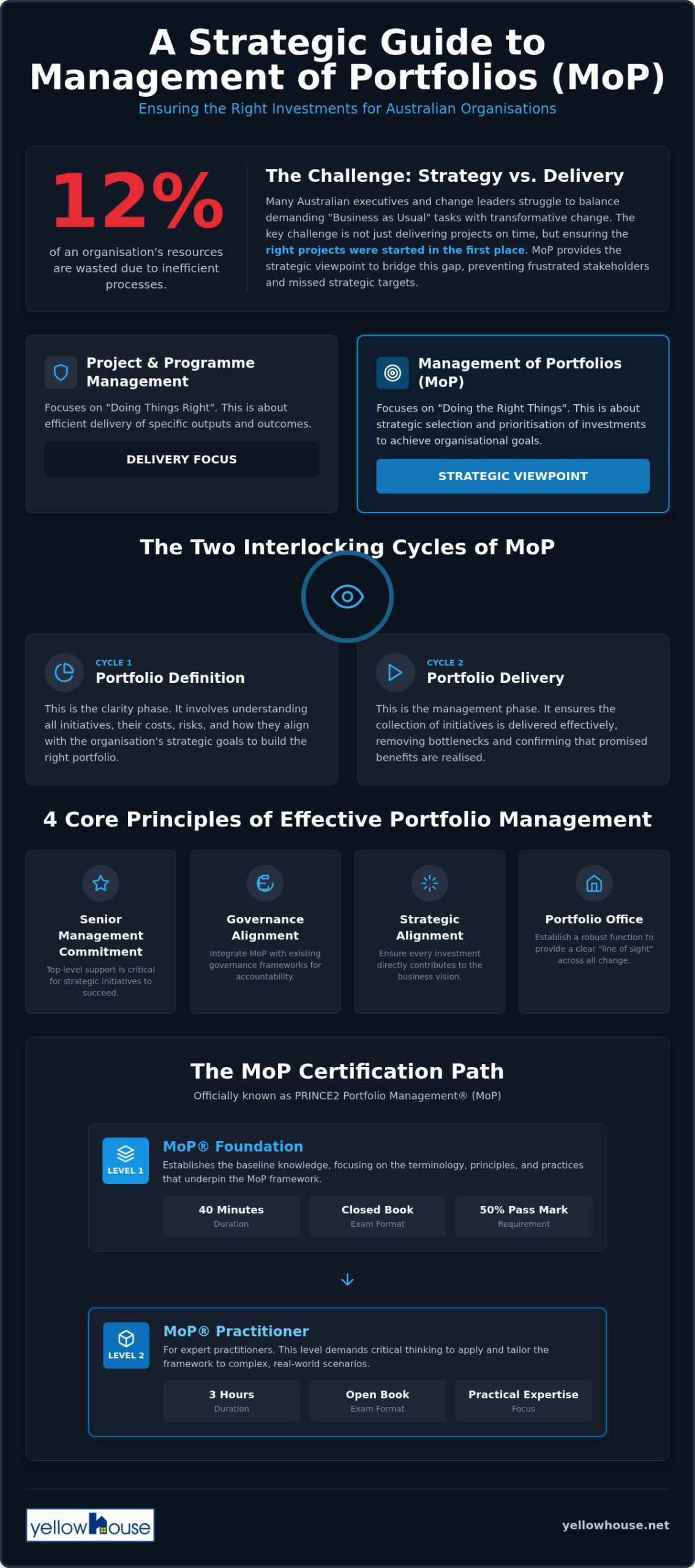
The framework operates through two continuous, interlocking cycles. The Portfolio Definition cycle is about clarity; it involves understanding exactly what initiatives are in the portfolio, what they cost, and how they align with business goals. Once the portfolio is defined, the Portfolio Delivery cycle takes over. This cycle ensures the collection of change initiatives is managed effectively as a whole, removing bottlenecks and confirming that the promised benefits are actually realised across the business.
MoP and the Australian Public Sector
Within Australian government departments, the need for transparent investment appraisal is paramount. MoP aligns perfectly with the government portfolio management framework Australia, providing a standardised language for senior leaders and decision-makers. This alignment is especially critical when preparing for independent Gateway assurance reviews. By gaining an MoP certification Australia, practitioners bring a level of rigour that satisfies both internal auditors and external stakeholders, proving that the change portfolio is both manageable and strategically sound.
The MoP Certification Path: Foundation and Practitioner Levels
Achieving a professional edge in the Australian market requires a clear understanding of the accredited path. For those pursuing MoP certification Australia, the curriculum is split into two distinct yet complementary stages that bridge the gap between theory and executive-level application. The Foundation level establishes the necessary baseline. It focuses on the specific terminology, principles, and practices that underpin the framework, ensuring candidates can identify the essential components of a healthy portfolio.
The Practitioner level demands a higher degree of critical thinking. It requires you to demonstrate an ability to apply and tailor the framework to a complex, real-world scenario. This stage is where the “Expert Practitioner” is forged, moving beyond rote learning to practical governance expertise. In 2026, the certification is officially known as PRINCE2 Portfolio Management® (MoP). All exams are conducted online through PeopleCert with a remote proctor. The Foundation exam is a 40-minute, closed-book session requiring a 50% pass mark. Once achieved, you can progress to the Practitioner exam, which is a three-hour, open-book assessment. Many professionals find that a combined training program is the most efficient way to master both levels in a single, immersive week.
The 5 Principles of Effective Portfolio Management
Success in portfolio management relies on five core principles. Senior Management Commitment is perhaps the most critical; without top-level support, strategic initiatives rarely survive the friction of daily operations. Governance Alignment is equally vital, as MoP must integrate seamlessly with existing portfolio governance frameworks to ensure accountability. Finally, Strategic Alignment and a robust Portfolio Office provide the “line of sight” needed to ensure every project delivers measurable business value.
Who Should Seek MoP Certification?
This accreditation is designed for those in formal and informal portfolio management roles. While Portfolio Managers and PMO Leads are the obvious candidates, Business Change Managers and Financial Managers also benefit significantly from the framework’s investment appraisal techniques. Earning an MoP certification Australia helps a Project Manager transition from being a simple “deliverer” of tasks to a trusted strategic advisor who understands the broader organisational context. Professionals looking to further strengthen their governance credentials may also benefit from exploring P3GP certification Australia, which addresses the structural integrity of decision-making at the executive level.
Implementing MoP: From Training to Organisational Capability
Choosing an Accredited Training Provider in Australia
Prioritise trainers who have active experience in Gateway assurance and strategic consulting. This practical background ensures they teach you how to survive a rigorous review, not just how to pass a multiple-choice test. Post-course support is another hallmark of a quality provider. Look for a partnership model that offers ongoing guidance as you begin the difficult task of implementing new governance structures within your organisation. A seasoned advisor can help you tailor the framework to your specific business context.
Next Steps for Your Professional Journey
Building a business case for your MoP certification Australia starts with highlighting the potential for resource optimisation. Show your leadership how improved portfolio visibility protects the bottom line by eliminating redundant or low-value projects. To build a truly comprehensive management skillset, consider integrating your portfolio knowledge with PRINCE2 project management. This combination ensures you understand both the high-level strategic selection and the granular delivery required for long-term organisational success.
Future-Proof Your Career and Portfolio Governance
Mastering the Management of Portfolios framework is the most effective way to ensure your organisation’s change initiatives deliver genuine strategic value. You now understand how this methodology bridges the gap between high-level vision and project execution, providing the visibility needed to prioritise high-impact investments. By following the path to MoP certification Australia, you move beyond basic project delivery to become a trusted advisor capable of navigating complex governance requirements and Gateway reviews. This shift in perspective is what separates a standard manager from a strategic leader who can balance transformative change with daily operations.
Yellowhouse is here to support your professional growth through expert-led training delivered by seasoned Australian practitioners. Our courses provide comprehensive PeopleCert exam preparation and unique insights from Gateway assurance specialists who understand the local landscape. We invite you to Enrol in Accredited MoP Training with Yellowhouse to begin your journey toward organisational excellence. Taking this step not only advances your career standing but also empowers you to lead change with confidence and precision. We look forward to partnering with you as you reach your full potential as a strategic leader.
Frequently Asked Questions
Is MoP certification worth it for individual project managers?
Yes, earning an MoP certification Australia is highly beneficial for project managers who want to transition from delivery-focused roles into senior leadership or PMO management. While traditional project management focuses on the tactical execution of tasks, MoP provides the strategic context required to understand why certain initiatives are prioritised over others. This knowledge allows you to act as a strategic advisor who can justify project existence based on organisational ROI and long-term business value.
What is the difference between MoP and P3O certification?
The primary difference lies in their focus: MoP provides the methodology for managing the change portfolio, while P3O focuses on the office structures required to support it. MoP defines the specific principles and cycles for investment appraisal and benefit realisation across the organisation. In contrast, P3O provides the blueprint for setting up the permanent or temporary office hubs that provide the administrative and technical support for projects, programmes, and portfolios.
How long does MoP certification remain valid in Australia?
Under the current PeopleCert guidelines, your certification remains valid for a period of three years from the date of issue. To maintain your status as a current practitioner, you’ll need to either retake the relevant exam before the expiry date or earn and log sufficient Continuing Professional Development (CPD) points through an AXELOS membership. This requirement ensures that all accredited professionals stay aligned with the latest global standards in portfolio management and governance.
Can I take the MoP Practitioner exam without the Foundation certificate?
No, you cannot bypass the initial stage because the MoP Foundation certificate is a mandatory prerequisite for the Practitioner level exam. You must successfully pass the Foundation assessment to demonstrate your comprehension of the core terminology and principles before attempting the Practitioner level. Most Australian candidates find it most efficient to complete both levels back-to-back in a combined course to ensure they have the best possible preparation for the final assessment.


About Post Author
