

How to Implement a Government Portfolio Management Framework in Australia (2026)
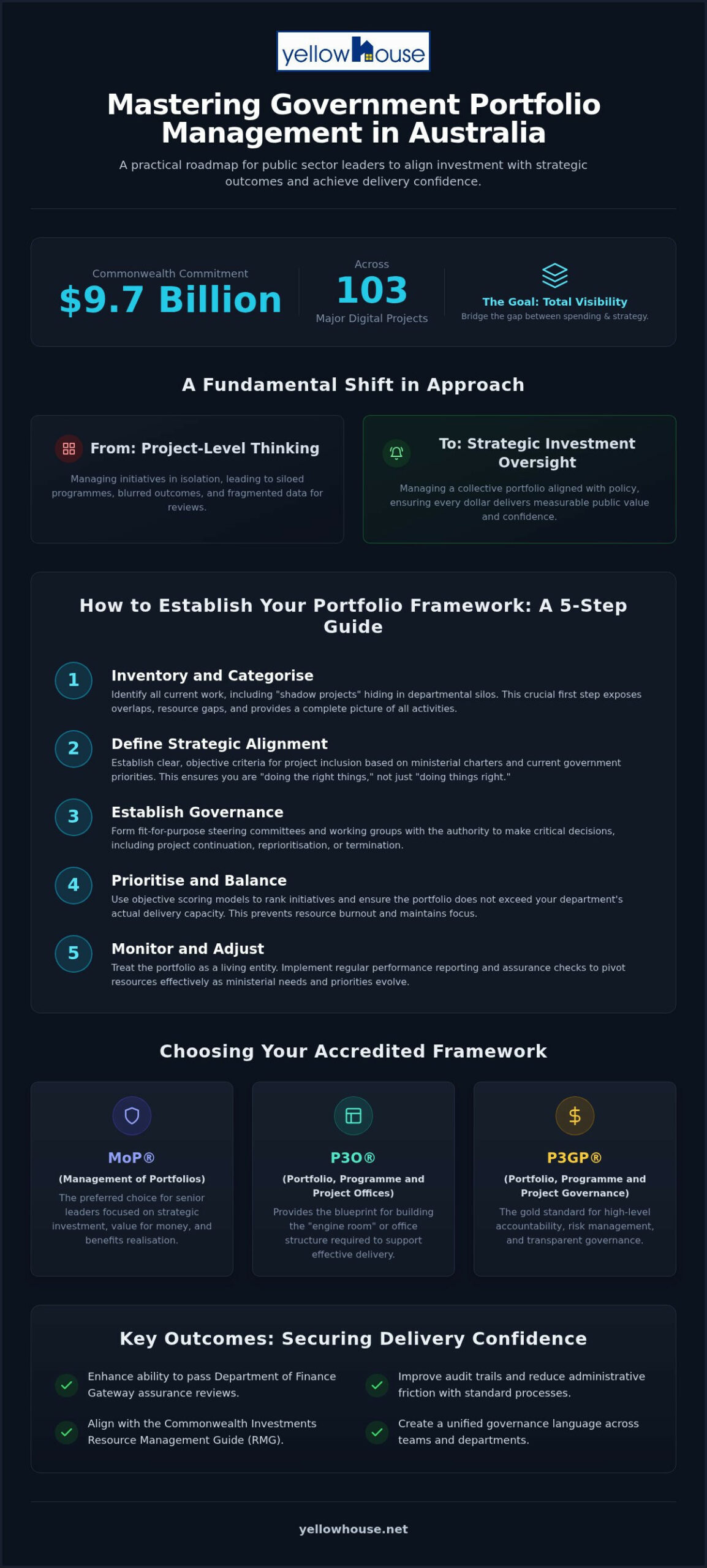
With the Australian Government managing a $9.7 billion commitment across 103 major digital projects, the margin for error in investment alignment has never been thinner. You likely feel the weight of this responsibility every time a Gateway assurance review looms or a programme remains siloed from your department’s overarching strategy. It’s a common frustration for public sector leaders when significant capital is deployed, yet the line of sight between departmental spending and strategic outcomes remains blurred.
This guide provides a practical roadmap to implement a robust government portfolio management framework Australia public sector leaders can rely on to secure delivery confidence. We’ve designed this approach to bridge the gap between high-level policy and practitioner capability. You’ll learn how to integrate accredited methodologies like MoP® and P3GP® to organise your investments, satisfy Department of Finance requirements, and ensure every dollar contributes to measurable public value. We’ll move from the foundational principles of governance to the specific steps required for successful Gateway outcomes in the current 2026 landscape.
Key Takeaways
- Shift from project-level thinking to strategic investment oversight by understanding the relationship between departmental offices and the Commonwealth Investment Framework.
- Follow a structured five-step guide to implement a government portfolio management framework Australia leaders use to categorise departmental work and eliminate overlaps.
- Align your investment decisions with current 2026 government priorities by establishing clear, criteria-based assessment models for all programmes.
- Build organisational maturity by adopting accredited best-practice frameworks such as MoP® and P3GP® to create a unified governance language across your team.
- Enhance your department’s ability to pass Gateway assurance reviews by improving audit trails and reducing administrative friction through standardised processes.
Navigating the Australian Government Portfolio Landscape
In the Australian public sector, the transition from tactical project delivery to strategic investment oversight is no longer optional. It’s a fundamental shift in how departments operate. Implementing a robust government portfolio management framework Australia wide allows leaders to stop viewing initiatives in isolation and start managing them as a collective engine for policy delivery. This approach moves beyond simply “doing things right” to ensuring the department is “doing the right things” to meet long-term objectives. It’s about total visibility.
A government portfolio is a centralised collection of programmes and projects aligned to specific ministerial priorities. Effective governance requires a seamless connection between the Commonwealth Investment Framework and individual departmental portfolio offices. In 2026, the primary driver for this alignment is “value for money”, a concept that has evolved to encompass social impact, sustainability, and long-term economic resilience. By applying established Project Portfolio Management Principles, agencies can create a transparent environment where every dollar spent is defensible against the current fiscal climate and ministerial charters.
The Critical Role of Gateway Assurance
Portfolio frameworks act as the primary evidence base for Department of Finance Gateway reviews. Without a standardised framework, gathering the data required for these high-stakes evaluations becomes a fragmented, manual chore. A well-structured portfolio office links independent assurance directly to the six key decision points in the project lifecycle, from initial business case development to post-implementation benefits realisation. This proactive approach ensures that independent gateway assurance services help identify risks before they become departmental liabilities or front-page news.
How to Establish Your Portfolio Framework: A 5-Step Guide
Building a government portfolio management framework Australia public sector agencies can effectively sustain requires a transition from ad-hoc project tracking to a disciplined, cyclical process. It isn’t merely an administrative exercise; it’s a strategic realignment of every dollar and hour spent within your department. This ensures that the “human element” of service delivery remains at the heart of technical governance.
- Step 1: Inventory and categorise. You can’t manage what you don’t see. Begin by identifying all current work, including “shadow projects” that often hide within departmental silos, to expose overlaps and resource gaps.
- Step 2: Define strategic alignment. Establish clear criteria for project inclusion based on ministerial charters and current 2026 government priorities. Citing Public Sector Strategic Management Research, this alignment is what differentiates public value from private sector profit-seeking.
- Step 3: Establish governance. Form fit-for-purpose steering committees and working groups that possess the authority to make hard decisions about project continuation or termination.
- Step 4: Prioritisation and balancing. Use objective scoring models to ensure your portfolio doesn’t exceed the department’s actual delivery capacity.
- Step 5: Monitor and adjust. Portfolios are living entities. Regular performance reporting and assurance checks allow you to pivot resources as ministerial needs evolve.
Choosing Your Framework: MoP®, P3O®, or P3GP®?
Selecting the right methodology is critical for creating a unified organisational language. MoP® (Management of Portfolios) is the preferred choice for senior leaders focused on strategic investment and benefit realisation. If your goal is to build the actual “engine room” or office structure to support delivery, P3O® provides the necessary blueprints. For those prioritising high-level accountability and transparency, P3GP® stands as the gold standard for portfolio governance. Exploring P3GP certification Australia pathways can help senior leaders understand the exact training and exam requirements needed to master these governance standards. Exploring MoP certification Australia can help your team master these selection criteria.
Aligning with the Commonwealth Investments Resource Management Guide
Your framework must remain compliant with the Resource Management Guide (RMG), specifically Parts 3 and 4. These sections mandate rigorous oversight for significant investments and high-risk initiatives. A successful implementation creates a fluid governance structure that scales based on the sensitivity of the project; this ensures that low-risk tasks aren’t strangled by red tape while high-stakes digital transformations or critical infrastructure projects—such as those requiring a Level 2 ASP like High Demand Electrical—receive the intensive scrutiny they require.
Building Organisational Capability and Governance Excellence
A policy is only as effective as the people tasked with its execution. While individual certifications provide foundational knowledge, a high-performing department requires a collective “framework language” to ensure seamless communication across all tiers of management. When every team member understands the same government portfolio management framework Australia standards, process friction decreases and the clarity of audit trails improves significantly. This shared understanding transforms a collection of disparate projects into a cohesive strategic engine.
We must move past the era of the “accidental project manager” where staff are thrust into complex roles without the necessary governance tools. Professionalising these roles ensures that accountability is not just a buzzword but a practiced discipline. Government teams often start with prince2 project management before scaling to portfolio-level governance. This progression allows for a steady build-up of organisational maturity, ensuring that as investments grow in complexity, so too does the department’s ability to manage them.
Accredited Training Paths for Public Sector Leaders
Success in the Australian public sector requires more than just theoretical knowledge; it demands practical application within specific legislative and budgetary constraints. Tailoring MoP® and P3GP® courses to these contexts ensures that senior leaders can apply best practices to real-world departmental challenges. Selecting an AXELOS accredited training provider is essential. This guarantee of quality ensures your team is learning from global standards that have been proven in diverse government environments around the world.
Continuous Improvement and Strategic Change
Data-driven portfolios allow departments to adapt to shifting political landscapes with agility. By using real-time portfolio data, leaders can drive organisational change that is grounded in evidence rather than intuition. Yellowhouse partners with departments to provide “quiet expertise” and long-term governance support. We work as collaborators to ensure your government portfolio management framework Australia implementation remains resilient, principled, and deeply committed to achieving your strategic potential.
Securing Your Department’s Strategic Future
Adopting a robust government portfolio management framework Australia public sector agencies can effectively sustain requires more than just policy documentation; it demands a deliberate shift towards transparency and collective accountability. By moving through the structured steps of inventorying work and aligning it with ministerial priorities, you ensure that every investment serves the public interest. It’s about professionalising your governance practitioners so that Gateway reviews become a validation of excellence rather than a hurdle to be overcome.
Yellowhouse stands ready to support your transition as an accredited MoP®, P3O®, and P3GP® training provider with deep expertise in Australian Government Gateway assurance. We specialise in expert-led strategic change consulting that bridges the gap between high-level policy and real-world practitioner capability. Our team acts as a business partner to help you navigate the complexities of modern governance with confidence and quiet expertise. Enquire about accredited government portfolio training and consulting to begin your organisational transformation today. You have the roadmap; now it’s time to build the capability to lead your department forward.
Frequently Asked Questions
What is the best project management certification for government employees in Australia?
PRINCE2® remains the foundational standard for project delivery across most Commonwealth and state departments. However, for those operating within a government portfolio management framework Australia context, MoP® (Management of Portfolios) is increasingly essential. It provides the strategic tools required to manage multiple initiatives and ensure they align with ministerial priorities rather than just focusing on individual project outputs. Leaders seeking to deepen their expertise can explore MoP certification Australia options for 2026 to understand the full scope of the updated standards and certification pathways available.
How does MoP® differ from the Department of Finance Gateway Review process?
MoP® is a management methodology that gives you the internal tools to run your portfolio day-to-day. In contrast, the Department of Finance Gateway Review is an external assurance process that evaluates a project or programme at specific “gates” or decision points. You use MoP® to build and manage your investments, while Gateway reviews provide the independent check to ensure those investments are on track to deliver public value.
Can we use the Praxis Framework for government portfolio management?
Yes, the Praxis Framework is an excellent choice because it integrates project, programme, and portfolio management into a single, cohesive structure. It’s already endorsed by bodies like the Queensland Government for digital and ICT-enabled initiatives. Using Praxis allows your department to adopt a unified language across all delivery tiers, which significantly reduces the administrative complexity of managing separate methodologies for different project types.
Is P3GP governance training suitable for Senior Executive Service (SES) officers?
P3GP is specifically designed for senior leaders who hold ultimate accountability for investment outcomes. It’s highly suitable for SES officers because it focuses on high-level governance rather than technical project management. This training ensures that executives have the specific tools required to oversee complex portfolios, manage strategic risk, and provide the transparency demanded by ministerial charters and the Australian public. Senior leaders can review the full P3GP certification Australia professional guide to understand the two-day training pathway, open-book exam structure, and how these standards apply to the unique demands of the Australian public sector.


About Post Author
