

PRINCE2 Certification in Australia: Foundation vs Practitioner Comparison
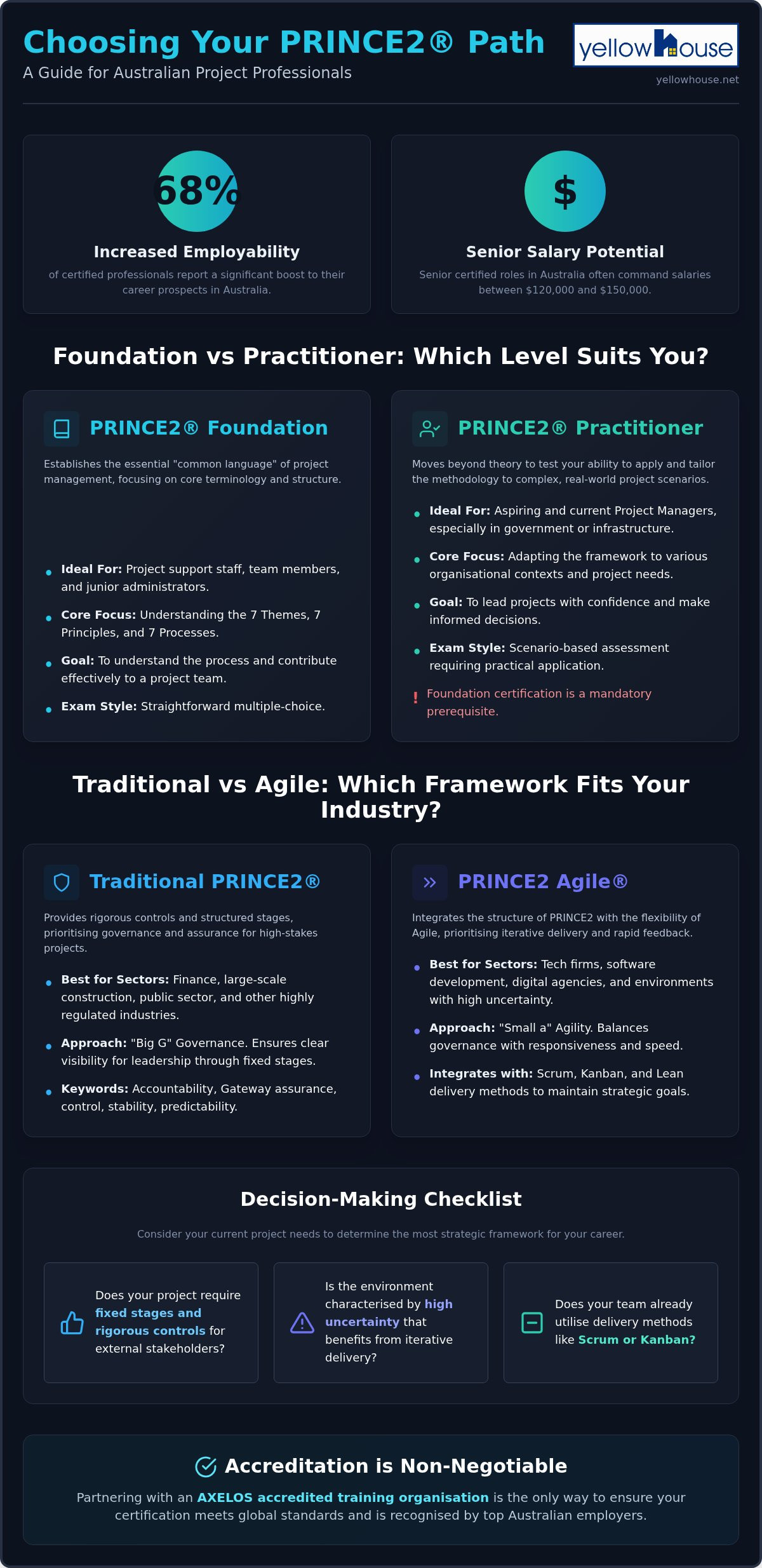
Did you know that 68% of project professionals who hold a PRINCE2 certification report a significant boost in their employability? In a competitive Australian market where senior roles often command salaries between $120,000 and $150,000, choosing the right qualification is a vital career move. We understand the confusion that often arises when comparing Foundation and Practitioner requirements. It’s even more complex when you’re trying to decide if the Agile path better suits your industry’s pace. You deserve a training partner that offers more than just exam preparation; you need a collaborator who understands how these frameworks integrate with local governance standards.
This article will help you discover which level aligns with your specific career goals and the requirements of the Australian project management landscape. We’ll provide a clear decision-making framework to help you choose between methodologies and ensure you have the confidence to select an accredited training provider that prioritises your long-term success.
Key Takeaways
- Distinguish between the structural knowledge of Foundation and the practical application of Practitioner to align your training with your current career stage.
- Evaluate the specific demands of your industry to determine if traditional governance or the PRINCE2 Agile framework provides the most strategic advantage.
- Gain clarity on how a prince2 certification influences your employability and salary expectations within the Australian project management landscape.
- Learn why partnering with an AXELOS accredited organisation is the only way to ensure your credentials meet global standards and local corporate requirements.
PRINCE2 Foundation vs Practitioner: Which Path Suits Your Career?
Selecting the right tier for your prince2 certification depends on your day-to-day responsibilities and your broader career aspirations. The Foundation level introduces you to the PRINCE2 methodology by focusing on its core terminology and structured approach. In contrast, the Practitioner level demands a higher cognitive effort; it tests your ability to apply and tailor these concepts to complex, real-world project scenarios. Choosing between them is a matter of determining whether you need to understand the process or lead it.
The Foundation Level: Establishing Methodological Groundwork
The Practitioner Level: Moving from Theory to Applied Mastery
For those aiming for roles in Australian government departments or major infrastructure projects, Practitioner status is often non-negotiable. This level proves you possess the sophisticated skills needed to adapt the PRINCE2 project management method to varying organisational contexts, making it a cornerstone of a high-level prince2 certification profile. While the Foundation exam uses a straightforward multiple-choice format, the Practitioner exam is an objective-testing, scenario-based assessment. It requires you to make informed decisions based on a specific project case study.
Passing the Foundation exam is a mandatory prerequisite before you can attempt the Practitioner level. Many Australian professionals find it most efficient to undertake an integrated programme that combines both levels into a single week of intensive learning. This approach allows you to move rapidly from basic understanding to professional mastery, ensuring you’re ready to lead projects with confidence. It’s a strategic investment that reflects a commitment to excellence in the Australian project management landscape.
Choosing the Right Framework: PRINCE2 vs PRINCE2 Agile
The choice between traditional PRINCE2 and PRINCE2 Agile often hinges on the balance your organisation requires between “Big G” governance and “Small a” agility. Traditional methodology provides the rigorous controls necessary for high-stakes environments, whereas the Agile variant prioritises iterative delivery and rapid feedback loops. In Australia, market demand reflects this functional split. Highly regulated sectors, such as finance and large-scale construction, still view the traditional prince2 certification as the gold standard for project assurance. Conversely, tech firms and digital agencies are surging toward the Agile framework to maintain a competitive edge in innovation hubs.
To determine which path aligns with your current project needs, consider this brief decision-making checklist:
- Does your project require fixed stages and rigorous controls to satisfy external stakeholders?
- Is the project environment characterised by high uncertainty that benefits from iterative delivery?
- Does your team already utilise delivery methods like Scrum or Kanban?
Many Australian enterprises now adopt a hybrid approach. They utilise the traditional PRINCE2 framework to manage overarching governance and business case alignment, while delivery teams employ agile techniques to produce specific outputs. This allows for flexibility without compromising accountability. If you’re looking to refine your team’s approach, consulting with an accredited trainer can help you identify the most effective path forward.
When to Stick with Traditional PRINCE2 Governance
For high-risk, high-budget initiatives where Gateway assurance and strict accountability are non-negotiable, traditional PRINCE2 remains the superior choice. It ensures that senior leadership maintains clear visibility through every stage of the project lifecycle. This structured approach creates a powerful synergy with P3GP governance training; it provides the robust framework required for complex organisational change and public sector projects.
The PRINCE2 Agile Advantage: Navigating Rapid Change
PRINCE2 Agile is specifically engineered for environments that demand speed and responsiveness. It integrates the overarching project structure with the flexibility of Scrum, Kanban, and Lean concepts. This ensures that while the delivery remains fast, the project never loses sight of its strategic goals. It’s becoming the preferred prince2 certification for digital transformation projects across Australia, where requirements often evolve based on user feedback and market shifts.
Selecting an Accredited Training Partner in Australia
Securing your professional future requires more than just a certificate; it demands a partnership with a provider that understands the practicalities of delivery. You must ensure your chosen training partner is an AXELOS accredited training organisation (ATO). This accreditation is the only way to guarantee that your prince2 certification is recognised by employers across the globe and within the Australian public and private sectors. Without this verified status, you risk investing time and resources into a qualification that lacks the necessary professional weight.
Beyond the Exam: The Value of Practitioner-Led Training
Yellowhouse integrates real-world Australian project scenarios directly into the learning environment. By mirroring the challenges you actually face on the ground, we help you transition from theoretical knowledge to practical, high-stakes application. You don’t just learn the rules; you learn how to use them to drive project success.
Ensuring Compliance and Long-Term Success
A robust prince2 certification is a powerful asset when navigating Gateway assurance reviews. These independent assessments are a staple of Australian government projects, and your ability to demonstrate methodological compliance is often the difference between a project’s continuation or its halt. You should view this qualification as the foundation of a much larger professional journey. Once you’ve mastered the project level, you can further enhance your strategic value by exploring MSP® for programmes or MoP® for portfolio management, ensuring your career remains on a trajectory of constant growth.
Elevate Your Career with Strategic Project Mastery
Navigating the decision between Foundation and Practitioner levels is a pivotal step in refining your professional identity. You now have a clearer understanding of how each tier supports different roles within the Australian project management landscape. While the Foundation level establishes a robust methodological base, the Practitioner level ensures you possess the applied mastery required for senior leadership and complex governance environments. Aligning your choice with the specific demands of your industry, whether through traditional frameworks or agile variants, ensures your skills remain relevant and highly sought after.
A prince2 certification is most effective when backed by the guidance of those who’ve managed high-stakes projects themselves. Yellowhouse is an AXELOS Accredited Training Provider specialising in Gateway assurance and strategic change. Our team operates as your supportive partner, offering expert-led training that bridges the gap between theory and real-world implementation. We focus on the human element of project management, ensuring you gain the confidence to lead effectively.
View our Accredited PRINCE2 Training Courses and Start Your Certification Journey
We look forward to helping you achieve your goals and lead your projects with newfound clarity and purpose.
Frequently Asked Questions
Is the PRINCE2 certification worth it in Australia for 2026?
Yes, achieving this qualification remains a strategic move for 2026, as 68% of qualified professionals report a marked improvement in their employability. In the Australian market, a prince2 certification is often a prerequisite for senior roles in government and infrastructure where salaries typically range between $120,000 and $150,000. It provides a globally recognised benchmark of competence that reassures employers you can manage projects with discipline and professional rigour.
How long does it take to complete the PRINCE2 Foundation and Practitioner courses?
Most professionals complete the Foundation level in three days, while the Practitioner level usually requires a further two days of intensive training. Many Australian providers offer an integrated five-day programme that allows you to complete both certifications within a single working week. This condensed format is highly effective for practitioners who want to move quickly from learning core terminology to applying the methodology in real-world scenarios.
Do I need to renew my PRINCE2 certification periodically?
You must renew your Practitioner status every three years to ensure your skills stay aligned with current industry standards like the PRINCE2 7th Edition. Maintaining a current prince2 certification demonstrates your commitment to professional growth and your understanding of evolving project governance requirements. You can maintain your status by retaking the exam or through a subscription that tracks your continuing professional development points over the three-year cycle.
Can I take the PRINCE2 Practitioner exam without the Foundation certificate?
No, you cannot attempt the Practitioner exam without first passing the Foundation level or holding a recognised equivalent qualification. The Foundation exam is a mandatory prerequisite because it ensures you’ve mastered the essential language and structure of the framework. This foundational knowledge is critical for success in the Practitioner assessment, which focuses on your ability to apply and tailor those concepts to complex project case studies.
What is the difference between PRINCE2 and PMBOK in the Australian market?
The main difference is that PRINCE2 is a process-based methodology while PMBOK is a broad body of knowledge. In Australia, PRINCE2 is the preferred standard for governance and accountability, particularly within public sector departments and highly regulated industries. While PMBOK offers a vast library of tools and techniques, PRINCE2 provides the specific “how-to” steps for managing project stages, making the two frameworks highly complementary when used together in a hybrid environment.


About Post Author
