

Implementing Change Management Frameworks in Australia: A Strategic Guide
Table of Contents
-
Defining Strategic Change Management Frameworks in Australia
-
A 5-Step Roadmap for Implementing Frameworks in Your Organisation
Defining Strategic Change Management Frameworks
In a professional context, implementing change management frameworks is not merely about introducing new processes; it involves the systematic application of structured methodologies to transition individuals, teams, and entire organisations from a current state to a desired future one. The goal is to manage the human side of change, ensuring that new initiatives deliver their intended value with minimal resistance and disruption.
In Australia, leading organisations rely on a portfolio of globally recognised, best-practice frameworks. While project and programme management standards like Managing Successful Programmes (MSP®) are essential for delivering the technical components of change, they are most effective when paired with a dedicated people-centric methodology. The premier standard in this domain is the APMG Change Management™ framework, which provides the tools to manage human responses and secure buy-in. For organisations seeking a fully integrated model, the Praxis Framework™ offers a comprehensive and unified structure.
Australian organisations, particularly in the public sector, are increasingly moving towards these ‘government-endorsed’ standards to enhance accountability, transparency, and benefits realisation. This signifies a shift from simple tool usage to an ‘Expert Practitioner’ approach—an integrated strategy where change is managed as a core business capability, not an afterthought.
Why Global Standards need an Australian perspective
Adopting a global best-practice framework is only the first step. True success lies in localising these standards to fit the unique Australian corporate and regulatory landscape. Global methodologies must be aligned with local corporate governance requirements and stringent assurance processes, such as the federal and state-based Gateway review processes. Regulatory bodies like the Australian Prudential Regulation Authority (APRA) also impose specific compliance demands that influence how change is governed, particularly in the financial services sector. For organisations in the life sciences sector, you can visit APS Compliance Consultants Inc. to ensure transformation projects meet rigorous GMP and validation standards. This local adaptation ensures that a framework is not just theoretically sound but practically effective within an Australian context.
The Intersection of Project Management and Strategic Change
A common point of confusion for leaders is the distinction between project outputs and change outcomes. A project might successfully deliver a new IT system (an output), but the change is only successful when employees proficiently use that system to improve productivity (an outcome). This is where project management and change management intersect. Frameworks like PRINCE2® manage the controlled delivery of outputs, while the APMG Change Management methodology ensures those outputs are embedded and embraced by the people they affect. Effective organisational governance advisory in Australia serves as the pillar that connects these disciplines, ensuring that both the technical and human elements of a transformation are managed cohesively for lasting success.
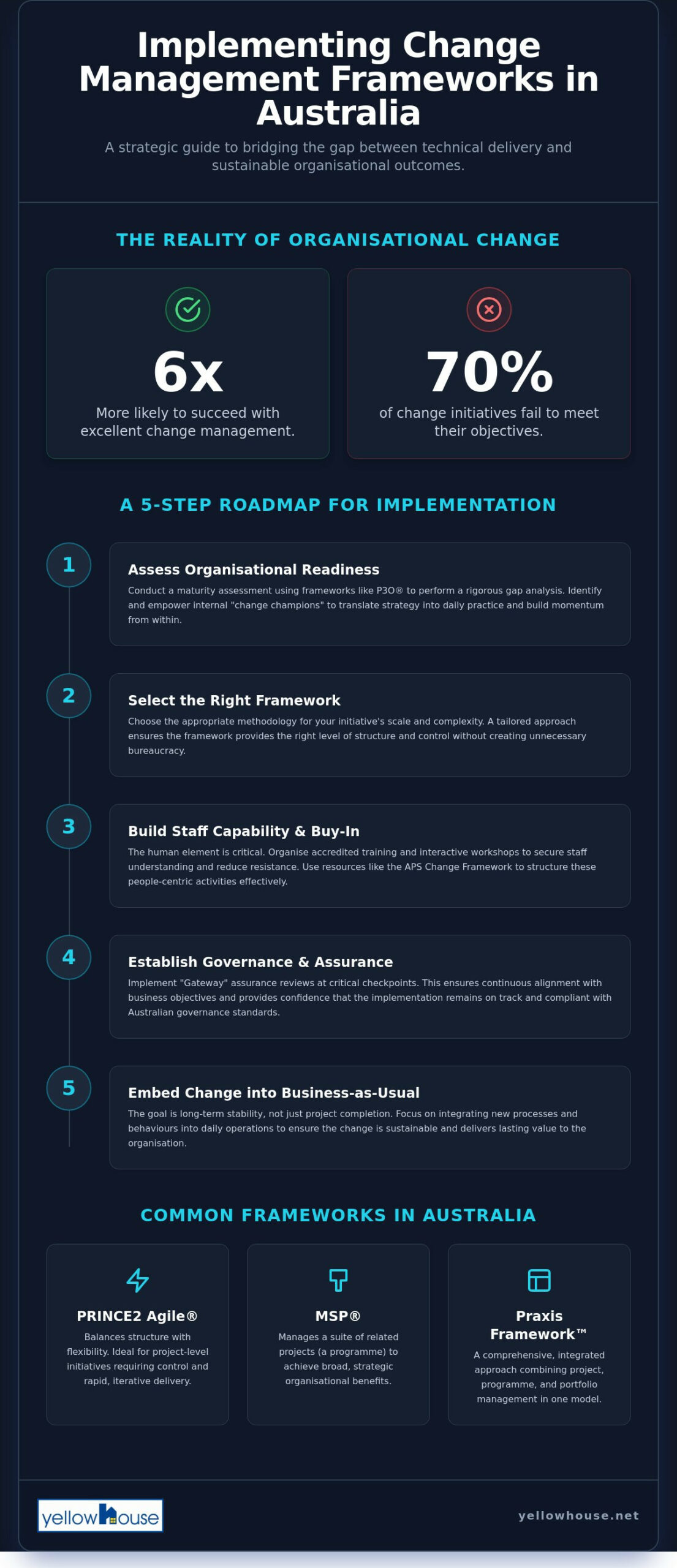
A 5-step roadmap for implementing frameworks in your organisation
Introducing a new management framework requires a deliberate and structured sequence of actions. This roadmap provides a clear path for leaders to follow, balancing strategic direction with practical, people-focused execution. The approach combines essential top-down sponsorship from leadership with the bottom-up capability building needed to make change stick.
-
Assess Organisational Readiness: Before implementation, conduct a thorough analysis of your organisation’s current state. This involves evaluating your existing change maturity, identifying key stakeholders, and pinpointing potential ‘change champions’ who can advocate for the new approach.
-
Select and Tailor the Right Framework(s): Choose the framework that best aligns with the scale and nature of your change. This may involve a combination of methodologies to address different aspects of the transformation.
-
Develop a Communication and Engagement Plan: The ‘human element’ is paramount. Design a comprehensive plan to communicate the ‘why’ behind the change. Organise workshops, Q&A sessions, and training to address concerns, build understanding, and ensure staff buy-in from the outset.
-
Execute with Pilot Programs and Training: Begin with a pilot project to test the framework in a controlled environment. Use this phase to provide accredited training, allowing teams to build practical skills and a common language for managing change.
-
Measure, Embed, and Assure: Establish clear metrics to track progress and benefits. Use checkpoints, such as Gateway reviews, to ensure the implementation stays on track and delivers its intended value. The final goal is to embed the new ways of working into the business-as-usual (BAU) environment.
Phase 1: Assessing Organisational Readiness
The first phase is a critical diagnostic step. It involves conducting a gap analysis to measure the distance between your organisation’s current capabilities and the desired future state. Frameworks like P3O® (Portfolio, Programme, and Project Offices) can provide a structured model for assessing your existing support structures. During this phase, it is crucial to map your stakeholders, understand their influence and interest, and identify individuals who can act as enthusiastic advocates or ‘change champions’ within their respective teams.
Phase 2: Selecting the Right Framework for the Job
Not all frameworks are interchangeable; the right choice depends on your specific needs. For discrete, project-level initiatives, a methodology like PRINCE2 project management provides unparalleled control over delivery. For broader business transformations involving multiple projects, MSP® offers the rigour to manage a coordinated programme of change. Crucially, the APMG Change Management framework should be integrated alongside these to specifically manage the people-side of the transition—addressing impacts, readiness, and cultural adoption. For smaller Australian enterprises or those seeking an all-in-one solution, the Praxis Framework™ provides a unified and adaptable approach covering project, programme, and portfolio management.
Ensuring long-term success and governance
Successful implementation is not a one-off event; it is the beginning of a sustained effort to embed new capabilities into the fabric of the organisation. The ultimate goal is to shift from temporarily ‘implementing’ change to permanently ’embedding’ it within the business-as-usual (BAU) environment. This requires a long-term commitment to governance, continuous improvement, and professional development.
Positioning strategic change as a core competency for modern Australian leaders ensures that the organisation remains agile and resilient. It involves creating a culture where change is viewed not as a threat, but as a constant opportunity for growth. To truly capitalise on these opportunities, SME entrepreneurs often seek support from experts like Full Potential, who provide the training and consulting necessary to realise their long-term growth ambitions.
The Role of Gateway Assurance in Change Success
For high-risk, high-value initiatives, particularly within the public sector, independent assurance is non-negotiable. This is where the Gateway Review process plays a pivotal role. Acting as a critical friend, Gateway review consultants provide an objective, independent lens to validate implementation progress at key decision points. These reviews are not audits; they are forward-looking assessments designed to identify potential issues early and provide actionable recommendations. The benefits are clear: Gateway reviews significantly de-risk major Australian projects and programmes, increasing their likelihood of success by ensuring they remain aligned with strategic objectives and are on track to deliver their promised benefits.
Building Internal Capability through Training
The most sustainable way to ensure long-term success is to build a self-sufficient internal capability for managing change. Organisations should invest in accredited training for their staff in globally recognised frameworks like APMG Change Management™, PRINCE2®, and MSP®. This investment does more than just upskill individuals; it creates a shared, professional language for change across the entire organisation, breaking down silos and fostering collaboration between technical project teams and business-as-usual functions. Accredited certification acts as a quality benchmark for Australian management professionals, providing a clear standard of knowledge and competence that organisations can trust.
Frequently Asked Questions (FAQs)
What is the most common change management framework used in Australia?
While project management frameworks like PRINCE2® are widespread for delivering the technical aspects of change, the APMG Change Management™ framework is the globally recognised standard specifically for managing the ‘people side’. Australian organisations often use a hybrid approach, combining a delivery framework (like PRINCE2® or Agile) with a people-focused framework (like APMG’s) to ensure a holistic and successful transformation. Yellowhouse | Change Management


About Post Author
