

The Essential Guide to PRINCE2 Project Management in Australia (2026)
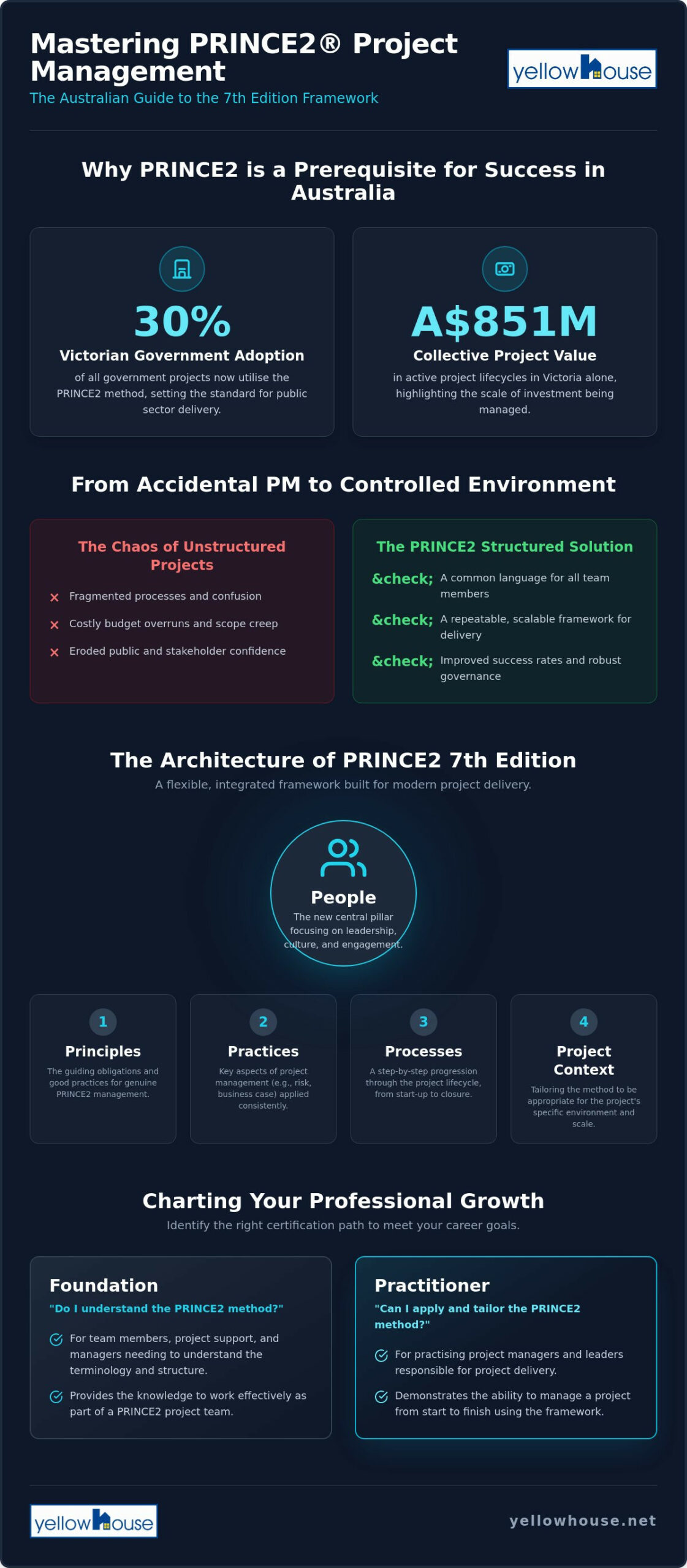
In Victoria, 30% of all government projects now utilise the PRINCE2 method, representing a collective A$851 million in active project lifecycles. This widespread adoption highlights why mastering prince2 project management is no longer just an advantage; it’s a prerequisite for leading strategic change in Australia’s complex corporate and public sectors. You’ve likely felt the pressure of delivering high-stakes outcomes while wrestling with fragmented processes or the confusion caused by shifting methodologies.
We understand that project success relies on more than just a manual. It requires a balance of rigorous governance and the human element. This guide provides the clarity you need to master the PRINCE2 7th Edition, ensuring you can implement a repeatable structure that improves success rates and helps your organisation speak a common language. We’ll explore the latest certification paths, the 2026 updates to the APS framework, and how to apply these globally recognised principles within the Australian market.
Key Takeaways
- Master the four integrated elements of the PRINCE2 7th Edition to create a tailored, flexible framework for any project environment.
- Discover how to integrate prince2 project management with Australian governance and Gateway assurance to provide the steering for your project engine.
- Identify the specific certification path, whether Foundation or Practitioner, required to meet your professional development goals and improve project success rates.
- Understand why the human element and strategic change are now central to the latest evolution of the PRINCE2 methodology.
Navigating Complexity: Why PRINCE2 Project Management is Vital for Australian Organisations
Effective project delivery is the engine of strategic change, yet many Australian organisations still struggle with inconsistent results. The PRINCE2 project management method, which stands for PRojects IN Controlled Environments, offers a structured solution to this volatility. It has evolved from a static manual into a living professional standard that adapts to the unique needs of modern business. By focusing on a process-based approach, it provides a clear roadmap for navigating the complexities of high-stakes delivery.
The cost of project failure in the Australian corporate and government sectors is staggering. In Victoria alone, the lifecycle cost of active projects using this methodology is A$851 million, representing a significant investment of taxpayer and shareholder funds. When projects fail, the damage extends beyond the balance sheet; it erodes organisational momentum and public confidence. Utilising prince2 project management creates a common language for teams. This shared terminology allows professionals from diverse backgrounds to collaborate seamlessly, ensuring everyone understands their roles, responsibilities, and the project’s ultimate objectives.
The Problem PRINCE2 Solves: Moving Beyond Accidental Project Management
Many Australian businesses rely on “accidental project managers” who have been promoted due to their technical expertise rather than their delivery experience. While these individuals are highly skilled in their fields, they often lack the formal tools to manage complex lifecycles. This absence of structure frequently leads to budget overruns and scope creep, where the project’s goals expand without a corresponding increase in resources. PRINCE2 introduces a “controlled environment” that serves as a safety net for innovation. It doesn’t restrict creativity; instead, it provides the boundaries within which teams can take calculated risks while ensuring the business case remains valid.
Why Australian Government and Industry Standardise on PRINCE2
Standardisation is the key to reliability and scalability across large-scale programmes. PRINCE2 is the benchmark for government-endorsed project delivery in 2026. This alignment is essential for organisations that interact with the Australian Public Service (APS) or state government bodies. For instance, the Queensland Government mandates a project assurance framework that integrates PRINCE2 principles into its Gateway review process. When organisations commit to prince2 project management training, they aren’t just buying a certificate; they’re investing in a methodology that has been refined by decades of real-world application. Using a repeatable framework makes Gateway reviews and assurance processes significantly smoother, ensuring that governance adds value rather than just creating administrative hurdles.
The Architecture of Success: Understanding the PRINCE2 7th Edition Framework
The release of the 7th Edition in late 2023 marked a definitive shift in how we approach prince2 project management. It’s no longer just about rigid checklists; it’s the current gold standard for project professionals who need to deliver results in a volatile market. This latest version is built upon four integrated elements: principles, practices, processes, and the project context. By understanding how these components interact, organisations can create a bespoke delivery environment that remains stable yet flexible enough to handle unexpected changes.
Perhaps the most significant evolution in this edition is the elevation of “People” to a central pillar of the framework. Previous versions focused heavily on mechanics, but the 7th Edition recognises that projects are delivered by humans, for humans. It addresses leadership, team culture, and stakeholder engagement as critical success factors. This human-centric approach is vital for Australian teams where collaboration and soft skills are increasingly prioritised alongside technical competence. Developing these skills through accredited training helps practitioners move beyond theory into effective application.
Tailoring remains the heart of the methodology. It ensures that the framework is never “too big” for a small project or “too light” for a massive infrastructure rollout. In the Australian landscape, where we see everything from lean tech startups to billion-dollar mining operations, the ability to scale the method ensures it remains fit-for-purpose and agile.
The 7 Principles: The Guiding Obligations of Every Project
Principles are the bedrock of the methodology; they are non-negotiable obligations that must be applied for a project to be considered a true PRINCE2 endeavour. These include “Continued Business Justification,” which ensures a project only proceeds if it remains viable, and “Learn from Experience,” which prevents the repetition of past mistakes. A practical Australian example of “Manage by Exception” can be seen in corporate hierarchies where a Project Board sets specific tolerances. For instance, a Project Manager at a Sydney-based financial firm might have a A$20,000 budget tolerance. If a change exceeds this amount, it is automatically escalated, allowing senior leadership to focus only on critical deviations rather than day-to-day minutiae.
Practices and Processes: The Engine Room of Delivery
Practices (formerly known as Themes) such as Business Case, Risk, and Quality provide the specific tools required to support the project throughout its life. This focus on robust practices aligns with the standards set by the Australian Governance and Gateway Assurance framework, which ensures that public sector investments are managed with transparency. The engine room is further powered by seven distinct processes, moving from “Starting up a Project” through to “Closing a Project.” The “Directing a Project” process is particularly vital as it empowers senior leadership to provide high-level oversight and make key decisions without becoming bogged down in technical delivery details.
Beyond the Certificate: Integrating PRINCE2 with Australian Governance and Gateway Assurance
A certification confirms knowledge, but the true value of prince2 project management lies in its integration into broader organisational governance. While the project manager focuses on delivery, the Project Board provides the critical link to strategic objectives, ensuring the initiative remains aligned with the business’s long-term vision. This is where the concept of P3GP (Project, Programme, and Portfolio Governance) becomes essential. If PRINCE2 is the engine of delivery, P3GP acts as the steering mechanism. It provides the oversight and decision-making framework that prevents projects from drifting off course or losing their business justification.
This “steering” is particularly relevant in the Australian landscape, where government departments and large corporations often face intense scrutiny. Using a structured project management method ensures that every decision is documented and every risk is accounted for. It transforms the project from a black box into a transparent process that senior leadership can trust. This transparency is the foundation of high-performance delivery, allowing for accountability without stifling the project team’s ability to innovate.
PRINCE2 and the Gateway Review Process
In the Australian public sector and large-scale infrastructure, Gateway reviews are a mandated reality. These independent assessments occur at key decision points to ensure a project is viable and ready to progress. A robust framework provides the documentary evidence auditors require during these high-pressure evaluations. For instance, the Project Initiation Documentation (PID) serves as a primary source of truth, outlining the project’s purpose, costs, and risks in a format that is universally understood. By maintaining standard management products, teams can significantly reduce the administrative burden and stress associated with independent assurance, as the required evidence is a natural byproduct of the delivery process.
The Human Element: Leading Change, Not Just Managing Tasks
The 7th Edition explicitly addresses the “People” element, recognising that stakeholder engagement is not a peripheral activity but a core requirement for success. Modern prince2 project management practitioners must be leaders who can foster a collaborative team culture and manage the complexities of human behaviour. This focus on culture and leadership is what allows a project to transition from simply hitting technical milestones to delivering genuine strategic change. When stakeholders feel heard and involved through structured communication practices, the resistance to change decreases, and the likelihood of achieving the intended benefits increases. This human-centric approach ensures that the “engine” of the project is powered by a motivated and aligned team.
Charting Your Professional Growth: PRINCE2 Foundation vs Practitioner Certification
Selecting the appropriate certification level is a strategic decision that should align with your current role and long-term career aspirations. While both levels are integral to the same methodology, they serve distinct purposes in your professional development. In 2026, the PeopleCert requirements for the 7th Edition have become more rigorous to reflect the high standards of modern delivery. Both Foundation and Practitioner exams now require a pass mark of 60%, and the Practitioner certification must be renewed every three years to ensure your expertise remains current with evolving best practices. For a detailed breakdown of how each level compares, our guide on PRINCE2 certification in Australia: Foundation vs Practitioner comparison provides a clear decision-making framework tailored to the Australian market.
PRINCE2 Foundation: Building the Core Vocabulary
The primary goal of the Foundation level is to ensure you have a comprehensive grasp of the terminology and the structure of the framework. It provides the necessary foundation for anyone involved in a project environment, ensuring that the entire team speaks a common language. The exam format is a 60-minute, closed-book, multiple-choice assessment that tests your knowledge and recall of the principles, practices, and processes. This level is ideal for new project managers, team members, and stakeholders who need to understand how their work fits into the broader project lifecycle without necessarily being responsible for the overall management of the project.
PRINCE2 Practitioner: Mastering the Art of Application
Once you have mastered the core vocabulary, the Practitioner level challenges you to demonstrate that you can apply and tailor the methodology to a specific project scenario. This is an objective testing exam that allows you to refer to the official manual, reflecting the real-world reality where project professionals use resources to make informed decisions. It tests your ability to analyse complex situations and determine the most effective management approach. Practitioner status is highly regarded by Australian recruiters because it serves as a verified indicator that you possess the practical expertise required to navigate high-stakes delivery. In a competitive job market, this level of certification signals to employers that you can manage by exception and protect the business case under pressure.
If you are ready to elevate your career and lead with confidence, explore our PRINCE2 certification paths to find the right training for your professional goals.
Elevating Capability: Why Accredited Training with Yellowhouse Makes the Difference
Yellowhouse operates as a trusted partner in your professional development. We combine the formal rigour of accredited training with an approachable, empathetic delivery style that respects the complexities of the Australian corporate environment. As an Australian-owned organisation, we pride ourselves on our “Expert Practitioner” philosophy. This means your training is delivered by seasoned professionals who’ve actually done the work and faced the same hurdles you encounter daily. Mastering prince2 project management through this lens ensures you gain more than just a certificate; you gain the seasoned wisdom required to lead strategic change with confidence.
We’re committed to a partnership approach that prioritises the human element within a technical industry. Every project exists within a unique business context, and our training reflects this reality by focusing on how to tailor the framework to suit your specific goals. By choosing AXELOS accredited training with us, you’re investing in long-term career credibility that’s recognised by major employers and government bodies across the country. We don’t just deliver a service; we collaborate with you to ensure your professional growth translates into tangible organisational results and a distinct competitive advantage.
Tailored Learning for Modern Professionals
Busy Australian schedules require flexible solutions that don’t sacrifice quality. We offer a variety of delivery options designed to fit your professional life, whether you prefer intensive workshops or structured online learning. Our curriculum is fully updated to include the PRINCE2 7th Edition, ensuring you’re equipped to handle modern project challenges like sustainability and digital data management. We focus on supporting your transition from theory to workplace application, providing the specific tools you need to implement structured processes immediately upon returning to your team.
A Holistic Approach to Organisational Excellence
PRINCE2 is often the foundation of a much larger professional roadmap. As your responsibilities grow, you might find the need to explore MSP for programme management or MoP for portfolio management to ensure total strategic alignment. We also specialise in P3O for project offices and P3GP for governance, providing a comprehensive ecosystem of best practices. This methodical progression allows you to build a sophisticated toolkit for managing change at every level of the organisation. Starting your journey here ensures you have a consistent, high-quality path toward reaching your full potential. Enquire about our upcoming PRINCE2 courses and start your journey with Yellowhouse today.
Leading with Confidence in the Australian Project Landscape
Success in our evolving economic environment requires a sophisticated blend of structured methodology and authentic leadership. By embracing the 7th Edition’s focus on people and tailoring, you ensure your projects remain resilient against the risks of budget overruns and shifting priorities. We’ve discussed how prince2 project management provides the common language necessary for cross-sector collaboration, especially when integrated with local governance standards and Gateway assurance. This framework serves as a living professional standard that empowers you to lead with clarity.
Selecting the right partner for your certification is vital for translating theory into tangible workplace results. As an AXELOS Accredited Training Organisation, Yellowhouse provides expert-led courses delivered by seasoned Australian practitioners who understand your specific context. We offer comprehensive support for the latest 7th Edition updates, ensuring you’re ready for the challenges of 2026 and beyond. View our accredited PRINCE2 training calendar and secure your place today. Your journey toward project excellence starts with a single step, and we’re here to walk it with you.
Frequently Asked Questions
Is PRINCE2 still relevant in 2026 with the rise of Agile?
PRINCE2 remains a cornerstone of effective delivery because it provides the governance structure that many Agile methods lack. In 2026, the 7th Edition is specifically designed to be “Agile-ready,” allowing organisations to maintain a controlled environment while teams use flexible delivery techniques. It’s not a matter of choosing one over the other; it’s about using prince2 project management to provide the steering and oversight that Agile teams need to stay aligned with strategic goals.
What are the main differences between PRINCE2 6th Edition and the 7th Edition?
The 7th Edition, released in late 2023, introduces “People” as a central pillar, acknowledging that project success depends on leadership and culture. It also incorporates three new management approaches: digital and data, sustainability, and commercial. Additionally, the pass mark for both Foundation and Practitioner exams has increased to 60% to reflect a higher standard of professional competency. These updates ensure the framework addresses modern project challenges like environmental impact and data security.
How long does it take to get PRINCE2 certified in Australia?
A standard Foundation certification course usually takes two to three days of intensive training. If you’re aiming for the Practitioner level, you’ll typically need an additional two days to master the application of the framework. Most Australian professionals choose a five-day combined programme to complete both certifications in a single working week, though self-paced online options are also available for those with busier schedules.
Do I need project management experience to take the PRINCE2 Foundation course?
No, there are no formal prerequisites or experience requirements for the Foundation level. It’s designed as an entry-level course that’s accessible to anyone involved in a project environment, including team members and administrative staff. The goal is to build a core vocabulary and understand the framework’s structure. It’s an excellent starting point for those looking to transition into a project role or improve their understanding of prince2 project management terminology.
Can I take the PRINCE2 Practitioner exam without the Foundation certificate?
Generally, you must pass the Foundation exam before you can sit the Practitioner level. However, PeopleCert recognises certain external qualifications as valid prerequisites. If you already hold a current Project Management Professional (PMP) or Certified Associate in Project Management (CAPM) certification, you may be eligible to skip the Foundation course and proceed directly to Practitioner. It’s important to verify your specific credentials with your training provider before enrolling.
How much does PRINCE2 certification cost for an individual in Australia?
Certification costs in Australia vary depending on whether you choose a classroom-based workshop, a virtual instructor-led course, or a self-paced online programme. Fees typically include the cost of the training, the official PRINCE2 manual, and the PeopleCert exam voucher. Because prices fluctuate based on current PeopleCert requirements and delivery modes, we recommend checking our current training calendar for the most accurate and up-to-date investment details for your chosen path.
Is the PRINCE2 exam conducted online or in person?
While you can attend training in a physical classroom in many Australian cities, the exams themselves are now almost exclusively conducted online via PeopleCert’s proctoring system. This allows you to take the exam from your home or office at a time that suits you. You’ll need a computer with a webcam and a stable internet connection, as a live proctor will monitor your session to ensure the integrity of the assessment process is maintained.
What is the pass mark for the PRINCE2 Practitioner exam?
The pass mark for the PRINCE2 7th Edition Practitioner exam is 60%. This means you must correctly answer 42 out of 70 questions within the two-and-a-half-hour time limit. The exam is an objective testing format and is “open book,” meaning you’re permitted to refer to your official PRINCE2 manual during the session. This higher pass mark ensures that practitioners can demonstrate a genuine ability to apply and tailor the methodology to complex scenarios.


About Post Author
