

PRINCE2 vs PRINCE2 Agile Difference: Which Framework Suits Your Australian Project?
The more structured option isn’t automatically the less adaptable one. If you’re weighing the PRINCE2 vs PRINCE2 Agile difference, it’s understandable to wonder which certification fits your role. Australian government projects and technology teams can have very different delivery needs. Agile isn’t limited to software, and PRINCE2 isn’t simply a rigid, step-by-step method.
The right choice depends on how your project needs to balance governance, control and responsive delivery. This guide compares PRINCE2 Project Management (Version 7) with PRINCE2 Agile (Version 2), explains where each may fit and outlines what to check before choosing a certification. Use the comparisons to assess your role, your organisation’s expectations and the way your team delivers work.
Key Takeaways
- Understand the PRINCE2 vs PRINCE2 Agile difference by comparing governance needs with the flexibility your delivery team requires.
- Consider how roles, controls and documentation can work alongside agile ways of working.
- Assess your industry, workplace and career goals before choosing which framework to study.
- Check whether you need a PRINCE2 Foundation qualification first, rather than assuming it’s a prerequisite for PRINCE2 Agile Foundation.
The Fundamental Architecture: Governance vs. Delivery Flexibility
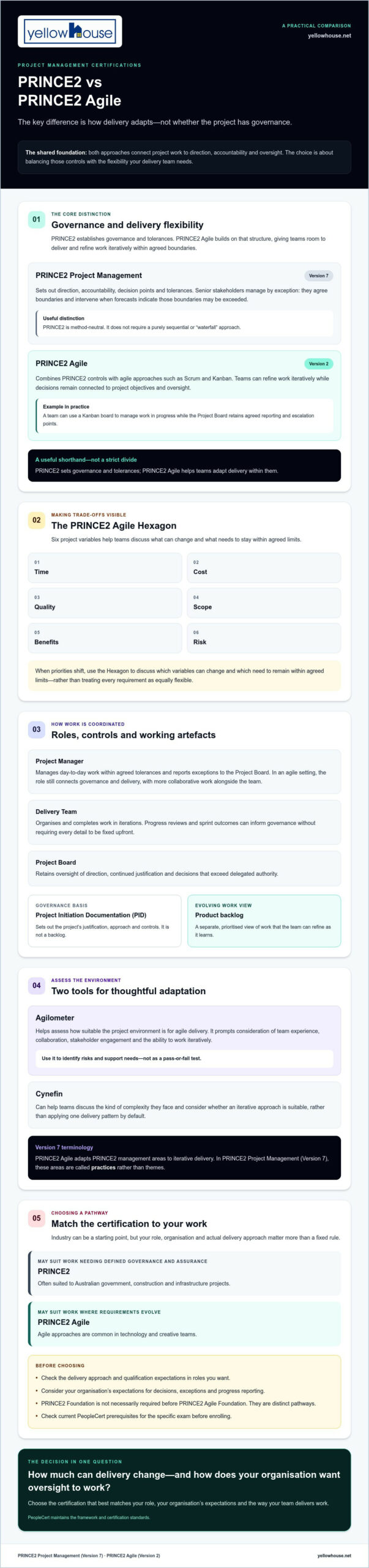
The central PRINCE2 vs PRINCE2 Agile difference is how each framework accommodates delivery, not whether it provides governance. PRINCE2 sets out direction, accountability, decision points and tolerances. Senior stakeholders manage by exception: they agree boundaries, then intervene when forecasts indicate those boundaries may be exceeded. PRINCE2 is also method-neutral, so using it doesn’t require a purely sequential or “waterfall” approach. For background on its principles and structure, see this overview of the PRINCE2 methodology.
PRINCE2 Agile builds on that governance rather than replacing it. It combines PRINCE2 controls with agile approaches such as Scrum and Kanban, giving teams room to deliver and refine work iteratively while keeping decisions connected to project objectives and oversight. For example, a team might use a Kanban board to manage work in progress while the project board retains agreed reporting and escalation points.
Understanding the ‘Agile’ Layer in Project Management
PRINCE2 Agile draws on the Agile Manifesto’s emphasis on collaboration, working solutions and responding to change. Its Hexagon frames six project variables: time, cost, quality, scope, benefits and risk. Teams can use this model to make trade-offs deliberately, rather than treating every requirement as equally flexible. When priorities shift, it helps project leaders discuss which variables can change and which need to stay within agreed limits.
This is governance with agility: decision-makers retain visibility and control, while delivery teams learn through short cycles and adapt their work. PeopleCert maintains the framework and certification standards. Its PRINCE2 Agile guidance applies this combined approach. Organisations and professionals can explore PRINCE2 Agile training to understand how the framework supports that balance.
In practice, “fixed versus flexible” is a useful shorthand, not a strict divide. PRINCE2 establishes governance and tolerances; PRINCE2 Agile helps teams adapt delivery within the agreed boundaries. When comparing the two, ask how much delivery can change during the project and how the organisation wants decisions, exceptions and progress reported.
Key Differences in Roles, Processes, and Documentation
The PRINCE2 vs PRINCE2 Agile difference becomes clear in how people coordinate delivery. In PRINCE2, the Project Manager manages day-to-day work within agreed tolerances and reports exceptions to the Project Board. In an agile setting, the Project Manager still connects governance and delivery, but works more collaboratively with the team. The Delivery Team organises and completes work in iterations; the board retains oversight of direction, continued justification and decisions that exceed delegated authority.
Documentation also adapts. The Project Initiation Documentation (PID) remains an important basis for project governance, but it shouldn’t be mistaken for a backlog. The PID sets out the project’s justification, approach and controls. A product backlog is a separate, prioritised and evolving view of work that the team can refine as it learns. Progress reviews and sprint outcomes can inform governance without requiring every detail to be fixed upfront.
The Agilometer helps assess how suitable a project environment is for agile delivery. It prompts consideration of factors such as team experience, collaboration, stakeholder engagement and the ability to work iteratively. Use it to identify risks and areas needing support, not as a pass-or-fail test. If the assessment highlights gaps, consider what support or changes the team needs before relying on iterative delivery.
How PRINCE2 Agile Tailors the Seven Themes
PRINCE2 Agile adapts PRINCE2’s management areas to iterative delivery. For example, teams can manage change by refining and reprioritising backlog items between sprints while keeping agreed objectives and controls visible. Progress can be reviewed through completed increments and regular checkpoints, alongside the project’s wider reporting. In PRINCE2 Project Management (Version 7), these areas are called practices rather than themes.
Cynefin can help teams discuss the kind of complexity they face and consider whether an iterative approach is suitable, rather than applying one delivery pattern by default. For curriculum details, explore Yellowhouse’s PRINCE2 Agile course.
Selecting the Right Path for Your Career and Organisation
The PRINCE2 vs PRINCE2 Agile difference matters most when you match the certification to your work, not just your industry. PRINCE2 is often suited to Australian government, construction and infrastructure projects that need defined governance and assurance. Agile approaches are common in technology and creative teams, where requirements may evolve. These are useful starting points, not fixed rules. Check the delivery approach and qualification expectations in roles you want.
You don’t necessarily need PRINCE2 Foundation before taking PRINCE2 Agile Foundation. They’re distinct certification pathways, so check the current PeopleCert prerequisites for the specific exam before enrolling. The frameworks can also complement each other across a wider change environment: PRINCE2 provides project governance, while the Praxis Framework offers an integrated view of project, programme and portfolio management.
Aligning Certification with Australian Industry Standards
For public-sector work, PRINCE2’s governance practices can support clear oversight and evidence during Gateway assurance reviews. They don’t replace an organisation’s review requirements. PeopleCert Plus membership can support certification renewal through ongoing professional development: eligible PRINCE2 certifications can be renewed by logging 20 CPD points annually and maintaining membership. Check PeopleCert’s current renewal conditions. This option may be relevant whether you work in Brisbane, Sydney, Melbourne, Canberra, Adelaide, Perth, Cairns, Townsville, Hobart, Darwin, Mackay, the Gold Coast, Logan, Ipswich or Toowoomba.
Next steps:
- Review job descriptions and your organisation’s preferred framework.
- Choose PRINCE2 for a focus on structured project governance, or PRINCE2 Agile for governance alongside agile delivery.
- Check exam prerequisites and renewal requirements with PeopleCert.
- For public-sector roles, clarify how the project method fits existing Gateway assurance processes.
Yellowhouse provides accredited PRINCE2 and PRINCE2 Agile training for professionals considering how to apply these frameworks in their project context. For related public-sector assurance support, explore its Gateway assurance review services.
Choose the Framework That Moves Your Work Forward
The PRINCE2 vs PRINCE2 Agile difference comes down to the balance your work needs: structured project governance, or governance alongside adaptive delivery. Neither is automatically the better choice. Consider your organisation’s expectations, the way your team delivers work and the direction you want your career to take.
Both frameworks can support accountable project delivery, while PRINCE2 Agile offers an approach for teams working iteratively. The right training can help you turn that understanding into practical decisions for your projects and stakeholders.
Yellowhouse provides accredited training in project, programme and portfolio management frameworks, as well as strategic change consulting and Gateway assurance services. This gives learners and organisations options to build framework capability or seek support with broader governance needs.
Ready to take the next step? Explore PRINCE2 and PRINCE2 Agile training with Yellowhouse and choose a learning path that fits your role and project context.
Frequently Asked Questions
What is the main difference between PRINCE2 and PRINCE2 Agile?
The main difference is how they approach delivery: PRINCE2 provides project governance and controls, while PRINCE2 Agile combines that structure with agile ways of working. The PRINCE2 vs PRINCE2 Agile difference isn’t a choice between control and no control. PRINCE2 Agile helps teams adapt delivery while maintaining oversight, defined responsibilities and alignment with project objectives.
Can I take PRINCE2 Agile if I already have a PRINCE2 Foundation certificate?
Yes. A PRINCE2 Foundation certificate gives you useful knowledge, but you don’t need it as a prerequisite for PRINCE2 Agile Foundation. If you’re considering a higher-level PRINCE2 Agile exam, check PeopleCert’s current eligibility requirements, as prerequisites can depend on the specific qualification. Choose the pathway that matches your experience and the certification level you’re aiming for.
Is PRINCE2 Agile better than traditional PRINCE2 for software development projects?
Not automatically. PRINCE2 Agile may suit software projects where teams deliver iteratively and need to respond to changing requirements while retaining project-level governance. Traditional PRINCE2 can also support software development because it’s not limited to one delivery method. Consider how your organisation manages priorities, oversight and team delivery, then check which approach best fits the project and role.
Which certification is more highly regarded in the Australian government sector?
PRINCE2 is widely recognised in Australia, particularly in the public sector, but the preferred certification depends on the agency, role and project. Check relevant job descriptions and internal requirements rather than assuming one qualification is always preferred. Yellowhouse provides training for professionals in Brisbane, Sydney, Melbourne, Canberra, Adelaide, Perth, Cairns, Townsville, Hobart, Darwin, Mackay, the Gold Coast, Logan, Ipswich and Toowoomba.


About Post Author
