

PMO Implementation Plan for Australian Organisations
What if a PMO earned its place by improving decisions, not producing more reports? For Australian organisations, that starts with building the PMO around the choices leaders need to make. A clear PMO implementation plan can establish purpose and executive expectations before governance expands, helping teams avoid adding processes that create work without practical value.
The concern is reasonable: roles, processes, measures and stakeholder engagement can be difficult to sequence when the PMO’s remit is unclear. This article sets out a staged, adaptable roadmap, from securing sponsorship and defining responsibilities to measuring value and engaging stakeholders. You’ll learn how to shape governance around your organisation’s needs and build a PMO model that can evolve as those needs change.
Key Takeaways
- Start with the organisational problems the PMO needs to address, such as prioritisation, visibility or consistent delivery.
- Build your PMO implementation plan in stages, with a clear owner, decision and tangible output for each stage.
- Use proportionate governance and clear role boundaries to support better decisions without adding unnecessary administration.
- Set review points to check whether PMO services, measures and responsibilities still fit your organisation’s needs.
PMO implementation plan: define the purpose before designing the office
A PMO implementation plan is a roadmap for establishing the office’s purpose, governance, capability and measures. Begin with the decisions the organisation needs to make better, not a preferred structure or reporting template. Leaders might need a clearer view of competing initiatives, more consistent delivery information or a reliable way to prioritise work against strategic goals. Those needs determine what the PMO should do and what value it must demonstrate.
Identify the problems with the people closest to them. Executives may want confidence in investment choices, project teams may need practical guidance, and stakeholders may need clearer visibility of progress. Agree on an executive sponsor who can champion the mandate and resolve competing expectations. Then specify which decisions the PMO will inform, who has authority to make them and what evidence those decision-makers need. For example, if leaders are deciding which initiatives to fund, clarify what information they need to compare priorities and who is responsible for providing it.
How should an organisation define its PMO mandate?
Separate the office’s purpose from its label. A PMO might provide support, set controls or direct aspects of delivery. These are design choices, not fixed stages on a maturity ladder. The right balance depends on decision rights, organisational capability and the level of consistency required. A Project Management Office (PMO) can take different forms, so define its customers and intended outcomes before settling its name or structure.
A PMO mandate states why the office exists, whom it serves and what authority it holds; an implementation plan explains how to establish and sustain that mandate. Keep the initial agreement focused on these points. Yellowhouse’s P3O® training can help build capability in portfolio, programme and project offices, but it shouldn’t dictate one universal model. Design for the decisions your organisation needs to improve, then shape roles and services around that purpose.
Build a PMO implementation plan in stages, from readiness to measurable value
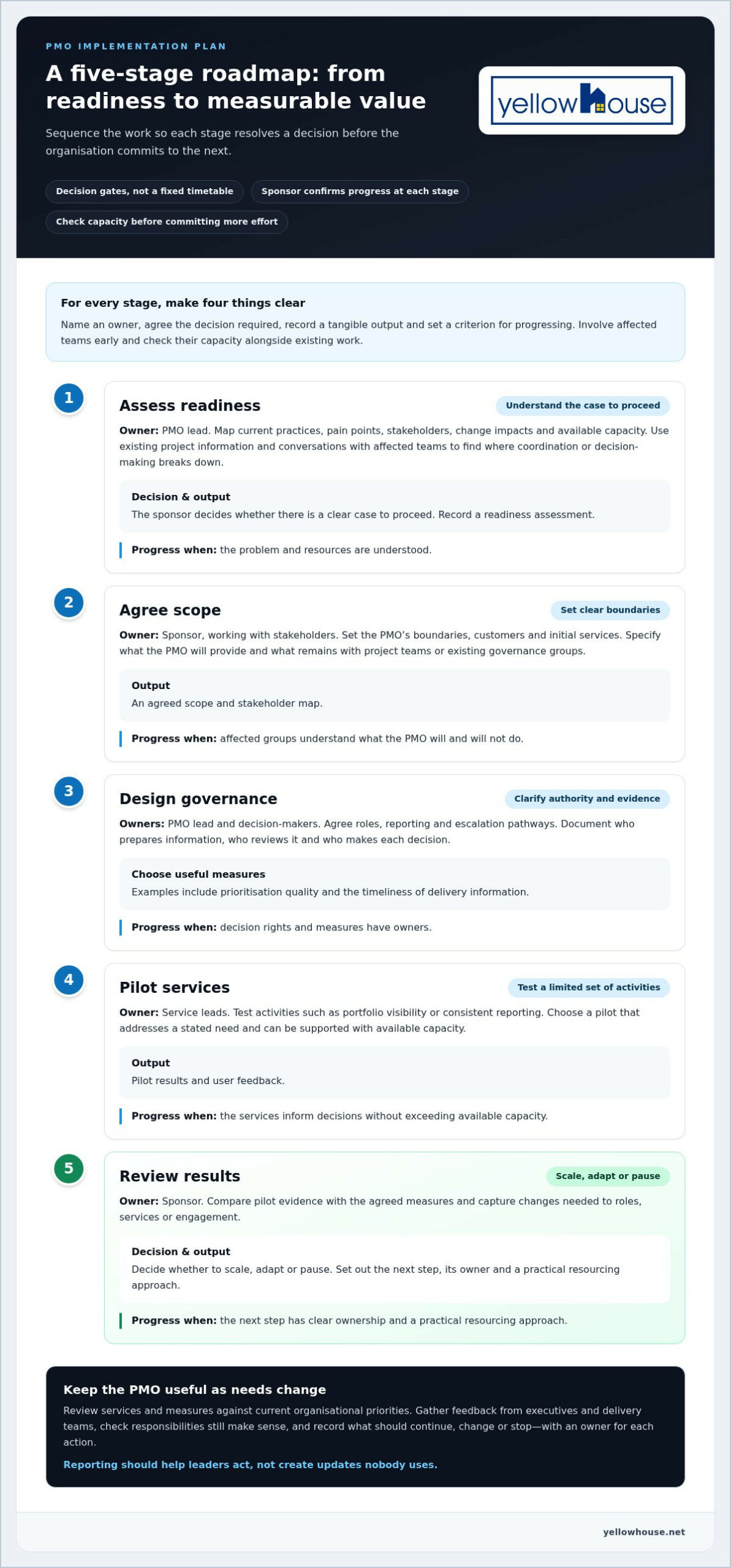
Sequence the work so each stage resolves a decision before the next begins. For every stage, name an owner, agree the decision required, record a tangible output and set a progression criterion. Involve affected teams early, and check their capacity to contribute alongside existing work. This makes it easier to spot gaps before they become design problems, such as assigning a reporting responsibility without agreeing who maintains the underlying information.
What should each PMO implementation stage deliver?
Use these stages as decision gates, not a fixed timetable. The sponsor should confirm progress before the organisation commits more people and effort.
- Assess readiness. The PMO lead maps current practices, pain points, stakeholders, change impacts and available capacity. Use existing project information and conversations with affected teams to identify where coordination or decision-making breaks down. The sponsor decides whether there’s a clear case to proceed. The output is a readiness assessment; progress when the problem and resources are understood.
- Agree scope. The sponsor works with stakeholders to set boundaries, customers and initial services. Be specific about what the PMO will provide and what remains with project teams or existing governance groups. The output is an agreed scope and stakeholder map; proceed when affected groups understand what the PMO will and won’t do.
- Design governance. The PMO lead and decision-makers agree roles, reporting and escalation pathways. Document who prepares information, who reviews it and who makes each decision. Choose a small set of useful measures, such as prioritisation quality or the timeliness of delivery information. Progress when decision rights and measures have owners.
- Pilot services. Service leads test a limited set of activities, such as portfolio visibility or consistent reporting. Choose a pilot that addresses a stated need and can be supported with available capacity. The output includes pilot results and user feedback; scale when the services inform decisions without exceeding available capacity.
- Review results. The sponsor decides whether to scale, adapt or pause. Compare pilot evidence with the agreed measures and capture changes to roles, services or engagement. Progress when the next step has clear ownership and a practical resourcing approach.
For teams building office capability, Yellowhouse’s P3O training in Australia can support a considered approach to PMO roles and services.
Make the PMO sustainable with governance, capability and review
A PMO stays useful when its governance remains proportionate to the decisions it supports. Keep accountability clear: define who prepares information, who challenges assumptions and who makes the decision. Reporting should give leaders enough insight to act, not create updates that nobody uses. If a report or meeting no longer informs a decision, review its purpose before adding another process.
Build regular review points into the PMO implementation plan. At each review, compare services and measures with current organisational priorities, gather feedback from executives and delivery teams, and check whether responsibilities still make sense. For instance, if a portfolio view helps leaders compare initiatives but teams struggle to maintain its data, revisit both the information required and who owns it. Record what should continue, change or stop, and assign an owner to each action.
How can leaders keep a PMO valuable as priorities change?
Test value through evidence and conversation. Are PMO outputs helping decision-makers prioritise, resolve issues or understand delivery? Do stakeholders find the information relevant, and do agreed outcomes still reflect organisational needs? Use the answers to adjust services and capability rather than treating the original design as permanent.
Connect learning to the work the PMO actually performs. Project, programme or portfolio training can strengthen role-specific capability, while recognised frameworks offer useful reference points without prescribing one structure for every organisation. Where leaders need an independent perspective on delivery or governance, Yellowhouse’s Gateway assurance reviews can provide a relevant assurance option. Keep the cycle simple: review evidence, agree changes, clarify ownership and revisit whether the PMO is helping the organisation make better decisions.
Turn your PMO direction into lasting capability
A PMO should keep pace with the organisation it serves. Treat your implementation plan as a working commitment that can adapt as priorities shift, new delivery challenges emerge and teams build confidence in their responsibilities. The next step is to identify the capability your people need to put the model into practice, then invest in learning that fits their project, programme or portfolio roles.
Yellowhouse provides training in PeopleCert frameworks, including PRINCE2®, MSP®, MoP® and P3O®, alongside strategic change consulting and Gateway assurance. Yellowhouse supports organisations and learners in Brisbane, Sydney, Melbourne, Canberra, Adelaide, Perth, Cairns, Townsville, Hobart, Darwin, Mackay, Gold Coast, Logan, Ipswich and Toowoomba. Explore Yellowhouse project, programme and portfolio management training to build the capability behind your PMO. With clear intent and relevant learning, your PMO can grow into a practical partner for better organisational decisions.
Frequently Asked Questions
What does PMO stand for in project management?
PMO stands for project management office. It describes an organisational function that helps coordinate or oversee project work, though its remit varies. One office may provide templates and advice, while another has portfolio-level responsibilities. The title alone doesn’t indicate its authority or services, so consider it alongside the organisation’s reporting lines and project decision processes.
Can a small organisation implement a PMO gradually?
Yes. A small organisation can start with a few useful practices rather than establish a fully staffed office. For example, a project lead could maintain a shared initiative register and facilitate regular prioritisation discussions. A PMO implementation plan can identify what to trial and what evidence would justify adding more coordination as workload or project complexity grows.
How many people should a PMO have?
There’s no standard headcount. Staffing depends on the PMO’s responsibilities, the number and complexity of projects it supports, and the capacity already available across the organisation. A small office might begin with one person coordinating information alongside another role, while broader assurance or portfolio responsibilities may call for additional capability. Define the work before setting the team size.
Can an organisation manage projects effectively without a PMO?
Yes. A dedicated PMO isn’t essential if project leads can access suitable methods, maintain useful records and escalate decisions through existing channels. For instance, a smaller business may manage a handful of internal improvements through team leaders and a shared project register. Consider a PMO if coordination gaps or competing demands become difficult to address through those arrangements.


About Post Author
