

Skills for a Programme Manager: Capabilities That Turn Strategy into Change
A programme can deliver every project on time and still miss the change it was meant to achieve. That’s why the skills for a programme manager go beyond schedules and status reports: they connect interdependent work to strategic outcomes and keep intended benefits in view.
It’s easy to confuse programme leadership with project control, especially when decisions, dependencies and teams span several workstreams. The distinction matters: project managers focus on delivering project outputs, while programme managers coordinate related projects and change activities towards wider benefits.
This article explores the leadership, governance and delivery capabilities that help programme managers align work with strategy, manage risk, engage stakeholders and make informed decisions. You’ll see how these skills work together, how to develop them through workplace experience and structured learning, and how MSP programme management training can support your development.
Key Takeaways
- Build the skills for a programme manager by balancing strategic leadership with governance, stakeholder engagement and delivery oversight.
- Align work with intended outcomes, coordinate dependencies, manage uncertainty and review whether benefits are emerging.
- Practise programme skills on live work, seek specific feedback and use the results to decide what to strengthen next.
- Structured MSP learning can support your development, while sound judgement, communication and applied experience remain essential.
What skills does a programme manager need to turn strategy into change?
Strategy becomes change through coordinated action. A programme manager brings related projects and change activities together, keeping them focused on a shared outcome rather than treating each as a separate undertaking.
Project management delivers a defined project; programme management coordinates related projects and change so they contribute to shared strategic outcomes and benefits. A project manager focuses on the scope, schedule, resources and risks of an individual project. A programme manager looks across the work, manages dependencies and helps decision-makers respond when one workstream affects another. The Program management overview provides further background on the discipline and its distinction from project management.
Which core capabilities distinguish programme leadership?
Strategic alignment means checking that proposed work still supports the intended outcome. Systems thinking helps identify dependencies and wider impacts. Sound judgement helps a programme manager weigh competing priorities and recommend where attention or resources are most needed.
These skills for a programme manager also depend on people. Clear communication helps teams understand decisions and how their work fits together. Stakeholder engagement builds shared understanding, brings concerns to the surface early and supports decisions across groups with different interests.
Governance, risk awareness and benefits focus reinforce one another. Governance clarifies who makes decisions, when issues should be escalated and how oversight works. Risk awareness helps the programme anticipate threats to delivery or outcomes. Benefits focus keeps attention on whether the change is producing its intended value. Together, these capabilities help programme managers guide progress without mistaking completed project outputs for realised benefits. Structured learning, such as MSP programme management training, can help build this capability alongside workplace experience.
How do programme manager skills work across governance, delivery and benefits?
Programme skills work as a connected cycle, not a checklist. The programme manager aligns intended outcomes, engages stakeholders, coordinates dependencies, manages uncertainty and reviews whether benefits are emerging. Each step informs the next: a delivery change may call for a decision, a revised plan or a fresh assessment of expected value.
Benefits management connects programme activity to intended outcomes by defining the value sought, tracking whether it is emerging and guiding action when results fall short. For a deeper explanation, explore this benefits management approach.
How can a programme manager apply these skills in practice?
Hypothetical Australian organisational change: a regional organisation is changing how it handles customer enquiries through process redesign, a new digital system and staff training. The programme manager clarifies the intended improvement, then works with service teams, technology staff and decision-makers to map dependencies. If training depends on the redesigned process, communication and negotiation can help resolve competing priorities and agree a workable sequence.
Governance gives the team a clear route for escalating decisions, reviewing risks and resolving issues that cross project boundaries. It supports timely action and keeps trade-offs connected to the intended outcome, rather than letting each workstream optimise only its own delivery.
After implementation, the programme manager reviews evidence, such as whether enquiries are being handled more consistently, investigates gaps and agrees follow-up action. This keeps attention on realised change, not just completed outputs.
To strengthen the practical skills for a programme manager, combine workplace experience with structured MSP learning. Yellowhouse’s MSP programme management training provides a structured way to develop programme management capability.
How can you develop programme manager skills and apply them at work?
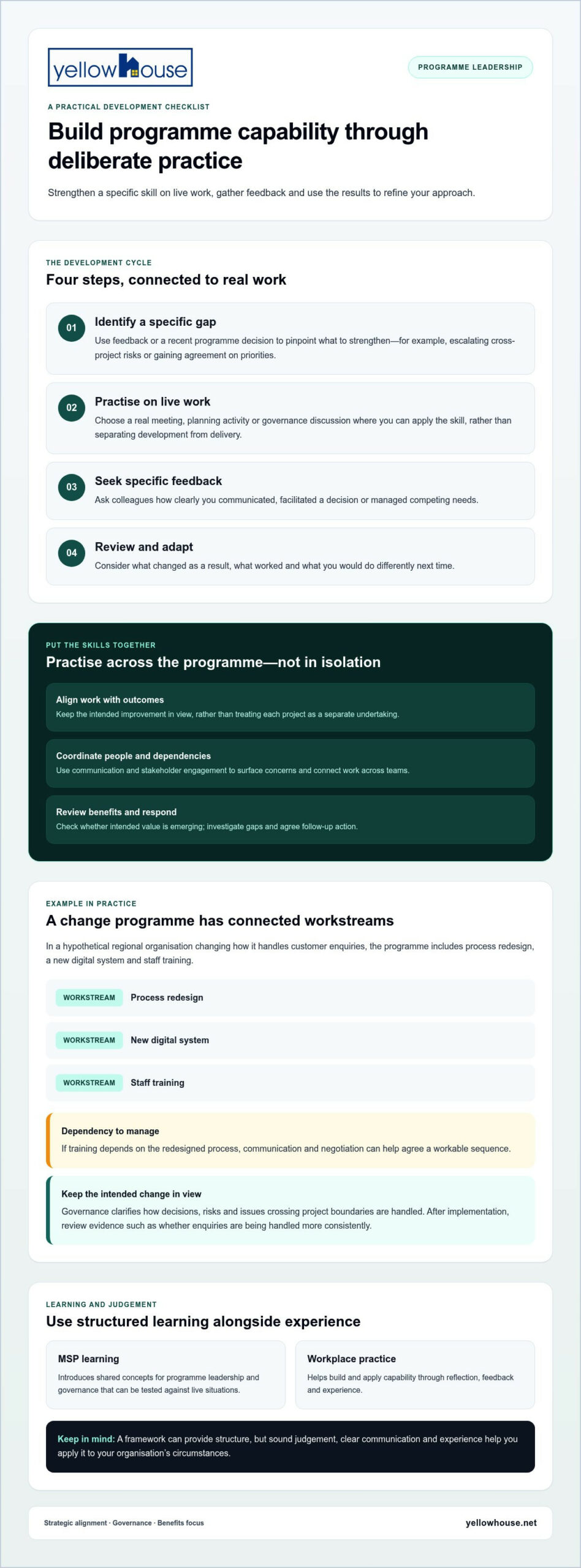
Capability grows through deliberate practice. Start by identifying a specific gap, such as difficulty escalating cross-project risks or gaining agreement on priorities. Then choose a live piece of work where you can practise that skill, rather than treating development as separate from delivery.
- Identify: Use feedback or a recent programme decision to pinpoint what you need to strengthen.
- Practise: Apply the skill in a real meeting, planning activity or governance discussion.
- Seek feedback: Ask colleagues how clearly you communicated, facilitated a decision or managed competing needs.
- Review: Consider what changed as a result, what worked and what you would adapt next time.
A framework can provide helpful structure, but it can’t make decisions for you. Strong skills for a programme manager also rely on judgement, clear communication and experience applying sound practice to the organisation’s circumstances. Reflection helps connect the method to the people and outcomes involved.
Where does MSP learning fit into a programme manager’s development?
Structured MSP learning introduces shared concepts for programme leadership and governance that you can draw on at work. Its value is greatest when you test those concepts against live situations, reflect on the results and use feedback to refine your approach. Training supports development, while practice helps you build and apply capability.
Explore MSP programme management training through Yellowhouse and consider how structured learning can complement your workplace practice.
Build the capability to lead change
The skills for a programme manager combine strategic alignment, clear communication and sound governance with a steady focus on intended benefits. Programme leaders coordinate connected work, help people make decisions across boundaries and keep activity linked to the change the organisation seeks.
Capability develops through practice. Identify a skill to strengthen, apply it to live work, invite feedback and reflect on the outcome. Framework knowledge can provide structure, while judgement and experience help you adapt that structure to the people and circumstances involved.
Yellowhouse provides accredited MSP programme management training and project, programme and portfolio management training in Australia. Structured learning can complement workplace experience as you build confidence in leading complex change. Explore MSP programme management training as your next step in developing these skills.
Frequently Asked Questions
What are the most important skills for a programme manager?
The most important skills for a programme manager include strategic alignment, systems thinking, communication, stakeholder engagement and sound judgement. Programme managers also need to coordinate dependencies, understand risk and focus on benefits. These capabilities work together: clear communication helps people make decisions, while governance and benefits oversight keep activity connected to the intended change.
How is a programme manager different from a project manager?
A project manager leads an individual project and manages its outputs, such as scope, schedule and delivery risks. A programme manager coordinates related projects and change activities so they contribute to wider strategic outcomes. For example, they may align technology, process and people-focused workstreams, resolve cross-project dependencies and monitor whether the combined effort is producing its intended benefits.
Can you become a programme manager without a certification?
Yes, programme management capability can develop through relevant workplace experience as well as formal learning. A certification isn’t the only way to build capability, but structured study can introduce shared concepts for programme leadership and governance. Applying those concepts, exercising judgement and learning from feedback are all important parts of professional development.
How can I improve my programme management skills?
Choose a capability to strengthen, practise it on live work, seek specific feedback and review the outcome. MSP learning can provide structure alongside experience. Yellowhouse delivers accredited MSP programme management training for professionals in Brisbane, Sydney, Melbourne, Canberra, Adelaide, Perth, Cairns, Townsville, Hobart, Darwin, Mackay, the Gold Coast, Logan, Ipswich and Toowoomba.


About Post Author
