

Stakeholder Management for Australian Project Leaders
How many technically sound projects have you seen stall because a key decision-maker felt unheard or a partner agency held misaligned goals? It’s a persistent challenge for project and programme leaders across Australia who often find themselves caught between conflicting priorities in complex, multi-agency environments. You likely agree that ineffective communication plans don’t drive action, and stakeholder opposition remains one of the primary drivers of project delays. This article will help you master the framework-driven stakeholder management strategies used by Australia’s top project and programme leaders to ensure delivery success. We’ll examine how to move beyond reactive engagement toward a structured approach that aligns with PeopleCert best practices. By the end, you’ll have the tools to strengthen your project governance and achieve more reliable assurance results for your organisation.
Key Takeaways
- Redefine stakeholder engagement as a formal governance function rather than just a communication task to better navigate complex Australian multi-agency environments.
- Identify the most effective stakeholder management strategies by comparing the structured approaches found within PeopleCert frameworks like PRINCE2®, MSP®, and ITIL® 4.
- Leverage the MSP® framework to manage the human element of strategic change, ensuring your programme remains aligned with organisational goals.
- Use independent Gateway assurance reviews to validate your engagement model and demonstrate robust governance to senior leadership and external partners.
Understanding Stakeholder Management Strategies in Complex Project Environments
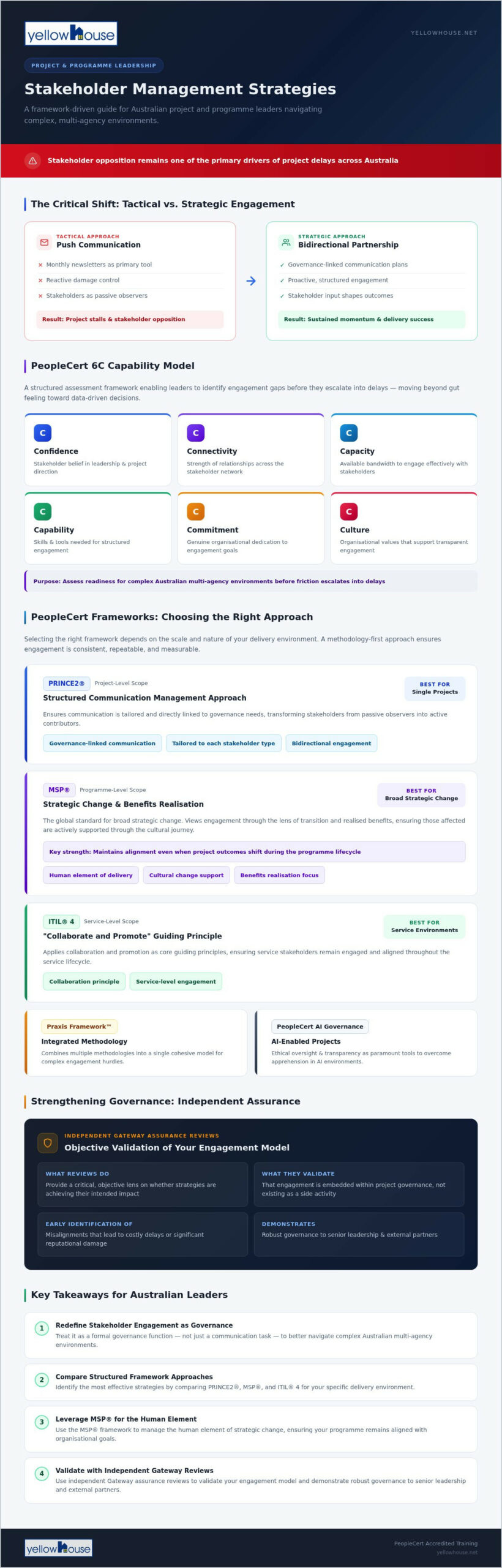
Effective project leadership requires treating stakeholder management as a core governance function. It isn’t just about keeping people informed; it’s about ensuring the project’s objectives remain viable within a complex web of influence. In the Australian context, leaders face unique pressures, such as navigating multi-agency dependencies and meeting high community expectations for transparency. Moving away from reactive damage control toward proactive stakeholder management strategies is essential for maintaining project momentum and securing long-term delivery success.
To assess readiness for these challenges, many organisations adopt the PeopleCert 6C Capability Model. This framework evaluates capability through six specific lenses: Confidence, Connectivity, Capacity, Capability, Commitment, and Culture. By using this model, leaders can identify where engagement gaps might lead to project friction before they escalate into delays. It provides a structured way to move beyond gut feeling and toward data-driven engagement decisions.
The Shift from Communication to Strategic Engagement
Relying on a monthly newsletter to manage high-stakes programmes often leads to failure. While newsletters are tactical, true engagement is strategic and bidirectional. Tactical management focuses on push-communication, whereas strategic engagement creates a partnership where stakeholders feel their input shapes the outcome. This distinction is central to how PRINCE2® structures its Communication Management Approach. This framework ensures that communication is tailored and directly linked to governance needs, transforming stakeholders from passive observers into active contributors.
Implementing PeopleCert Frameworks for Strategic Stakeholder Engagement
While software tools can track sentiment, they don’t provide the underlying methodology needed for complex stakeholder management strategies. A methodology-first approach ensures that engagement is consistent, repeatable, and measurable across the entire project portfolio. PeopleCert frameworks offer the structured logic required to align diverse interests with organisational goals. Selecting the right framework depends on the scale and nature of your delivery environment.
| Framework | Scope | Stakeholder Approach |
|---|---|---|
| PRINCE2® | Project-level | Structured Communication Management Approach |
| MSP® | Programme-level | Focus on strategic change and benefits realisation |
| ITIL® 4 | Service-level | The “Collaborate and Promote” guiding principle |
Choosing the Right Framework for Your Stakeholder Landscape
For broad strategic change, MSP® is the global standard. It views engagement through the lens of transition and realised benefits. This ensures that those affected by change aren’t just informed; they’re actively supported through the cultural journey. By focusing on the human element of delivery, MSP helps leaders refine their stakeholder management strategies to maintain alignment even when project outcomes shift during the programme lifecycle.
Modern leaders must also account for emerging technologies. The PeopleCert AI Governance framework provides a vital lens for managing stakeholders in AI-enabled projects. In these environments, ethical oversight and transparency are paramount to overcoming apprehension. For an integrated approach, Praxis Framework™ training combines these methodologies into a single cohesive model. If your organisation is facing complex engagement hurdles, our PeopleCert accredited training provides the necessary foundation for success.
Strengthening Organisational Governance through Stakeholder Assurance
Robust governance requires more than just internal check-ins or software-driven sentiment tracking. Independent Gateway assurance reviews provide a critical, objective lens on whether your stakeholder management strategies are actually achieving their intended impact. These reviews validate that engagement is embedded within the project governance framework, rather than existing as a side activity. By identifying misalignments early, leaders can prevent the kind of project friction that leads to costly delays or significant reputational damage within the public eye.
Building internal capability is the most sustainable way to manage intricate stakeholder maps across the Australian landscape. Accredited training ensures that your team speaks a common language of delivery, strictly aligned with PeopleCert standards. When internal teams possess these skills, they can navigate multi-agency environments with far greater confidence and precision. These skills allow leaders to deploy more sophisticated stakeholder management strategies that adapt to changing political or economic climates. In situations where a project reaches a complex deadlock, Strategic Change Consulting offers a high-level intervention to unblock stalled processes and realign competing priorities.
The Role of Gateway Assurance and Advisory
Preparing for a formal review involves a methodical approach to demonstrating engagement health and transparency. Following a structured path ensures that your project remains defensible and aligned with best practices.
- Step 1: Conduct a formal stakeholder audit aligned with PeopleCert standards to identify potential gaps in influence and interest before they become risks.
- Step 2: Embed engagement metrics into your Gateway review preparation to provide tangible evidence of active, bidirectional communication with partners.
- Step 3: Utilise Strategic Change Consulting to realign stakeholders during critical project pivots, ensuring the business case remains supported throughout every phase of the transition.
Mastering the Future of Project Engagement
Success in the Australian project landscape depends on your ability to treat engagement as a disciplined governance function. Shifting from tactical communication to strategic engagement ensures your projects remain resilient against shifting priorities and multi-agency complexities. By adopting accredited frameworks and preparing for independent Gateway assurance, you build the transparency required for long-term delivery success. Refining your stakeholder management strategies is a continuous journey that combines methodology with the human element of change. As a PeopleCert Accredited Training Provider and expert Gateway review consultants, we’re here to support your professional growth. Whether you require Strategic Change Management expertise or formal certification, the right foundation is essential. Enrol in a PeopleCert accredited course to master stakeholder governance today and lead your next programme with confidence.
Frequently Asked Questions
What is the difference between stakeholder management and stakeholder engagement?
Stakeholder management typically refers to the tactical process of identifying and organising individuals who can influence a project. In contrast, stakeholder engagement is a strategic, bidirectional partnership where stakeholders actively shape outcomes. While management focuses on tracking and informing, engagement builds the trust necessary for long-term success in complex Australian multi-agency environments.
How does the PRINCE2 framework handle stakeholder management?
The PRINCE2 framework addresses this through a formal Communication Management Approach. It defines how and when the project team will communicate with its stakeholders to ensure their continued support. This structured method helps project leaders in cities like Canberra and Sydney maintain clear governance by aligning communication with specific project milestones and decision-making points throughout the lifecycle.
Why is stakeholder management critical for Gateway assurance reviews in Australia?
Gateway assurance reviews evaluate the health and viability of high-value projects across Australian states. Effective stakeholder management strategies are critical here because reviewers look for evidence of robust governance and risk mitigation. Demonstrating that you’ve identified and engaged key partners ensures the project remains defensible and aligned with public sector expectations for transparency and accountability.
Can ITIL 4 principles be applied to stakeholder management in non-IT projects?
Yes, ITIL 4 principles are highly effective for non-IT projects, particularly the “Collaborate and Promote” guiding principle. This approach focuses on breaking down silos and building transparency with all project participants. Whether you’re managing a construction programme in Melbourne or a transformation initiative in Brisbane, these PeopleCert standards help teams implement reliable stakeholder management strategies that drive value beyond technical environments.


About Post Author
