

Gateway Review Process: 2026 Governance Guide
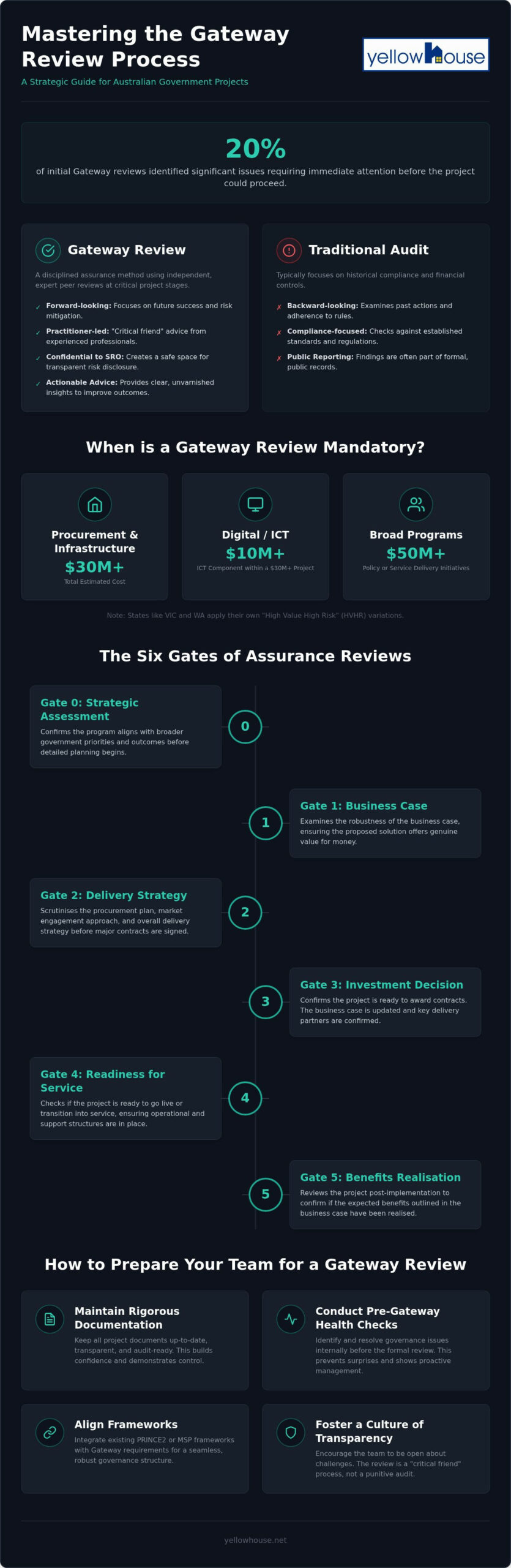
Did you know that during the initial rollout of the gateway review process for government projects Australia, approximately 20% of reviews identified issues so significant they required immediate attention before the project could proceed? Even with the 2026 updates to the NSW Infrastructure Investor Assurance Framework and Western Australia’s mandated business case gates, the prospect of a high-stakes review often creates more anxiety than clarity. It’s natural to feel concerned about “red” ratings or to find the differing requirements between Commonwealth and State jurisdictions confusing.
We recognise that managing a major project requires a delicate balance of technical precision and strategic leadership. This guide will help you move beyond compliance fears by showing you how to master the 2026 governance landscape. You’ll gain the knowledge needed to ensure your project passes every assurance checkpoint with confidence and clarity.
We’ll provide a detailed breakdown of the six critical gates and share actionable steps to prepare your project team for the intensive review period. We also explain how to align your existing PRINCE2 or MSP frameworks with Gateway requirements to create a robust, high-performance governance structure.
Key Takeaways
- Gain a clear understanding of the gateway review process for government projects Australia, focusing on how independent peer reviews provide the Senior Responsible Owner with confidential, actionable advice.
- Learn to navigate the six critical “gates” that act as go/no-go decision points for government investment across various Australian jurisdictions.
- Discover how to prepare your project team for intensive assurance reviews by fostering a culture of transparency and maintaining rigorous, audit-ready documentation.
- Understand the value of conducting pre-Gateway health checks to identify and resolve governance issues before they impact your project’s delivery confidence rating.
- Identify practical ways to align your existing PRINCE2 or MSP frameworks with Gateway requirements to ensure seamless integration and long-term project success.
What is the Gateway Review Process for Australian Government Projects?
The gateway review process for government projects Australia serves as a disciplined assurance methodology designed to bolster the delivery of high-risk initiatives. It operates as a series of short, intensive peer reviews conducted by independent experts at critical lifecycle points. This framework is a specialised application of the Phase-gate process, where each “gate” acts as a rigorous check to ensure a project remains viable and strategically aligned before further investment is committed.
While a traditional audit focuses on past compliance and financial controls, a Gateway review is forward-looking and practitioner-led. The review team consists of experienced professionals who offer “critical friend” advice based on real-world delivery experience. This peer-to-peer approach fosters a collaborative environment where project teams can discuss complex problems openly. The primary objective is to provide the leadership team with the insights needed to steer a project toward a successful conclusion.
The Critical Role of the Senior Responsible Owner (SRO)
The SRO holds ultimate accountability for the project’s success and serves as the primary recipient of the review findings. Because the final report is confidential to the SRO, it creates a safe space for transparent disclosure. This confidentiality ensures that the project team feels comfortable highlighting genuine risks. The SRO receives unvarnished, actionable advice to improve delivery outcomes without the pressure of immediate public or political scrutiny. It’s a partnership designed to protect the project’s integrity.
Financial Thresholds and Risk Assessment in 2026
Mandatory assurance is triggered by specific risk profiles and financial benchmarks. In 2026, Commonwealth projects must undergo the gateway review process for government projects Australia if they meet the following criteria:
- Procurement or Infrastructure: Total estimated cost of $30 million or more.
- Digital/ICT: Projects over $30 million with an ICT component of at least $10 million.
- Programs: Broad policy or service delivery programs exceeding $50 million.
States like Victoria and Western Australia apply their own “High Value High Risk” (HVHR) variations. These frameworks ensure that even smaller projects with high complexity receive the necessary level of independent scrutiny. Success at these thresholds requires more than just meeting a budget; it demands a robust governance structure that can withstand external examination.
How do the Six Gates Align with the Project Lifecycle?
A project’s lifecycle is rarely linear; it’s a complex journey from a vague concept to a tangible public benefit. The gateway review process for government projects Australia provides a structured map for this journey through six distinct stages. These stages, often referred to as The Six Gates of Assurance Reviews, ensure that significant public funds aren’t sunk into failing ventures. By identifying “red flags” early, governance teams can pivot or pause before costs escalate beyond recovery.
Many agencies struggle to bridge the gap between their daily project management activities and these high-level assurance requirements. This is where organisational governance advisory Australia plays a pivotal role. It ensures that your internal corporate strategy remains in lockstep with external assurance expectations, creating a seamless transition from one gate to the next. Aligning your PRINCE2 or MSP frameworks with these gates isn’t just about compliance; it’s about building a culture of delivery excellence. For executives leading public sector transformation, understanding how MSP for public sector transformation Australia integrates with the APS Program and Project Management Framework is essential to achieving this alignment effectively.
Gate 0 to Gate 2: Strategy, Business Cases, and Feasibility
The early stages focus on strategic alignment and viability. Gate 0 (Strategic Assessment) asks if the programme truly aligns with broader government priorities. Once confirmed, Gate 1 (Business Case) examines whether the proposed solution offers genuine value for money. Finally, Gate 2 (Delivery Strategy) scrutinises the procurement plan and market engagement approach. These gates ensure the foundation is solid before any major contracts are drafted. If you want to ensure your team is fully prepared for these hurdles, engaging gateway review consultants Australia for a preliminary health check can provide the necessary peace of mind.
Gate 3 to Gate 5: Implementation and Readiness for Service
How to Prepare Your Team for a Gateway Assurance Review
Preparation is paramount. While administrative readiness is a baseline requirement, the most successful projects are those where the team embraces a culture of radical transparency. Preparing for the gateway review process for government projects Australia requires moving beyond “polishing the files” to ensuring every team member understands the strategic intent of their work. Reviewers can quickly sense if a team is hiding behind a wall of documentation. Instead, aim for a “no surprises” environment where risks are documented, acknowledged, and actively managed.
We often recommend engaging gateway review consultants Australia early in the project lifecycle to conduct a preliminary health check. This objective assessment identifies potential governance gaps before they escalate into formal “red” ratings. Furthermore, ensuring your team has completed accredited PRINCE2 project management training provides a shared vocabulary. When the project office and the review team speak the same language, the assurance process becomes significantly more efficient. As highlighted in the ANAO report on the Gateway Review Process, the effectiveness of these reviews relies heavily on the quality and honesty of the evidence provided by the agency.
Building Governance Capability with P3GP and MoP
Passing a review with high delivery confidence requires more than just following a checklist. It requires a deep understanding of governance principles. P3GP (Project, Programme and Portfolio Governance Professional) training provides the theoretical foundation your leaders need to defend their governance structures under scrutiny. For broader organisational alignment, Management of Portfolios (MoP) ensures that every initiative entering at Gate 0 actually serves the department’s long-term strategic goals. This top-down clarity is often what separates a successful project from one that struggles at the first hurdle. Executives seeking to strengthen this foundation can also benefit from the 2026 executive guide to govt endorsed project management, which outlines how to synchronise global programme frameworks with the specific rigour of Australian Public Service standards.
The Planning Day and Review Week Logistics
The formal review begins with a Planning Day where the SRO and the review team set the scope and identify key interviewees. It’s vital to select a cross-section of stakeholders, including those who may have critical perspectives, to demonstrate a robust gateway review process for government projects Australia. The review week itself is an intensive 3-5 day period. You can expect daily briefings that keep the SRO informed of emerging themes. This ensures the final report contains no shocks, allowing the leadership team to focus on implementing the actionable advice provided by the peer reviewers.
Securing Your Project’s Future through Robust Assurance
Navigating the gateway review process for government projects Australia requires a shift in mindset from simple compliance to strategic opportunity. By understanding how the six gates align with your project lifecycle, you can identify critical risks before they compromise your delivery confidence. Success depends on more than just documentation; it requires a team that speaks a unified language of governance and is prepared to engage transparently with independent reviewers at every stage.
As an accredited PRINCE2 and P3GP training provider, Yellowhouse brings seasoned Australian expertise to your project challenges. Our team of expert strategic change consultants works alongside you to build the internal capability necessary for passing every assurance checkpoint with confidence. We’re committed to helping you turn complex governance requirements into a clear path for success by acting as a supportive partner in your professional growth. Organisations looking to improve project delivery outcomes in 2026 will find that integrating governance-led assurance with strategic oversight is the key to moving beyond task completion toward genuine organisational excellence.
Enquire about Yellowhouse Gateway Assurance and Governance Services today to ensure your major projects are equipped with the oversight they deserve. We look forward to partnering with you on your journey toward delivery excellence and long-term organisational success.
Frequently Asked Questions
Is a Gateway review the same as a financial audit?
No, a Gateway review is fundamentally different from a financial audit in both its timing and intent. While audits typically assess past compliance and financial controls, the gateway review process for government projects Australia is a forward-looking assurance exercise. It focuses on the project’s future viability and delivery confidence, providing the Senior Responsible Owner (SRO) with practitioner-led advice to steer the project toward success before issues escalate.
What happens if our project receives a “Red” traffic light rating?
Receiving a “Red” rating indicates that the review team has identified significant issues that require urgent attention before the project proceeds. It isn’t a project failure; rather, it’s a critical alert designed to protect the public investment. The SRO must develop a robust action plan to address the recommendations. This often leads to a “Red Zone” re-review to ensure the identified risks are effectively mitigated before the next gate.
Are Gateway reviews mandatory for all Australian government projects?
Gateway reviews are mandatory only for projects that meet specific high-risk or high-value thresholds. At the Commonwealth level, this includes procurement or infrastructure projects valued at $30 million or more. Risk assessments also play a role; some lower-value projects may be required to undergo the gateway review process for government projects Australia if they are deemed strategically significant or technically complex by the relevant department or treasury office.
How long does a typical Gateway review take to complete?
A typical Gateway review involves a one-day planning session followed by a focused, intensive review week lasting between three and five days. During this period, the independent review team conducts stakeholder interviews and scrutinises project documentation. The process concludes with a formal debrief and the delivery of a report to the SRO. This ensures the project team isn’t diverted from their delivery duties for an extended period while still receiving high-quality assurance.


About Post Author
