

How to Establish a High-Performing Project Office: A Consulting Guide for Australian Organisations
Why do so many Australian organisations treat their PMO as a costly administrative burden rather than a strategic asset? It’s a valid concern when you’re facing inconsistent delivery standards and a persistent lack of visibility across your project portfolio. You likely recognise that a simple administrative hub isn’t enough to drive real results, yet justifying the overhead cost remains a significant challenge in the boardroom.
This guide demonstrates how professional project office setup consulting can bridge that gap, helping you transition from basic oversight to a high-performing PMO that generates measurable business value. We’ll outline the practical steps to build internal capability through proven frameworks like P3O and PRINCE2, ensuring your governance is robust and your strategic alignment is precise. We will explore how to move beyond mere reporting to create a value centre that supports your organisation’s long-term success and competitive advantage.
Key Takeaways
- Understand why a high-performing PMO is a strategic function rather than a physical space, moving beyond simple task tracking to drive genuine business value.
- Learn how to apply the P3O® framework to create a logical decision-making structure that supports both corporate and public sector requirements in Australia.
- Engage with expert project office setup consulting to build internal capability and design a governance structure that reflects your specific organisational maturity.
- Adopt rigorous Gateway assurance and P3GP® Governance training to provide independent health checks and ensure your leadership team is equipped to manage complex change.
Table of Contents
-
Beyond Desks and Cables: What Strategic Project Office Setup Consulting Actually Entails
-
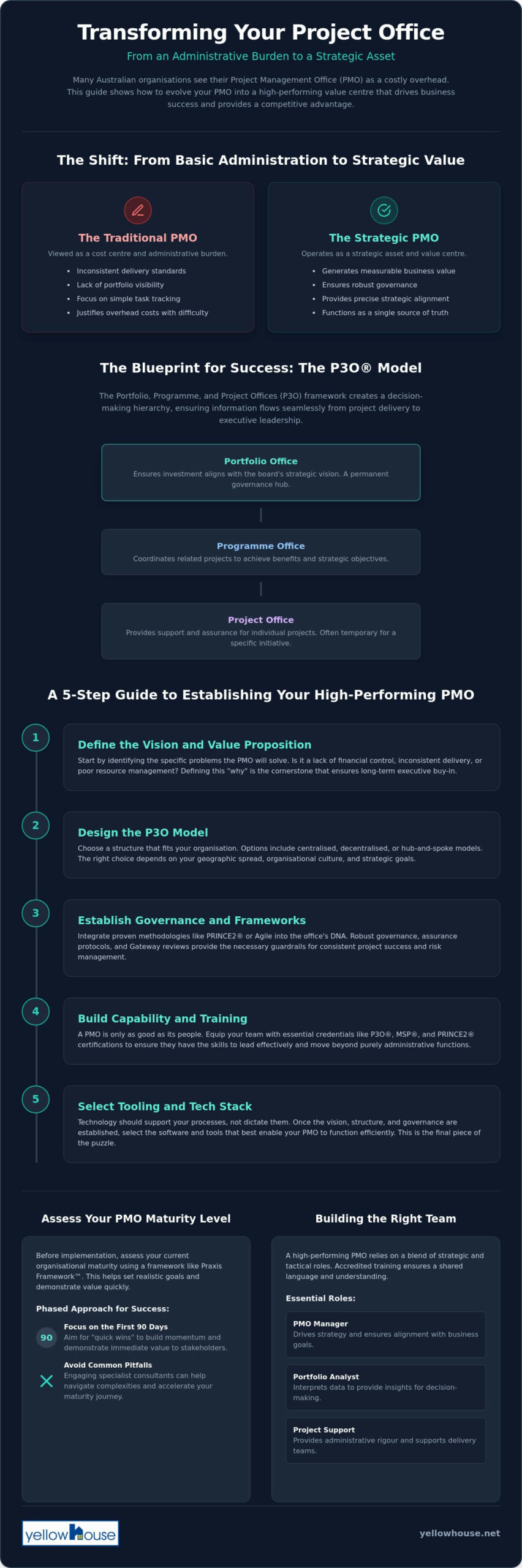
A 5-Step Guide to Establishing Your Project Management Office
-
Ensuring Long-Term Value: Governance and Assurance for Your New Project Office
Beyond desks and cables: What Strategic PMO Consulting entails
A common misconception persists that establishing a project office is primarily a logistical exercise involving floor plans and software licenses. In reality, effective project office setup consulting focuses on building a strategic engine that drives organisational performance. A Project Management Office serves as a governance hub rather than a physical location. While a temporary Project Office might exist only for the duration of a specific initiative, a permanent Portfolio Office provides the enduring oversight required to ensure every investment aligns with the board’s vision. Success requires a disciplined focus on people, process, and tools, strictly in that order.
The P3O Model: A Blueprint for Success
The Portfolio, Programme, and Project Offices (P3O) framework offers a sophisticated hierarchy designed to support decision-makers at every level. By implementing this model, an organisation ensures the PMO functions as a single source of truth for the executive team. This setup provides the data needed to stop failing projects early and reallocate resources to higher-value initiatives. It’s about creating a structured environment where information flows seamlessly from the ground up to the boardroom, providing clarity on resource constraints and delivery risks.
Why Australian organisations are moving toward Strategic PMOs
Australian organisations are increasingly moving away from administrative hubs toward strategic delivery centres. This shift is driven by a need for better value tracking and adherence to rigorous governance standards. By integrating P3GP principles, a modern Project Office ensures that accountability is clear and that every project contributes to a measurable competitive advantage. Expert project office setup consulting helps bridge the gap between theoretical frameworks and the practical realities of the Australian corporate and public sectors, ensuring the office remains a value centre rather than an overhead cost.
A 5-Step Guide to establishing your project management office
-
Step 1: Define the Vision and Value Proposition. Start by identifying the specific problems the PMO will solve. Is it a lack of financial control, or perhaps inconsistent delivery? Defining this "why" is the cornerstone of project office setup consulting and ensures long-term buy-in.
-
Step 2: Design the P3O Model. You must choose between centralised, decentralised, or hub-and-spoke structures. The right choice depends on your geographic spread and organisational culture.
-
Step 3: Establish Governance and Frameworks. Integrate PRINCE2® or Agile methodologies into the office DNA. Robust governance and assurance protocols provide the necessary guardrails for project success.
-
Step 4: Capability and Training. Your team needs the right credentials, such as MSP® or P3O® certifications, to lead effectively. Without these skills, the office remains purely administrative.
-
Step 5: Tooling and Tech Stack. Select software that supports your established processes. Never let the tool dictate the process; the tech should be the final piece of the puzzle.
Identifying Your PMO Maturity Level
Before racing toward a full-scale portfolio office, you need to understand your starting point. Using the Praxis Framework™ allows you to assess current organisational maturity across various dimensions. We recommend setting realistic milestones for the first 90 days of the setup. This phased approach allows you to demonstrate "quick wins" while building the foundation for more complex functions. Engaging with specialist consultants during this phase can help you avoid common pitfalls and accelerate your maturity journey.
Building the Right Team
A high-performing office relies on a mix of strategic and tactical roles. Essential positions typically include a PMO Manager to drive strategy, Project Support for administrative rigour, and a Portfolio Analyst to interpret data. Since accredited PRINCE2 training provides a universal language for delivery, it serves as the necessary foundation for any new PMO team. This shared understanding ensures everyone is aligned on how to manage risks, issues, and quality from day one.
Ensuring long-term value: Governance and Assurance for the Portfolio and Project Offices
The Role of Gateway Assurance Reviews
High-stakes Australian projects often face challenges because they lack external scrutiny. Gateway assurance provides essential independent "health checks" at critical points in the project lifecycle. A well-structured Project Office facilitates this process, acting as the bridge between delivery teams and independent reviewers. This level of transparency is closely aligned with the Australian Public Service Program and Project Management Framework, which sets the benchmark for principle-based governance in both public and private sectors.
To sustain this value, organisations should look toward MoP® Portfolio Management. This framework allows you to measure ROI by ensuring you’re investing in the right initiatives, rather than just delivering projects efficiently. It’s about continuous improvement. When your governance is robust, you can reallocate resources with precision, ensuring that every dollar spent aligns with your competitive advantage.
Consulting as a Partnership
Strategic change isn’t a "set and forget" activity. We believe in moving beyond one-off setups to form long-term collaborations. Yellowhouse works alongside your team to embed these frameworks permanently, ensuring the internal capability we build today sustains your project delivery for years to come. Our project office setup consulting is designed to empower your people, ensuring that methodology and best practice become part of your organisational DNA rather than just a collection of templates.
Taking the next step toward strategic PMO excellence
Building a high-performing project office is a significant undertaking that requires more than just templates and tools. It demands a shift in mindset, where the office is viewed as a strategic value centre rather than an administrative overhead. By prioritising people and processes through the P3O framework and ensuring robust governance with Gateway assurance, you ensure your organisation’s investments are protected. This structured approach provides the clarity needed to navigate complex changes with confidence and precision.
Engaging in expert project office setup consulting provides the guidance needed to embed these frameworks effectively within your unique context. As an Australian-owned and operated firm, Yellowhouse offers a partnership grounded in real-world experience and deep technical expertise. Our team of accredited PRINCE2®, MSP®, and P3O® experts has a proven track record in strategic governance and assurance. We’re committed to helping you build the internal capability required for sustained success. Enquire about our Project Office Setup Consulting and P3O Training today to secure your organisation’s delivery future. You have the potential to drive remarkable value; we’re here to help you unlock it.
Frequently Asked Questions
What is the difference between a PMO and a Project Office?
A Project Management Office (PMO) typically serves as a permanent organisational function focused on standardisation and strategic alignment across multiple initiatives. In contrast, a Project Office is often a temporary entity established to support the specific administrative and technical needs of a single project for its duration. While the PMO provides the overarching governance framework, the Project Office focuses on the day-to-day delivery of a specific set of outputs to meet immediate project goals.
How much does it cost to set up a Project Management Office in Australia?
The cost of establishing a PMO in Australia varies significantly based on the scale and maturity of the organisation. Primary expenses include personnel, where a permanent Project Manager’s annual base salary typically ranges between A$130,000 and A$160,000 as of February 2026. Engaging project office setup consulting can help streamline these initial investments by ensuring you select the right scale of governance and avoid unnecessary tool expenditure from the outset.
Do we need a permanent Project Office for a single large programme?
You don’t necessarily need a permanent Portfolio Office for a single large-scale programme; instead, a Programme Office is often more appropriate. This temporary function is designed to support the specific lifecycle of the programme and is decommissioned once the desired benefits are realised. However, if your organisation manages a continuous pipeline of change, transitioning to a permanent P3O structure ensures that the lessons learned from one programme are effectively transferred to the next.
How does P3O consulting differ from general business consulting?
P3O consulting is specifically focused on the Portfolio, Programme, and Project Offices (P3O) framework, which provides a dedicated decision-making structure for organisational change. Unlike general business consulting, which may address broad operational issues, project office setup consulting using P3O standards focuses on the specific integration of governance, assurance, and delivery support. This specialised approach ensures that your office is built on a globally recognised blueprint that is proven to improve project success rates.


About Post Author
