

Organizational Governance Advisory: A Strategic Guide for 2026
Why does a strategy that looks impeccable in an Australian boardroom so often lose its way before it reaches the delivery team? It’s a common frustration for executives who see clear intent diluted by the time it enters the project phase. Seeking professional organizational governance advisory is no longer just about meeting compliance checkboxes. It’s about creating a resilient bridge between high-level vision and the reality of execution through structured, independent assurance.
You likely recognise that the rising complexity of the local regulatory environment, particularly with the July 2026 commencement of mandatory sustainability reporting under AASB S2, demands more than just a reactive approach. This guide will show you how robust governance frameworks and Gateway reviews can transform your decision-making pathways and increase project success rates. We’ll explore how to navigate the latest APRA and ASX standards while ensuring your strategic change initiatives deliver the specific value your board expects.
Key Takeaways
- Understand the critical distinction between corporate governance at the board level and project-level delivery to ensure executive intent remains intact throughout the execution phase.
- Discover how structured frameworks such as MSP® and MoP® establish a clear hierarchy for portfolio oversight and long-term strategic alignment.
- Learn how a professional organizational governance advisory can help your entity navigate evolving 2026 standards, including mandatory sustainability reporting and updated APRA requirements.
- Identify the role of independent Gateway assurance reviews in safeguarding high-risk Australian government and corporate projects through objective, stage-based assessments.
- Explore the value of the “human element” in governance by integrating accredited P3GP® training to foster a culture of accountability and clearer decision-making pathways.
Table of Contents
-
Defining Organizational Governance in the 2026 Australian Context
-
The Pillars of Robust Governance: From Boardroom to Project Delivery
-
P3GP vs. General Corporate Governance: Understanding the Difference
Defining Organizational Governance in the 2026 Australian Context
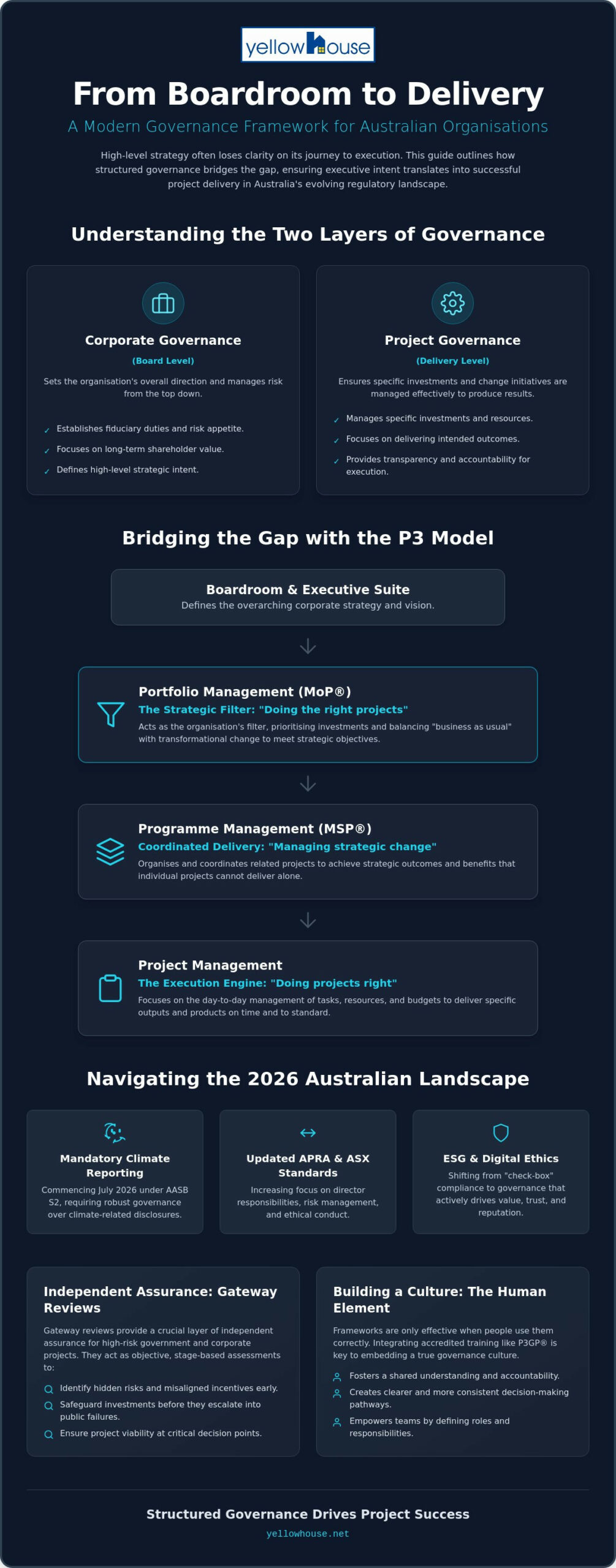
High-performance organisations don’t succeed by chance; they thrive because their systems of direction and control are deliberately designed. At its core, the corporate governance definition describes the framework of rules, relationships, and processes by which an entity is directed and controlled. In the Australian market, this definition has expanded significantly. It now encompasses a sophisticated interplay between board-level oversight and project-level execution. This dual focus ensures that an organisation’s strategic intent isn’t just a vision statement but a practical reality.
The 2026 landscape is defined by the upcoming fifth edition of the ASX Corporate Governance Principles and mandatory climate-related disclosures starting July 1, 2026. These requirements represent more than just administrative hurdles; they’re the foundation for sustainable strategic change. Effective governance provides the stability needed to navigate these shifts while protecting the organisation’s reputation and financial health.
The Evolving Australian Governance Landscape
Digital ethics and Environmental, Social, and Governance (ESG) criteria have shifted from peripheral concerns to central pillars of advisory needs. Australian entities are moving away from "check-box" compliance toward a model where governance actively drives value and trust. Modern governance is a strategic framework that enables organisations to respond to market shifts with precision while maintaining ethical and regulatory integrity.
Why Generic Governance Often Fails Australian Projects
The Pillars of Robust Governance: From Boardroom to Project Delivery
High-performance governance requires a seamless flow of information and accountability from the executive suite to the front lines. It’s not enough to have a visionary board. You need a structured hierarchy that translates that vision into tangible results. This is where the P3 governance model (Portfolio, Programme, and Project) becomes indispensable. It provides the necessary scaffolding for effective decision-making across all levels of an organisation.
While the guidance from ASIC on corporate governance sets the standard for director responsibilities and legal compliance, operational success depends on how these principles are applied to change initiatives. This is where **organizational governance advisory **services add the most value. They help entities move beyond legal conformance to achieve performance excellence by implementing proven frameworks like MSP and MoP. These methodologies ensure that every dollar spent on change is tracked, managed, and aligned with the overarching corporate strategy.
Portfolio Management (MoP) as a Strategic Filter
Portfolio management acts as the organisation’s strategic filter. It ensures you aren’t just doing projects right, but doing the right projects to meet your 2026 objectives. This involves a delicate balance between maintaining "business as usual" and driving transformational change. Leaders who invest in MoP portfolio management training gain the tools to prioritise investments based on actual strategic value rather than internal politics or historical momentum.
Programme Governance (MSP) for Complex Change
Programme governance shifts the focus from simple outputs to long-term benefits realisation. In the Australian context, the role of the Senior Responsible Owner (SRO) is pivotal. This individual provides the bridge between the executive board and the programme team, ensuring that complex change remains aligned with the organisational mission. Managing successful programmes requires a disciplined approach to risk and quality that generic management styles often lack.
Central to this structure is the Portfolio, Programme, and Project Office (P3O). This office maintains the standards and provides the single source of truth for executive oversight. It acts as the "conscience" of the organisation, ensuring that governance isn’t just a manual on a shelf but a living part of the culture. Integrating strategic change management into this framework ensures that the human element is never sidelined. If you’re looking to strengthen your internal structures, exploring specialised governance training can provide the clarity your leadership team needs to succeed.
P3GP vs. General Corporate Governance: Understanding the Difference
Many Australian executives mistakenly believe that strong corporate oversight automatically translates to effective project control. While board-level governance focuses on fiduciary duties and high-level risk, it rarely reaches the granular level required to steer a complex multi-million dollar transformation. P3GP (Project, Programme, and Portfolio Governance) has emerged as a specialised discipline designed to address this specific void. It provides the practical machinery that ensures executive intent isn’t lost in the transition from the boardroom to the delivery team.
The distinction lies in the difference between oversight and active decision-making. Corporate governance, often guided by the Australian Government’s governance framework and the PGPA Act, establishes the guardrails for organisational conduct and resource management. P3GP, however, is performance-oriented. It defines exactly who has the authority to make critical investment decisions, how those decisions are transparently recorded, and how accountability is maintained when challenges arise. This is why a growing number of entities are engaging organizational governance advisory Australia specialists who hold specific P3GP accreditation.
In the 2026 landscape, the "if not, why not" approach of the ASX is no longer enough for high-stakes projects. Organisations need a system that manages the unique risks of change, which are fundamentally different from the risks of steady-state operations. P3GP provides this system by treating governance as a professional craft rather than an administrative burden.
The P3GP Framework in Australia
The P3GP model is built on three core pillars: Accountability, Transparency, and Proportionality. It moves away from rigid, one-size-fits-all rules and instead scales governance to the complexity of the initiative. By investing in P3GP training, Australian organisations build internal capability, allowing for a new career path: the Governance Professional. This role acts as a dedicated custodian of the decision-making process, ensuring that every project remains viable and strategically aligned.
Choosing the Right Advisory Approach
Knowing when to call for legal counsel versus a governance practitioner is a hallmark of a mature leadership team. While lawyers ensure you meet statutory requirements, a P3GP advisor ensures your governance actually works in a high-pressure delivery environment. You need an "Expert Practitioner" who has faced the same hurdles your teams are currently navigating. Ultimately, P3GP bridges the gap between the ASX board and the project team, ensuring that strategic vision is backed by disciplined execution.
Navigating Gateway Reviews and Assurance in Australia
Success in high-stakes Australian delivery often hinges on the ability to withstand rigorous external scrutiny. Gateway assurance provides this through a series of independent peer reviews conducted at critical stages of a project or programme’s lifecycle. It acts as a vital safety net, ensuring that high-value investments remain viable and aligned with the original business case. Engaging an **organizational governance advisory **partner ensures your team isn’t just marking time, but actually meeting the exacting standards required by federal and state treasury departments.
Independent assurance is particularly critical for projects that meet specific financial or risk thresholds. In the Australian public sector, the Gateway Review Process is typically triggered for procurement or infrastructure projects valued at A$30 million or more, and for broader programmes exceeding A$50 million. These reviews provide an objective lens that internal teams often lack, helping to identify systemic issues before they become public failures. By embracing this process, organisations can significantly reduce delivery risk and improve the likelihood of achieving their intended benefits.
The Gateway Review Process Explained
The process follows a structured path from Gate 0 (Strategic Assessment) through to Gate 5 (Operations Review and Benefits Realisation). Each gate serves as a "go/no-go" point where independent experts assess the project’s health and readiness to proceed. Independence is non-negotiable here; reviewers must be external to the project team to ensure their findings are unbiased. Common triggers for these reviews include high levels of technical complexity, significant public interest, or substantial ICT components exceeding A$10 million within a larger project.
The Benefits of Proactive Assurance Services
Proactive assurance identifies "red flags" such as misaligned stakeholder expectations or inadequate resource planning well before they lead to budget blowouts. These reviews provide the board with a level of confidence that internal reporting alone cannot offer. They foster a culture of transparency where challenges are discussed openly rather than hidden. This objective, third-party reporting is essential for maintaining corporate stability in an increasingly complex regulatory environment. If your project is approaching a critical milestone, consider expert Gateway assurance reviews to secure your delivery path and ensure your strategic goals are met.
Building a Governance Culture with Yellowhouse Advisory
Yellowhouse approaches every engagement with the understanding that governance is a lived experience, not just a document stored on a server. While frameworks provide the necessary structure, the "human element" determines whether those systems actually function under pressure. We believe that people-centric governance leads to better adoption because it respects the unique business context of each Australian organisation. By combining accredited training with hands-on consulting, we help your team move beyond mere compliance to a state of genuine strategic agility.
Our role as an **organizational governance advisory **partner is to ensure that your chosen frameworks, whether PRINCE2®, MSP®, or P3GP®, are tailored to your specific needs. A government department in Canberra requires a different governance rigour than a private infrastructure firm in Brisbane. We specialise in customising these global best practices to fit local regulatory requirements and organisational cultures, ensuring that your governance model supports delivery rather than hindering it. Assessing your current governance maturity is the first step toward this alignment, identifying where gaps exist between board intent and project execution.
Our Strategic Change and Advisory Solutions
We provide a comprehensive suite of solutions designed to build internal capability and ensure external confidence. This includes:
-
Independent Gateway assurance reviews: Tailored to the scale and risk profile of your project to provide objective, actionable feedback.
-
Accredited training: Empowering your internal governance leads with P3GP®, MoP®, and MSP® certifications to foster a professional governance career path.
-
Strategic change consulting: Working alongside your leadership to ensure that new frameworks are integrated into the daily habits of your delivery teams. For organisations seeking to maximise adoption, understanding the principles behind implementing change management frameworks in Australia is essential to ensuring transitions are met with cooperation rather than resistance.
Partnering for Long-Term Success
The Yellowhouse partnership model is built on the principle of "expert practitioner" collaboration. We don’t just deliver a report from a distance; we work as an extension of your team to solve complex hurdles in real-time. Our consultants have faced the same delivery pressures and regulatory shifts you’re navigating, providing a level of seasoned wisdom that goes beyond theoretical advice. This supportive partnership aims to leave your organisation stronger and more capable of managing future change independently.
If you’re ready to bridge the gap between executive strategy and successful delivery, the next step is a formal review of your current structures. We invite you to organise a consultation with our advisory team to discuss your next strategic project. Together, we can build a robust governance culture that secures your organisation’s full potential for 2026 and beyond.
Securing Your Strategic Delivery for 2026 and Beyond
As we move toward 2026, the demand for structured oversight and clear accountability in Australian projects has never been higher. You’ve seen how bridging the gap between board-level intent and project execution requires more than just high-level policy; it requires the practical machinery of P3GP and the objective lens of independent Gateway assurance. By focusing on these pillars, your organisation can navigate the complexities of new sustainability reporting and updated regulatory standards with confidence.
Partnering with a specialist **organizational governance advisory **firm ensures that your governance frameworks are tailored to your specific context while remaining aligned with global best practices. As an Australian-owned and operated firm, Yellowhouse brings expert Gateway assurance reviewers and accredited P3GP® training to every collaboration. Enquire about our Strategic Change and Governance Advisory today to discuss how we can support your next major initiative. We’re here to help you turn strategic vision into measurable success.
Frequently Asked Questions
What is the primary role of an organizational governance advisory in Australia?
An organizational governance advisory Australia firm focuses on bridging the gap between a board’s strategic intent and the actual delivery of projects. They provide the structured frameworks and independent assurance needed to ensure that executive decisions are transparently executed and that accountability is maintained across all levels of the entity. This partnership helps leaders navigate complex regulatory environments while protecting long-term shareholder value and organisational reputation.
How does P3GP governance differ from traditional project management?
P3GP governance is a specialised discipline that focuses on the decision-making framework and accountability structures, whereas project management is concerned with the actual execution and delivery of specific outputs. While a project manager handles the technical "how" of delivery, a governance professional ensures the "who" and "why" of investment decisions are transparently managed. This distinction ensures that projects remain strategically aligned rather than just technically complete.
Why are Gateway assurance reviews mandatory for many government projects?
Gateway assurance reviews are mandatory because they provide an independent safety net for high-risk, high-value public investments. In the Australian public sector, these reviews are typically required for procurement or infrastructure projects exceeding A$30 million to ensure they remain viable and continue to meet the original business case. This process significantly reduces the likelihood of budget blowouts and failed delivery in the public eye by identifying risks early.
Can small to medium enterprises benefit from formal governance advisory?
Small to medium enterprises (SMEs) definitely benefit from formal advisory by adopting proportional governance that scales with their specific complexity. While an SME might not require the same depth of assurance as a federal agency, implementing clear decision-making pathways and risk management frameworks prevents the common pitfalls of rapid growth. A professional organizational governance advisory specialist can tailor these global best practices to suit smaller, more agile teams.
What are the ASX Corporate Governance Council recommendations for 2026?
The ASX Corporate Governance Council is scheduled to release a consultation draft for the fifth edition of its Principles and Recommendations in July 2026. Key focuses include the simplification of requirements and a stronger emphasis on mandatory sustainability reporting in line with AASB S2 Climate-related Disclosures. These updates aim to remove duplicative prescriptions while maintaining the established "if not, why not" approach to corporate transparency and director accountability.
How do we start implementing a P3O framework in our organisation?
Implementing a P3O (Portfolio, Programme, and Project Offices) framework begins with a thorough assessment of your organisation’s current governance maturity. Once the gaps are identified, the next step involves training key staff in P3O methodologies to establish a central "source of truth" for executive oversight. This office then acts as the custodian of standards, ensuring that all change initiatives are reported consistently and accurately to the board.
What is the difference between internal audit and independent assurance?
Internal audit typically focuses on retrospective compliance and checking that established processes were followed correctly. In contrast, independent assurance, such as a Gateway review, is a proactive and forward-looking exercise conducted at critical project milestones. It assesses the likelihood of future success and identifies potential "red flags" early enough for the project team to take corrective action before the next stage of investment begins.
How does governance advisory support strategic change management?
Governance advisory supports strategic change management by providing the stable structure required for new initiatives to actually "stick" within the organisation. It ensures that the human element of change is integrated into the decision-making process, rather than being treated as an administrative afterthought. By defining clear roles and accountabilities, advisory services help organisations manage the transition from "business as usual" to a new operational state without losing strategic focus.


About Post Author
