

Project Governance Training in Australia for Project Leaders
Strong project delivery depends on governance as well as execution. Project governance training in Australia helps leaders clarify oversight, decision-making, accountability and escalation, keeping delivery connected to organisational priorities. It builds practical capability to guide projects and raise issues at the right level.
Leaders may know how to manage tasks and timelines yet still need clear governance arrangements for sound decisions and effective oversight. This article explains what training can cover, how to assess course completion and CPD recognition, and how to apply governance principles in project leadership.
You’ll also learn what to consider when choosing training, including its relevance to your role and your organisation’s governance challenges. The aim is to build capability that supports both individual leaders and the wider organisation.
Key Takeaways
- Connect project plans, resources, risks and stakeholder engagement to clear governance, decision-making and oversight.
- Understand what a course completion certificate demonstrates, and how to assess CPD recognition for your professional development needs.
- Clarify the distinct responsibilities of boards and management so both can support project outcomes effectively.
- Choose training that fits your role, whether you need stronger project management, programme coordination or portfolio oversight capability.
Project leadership and delivery practices
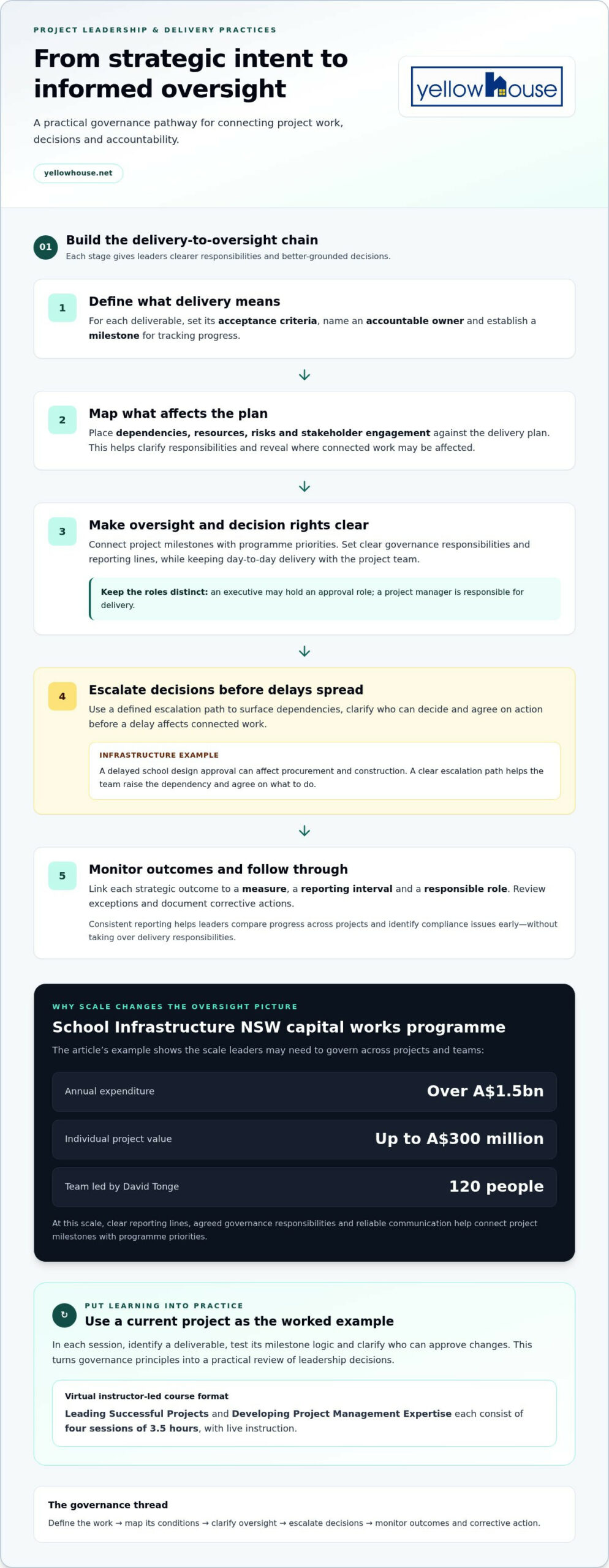
Project leadership connects strategic intent with the work teams deliver. Define each deliverable, its acceptance criteria, an accountable owner and a milestone for tracking progress. Then map dependencies, resources, risks and stakeholder engagement against the delivery plan. This clarifies responsibilities and helps leaders escalate decisions before delays affect connected work. Across a program, consistent principles also help teams report progress in comparable ways.
Infrastructure delivery shows why governance needs to match project scale. School Infrastructure NSW’s capital works program has annual expenditure over A$1.5bn, with individual projects valued up to A$300 million. Leaders need oversight that connects project milestones with program-level priorities, while keeping decision rights clear. For a school upgrade, for example, a delayed design approval can affect procurement and construction. A defined escalation path helps the team surface that dependency and agree on action.
Public infrastructure programs also involve multiple teams and stakeholders. David Tonge leads a 120-person team delivering School Infrastructure NSW’s capital works program. At that scale, leadership depends on clear reporting lines, agreed governance responsibilities and reliable communication between project teams. Project management training can help leaders structure plans, manage resources, track implementation and identify risks. These practices support informed oversight without confusing governance with the team’s responsibility for day-to-day delivery.
Virtual instructor-led training can offer a structured way to examine these practices. The virtual Leading Successful Projects and Developing Project Management Expertise courses each consist of four sessions of 3.5 hours. A live broadcast gives participants direct instruction while they work through project management concepts. Use each session to connect principles with a current project: identify a deliverable, test its milestone logic and clarify who can approve changes. This turns learning into a practical review of leadership decisions.
Certificate of Completion and CPD points
A certificate of completion records that you finished a course; it does not automatically establish a professional qualification or CPD credit. Keep the certificate, course title, provider, completion date and learning objectives together for your records. If you belong to a professional institute, compare these details with its CPD rules before logging the activity. The institute’s criteria determine whether the learning counts and how to record it.
Project governance training in Australia can cover governance principles and frameworks, while legal and standards content depends on the course syllabus and project context. A course should distinguish framework guidance from legal obligations, then explain how organisational policies and applicable requirements shape oversight and decisions.
Accredited training and certification are available in frameworks including PRINCE2®, MSP®, MoP® and Praxis Framework™. P3GP® provides a governance-focused learning option. Accreditation, certification and CPD recognition are separate considerations: identify the course’s awarding body, assessment requirements and credential, then check how your professional institute treats that learning. Don’t assume a completion certificate carries CPD points automatically.
For complex project and portfolio leadership, use governance learning to practise decisions involving competing priorities. For example, assess how a change to one project affects portfolio outcomes, delivery capacity and risk exposure. Clarify decision rights, record the rationale and assign an owner to follow up. These practices develop decision-making in complex environments while maintaining organisational accountability.
Effective performance monitoring requires defined measures and follow-through. Link each strategic outcome to a measure, reporting interval and responsible role; review exceptions and document corrective actions. In a portfolio with projects at different stages, this helps leaders compare progress consistently and identify compliance issues early. The resulting insight supports informed oversight without taking over the project team’s delivery responsibilities.
Corporate and project governance upskilling
Governance training connects oversight with project decisions and organisational objectives. Choose learning that reflects who makes decisions, who monitors outcomes and how stakeholders contribute throughout the project lifecycle.
Governance training topics
Project governance training covers the structures and practices used to direct, oversee and account for projects. Topics may include decision rights, assurance, risk oversight, stakeholder responsibilities, performance reporting and alignment with organisational objectives. For example, a team might distinguish an executive’s approval role from a project manager’s delivery responsibilities. Look for practical scenarios relevant to your organisation’s governance challenges.
Courses available in Australia
Australian learners can consider P3GP® Governance training alongside project, programme and portfolio frameworks such as PRINCE2®, MSP® and MoP®. These options address different needs: project-level controls, coordinated programme oversight or portfolio prioritisation. Compare course objectives, assessment and certificate details, then select the framework that matches your team’s work. A governance course should make clear how its concepts apply to real organisational decisions.
Choosing training for teams and career pathways
Choose team training by identifying a governance gap, the roles affected and the outcomes leaders expect. Match the course content to the team’s experience, project complexity and lifecycle responsibilities. Entry requirements vary, so review prerequisites and assessment expectations before enrolling. Depending on experience and organisational needs, project governance training can support progression into project, programme, portfolio or assurance responsibilities.
For teams strengthening project-office governance, explore P3O® training for project offices as a relevant capability pathway.
Yellowhouse: PRINCE2® Project Management Training
Yellowhouse provides PRINCE2® Project Management Training for leaders seeking a structured approach to project responsibilities, decisions and delivery. It’s a relevant next step when you want to strengthen project management practice alongside governance capability.
Choose training to match the level of oversight you need. PRINCE2® focuses on project management; MSP® Programme Management Training supports programme-level coordination, while MoP® Portfolio Management Training addresses portfolio management. PRINCE2 Agile® Training offers a project management pathway for work using agile approaches. Each provides a different framework for building capability, rather than replacing governance arrangements tailored to your organisation.
Consider your role, the decisions you’re accountable for and whether your development priority is at project, programme or portfolio level. This gives you a practical basis for choosing training that complements your governance responsibilities. Explore Yellowhouse’s training options to identify a suitable next step.
Turn governance insight into your next step
Make your next development decision practical: identify the governance responsibility you want to strengthen, then choose learning that supports it. Project governance training in Australia can help you develop a clearer approach to oversight and complement the frameworks your organisation already uses.
Yellowhouse offers PRINCE2® Project Management Training, MSP® Programme Management Training and MoP® Portfolio Management Training. Consider which level best matches the decisions you make now, or the responsibilities you’re preparing to take on. A focused conversation can help you explore a suitable direction for your professional development or team capability.
Contact Yellowhouse about training and take the next step towards applying governance principles with confidence. Your capability can grow one considered decision at a time.
Frequently Asked Questions
Who offers project governance training in Australia?
Yellowhouse offers P3GP® Governance Training and accredited training in project, programme and portfolio management frameworks. Its Australian training services are relevant to professionals and organisations in Brisbane, Sydney, Melbourne, Canberra, Adelaide, Perth, Cairns, Townsville, Hobart, Darwin, Mackay, the Gold Coast, Logan, Ipswich and Toowoomba. Teams can align their learning choice with the governance responsibilities they need to strengthen.
Are project governance courses available online or in person in Australia?
Yes. Yellowhouse offers instructor-led training face-to-face and virtually, giving Australian learners a choice of format. Virtual delivery can suit teams across Brisbane, Sydney, Melbourne, Canberra, Adelaide, Perth, Cairns, Townsville, Hobart, Darwin, Mackay, the Gold Coast, Logan, Ipswich and Toowoomba. Face-to-face learning provides an in-room format, while virtual training lets participants join remotely.
What Australian laws, standards, and frameworks are covered in project governance training?
Yellowhouse provides specialised training in P3GP® Governance. Legal and standards content depends on the course syllabus and project context, including applicable organisational policies and requirements.


About Post Author
