

Measuring PMO Performance and Value: A Practical Guide
What if your PMO’s busiest report still can’t show whether it helped the organisation make a better decision? Measuring PMO performance and value is difficult when dashboards count meetings, milestones and templates, while leaders need evidence of delivery and lasting benefits. Attribution can also be complex: outcomes depend on PMO guidance, delivery teams and the wider business working together.
A practical approach uses a small set of measures that leaders understand and teams can act on. This guide explains how to agree what value means, connect PMO performance to decisions and organisational benefits, and communicate evidence without overstating the PMO’s contribution. It also covers how capability development and governance practices can support more meaningful measurement.
Key Takeaways
- Make measuring PMO performance and value relevant by agreeing which organisational outcomes the PMO is expected to support.
- Trace PMO services to those outcomes, then choose indicators that show early signals and realised benefits.
- Use a baseline and regular reviews to spot changes, learn what is working and refine measures over time.
- Give executives a concise view of trends, evidence, risks and decisions, while describing the PMO’s contribution without claiming sole credit.
What does measuring PMO performance and value actually mean?
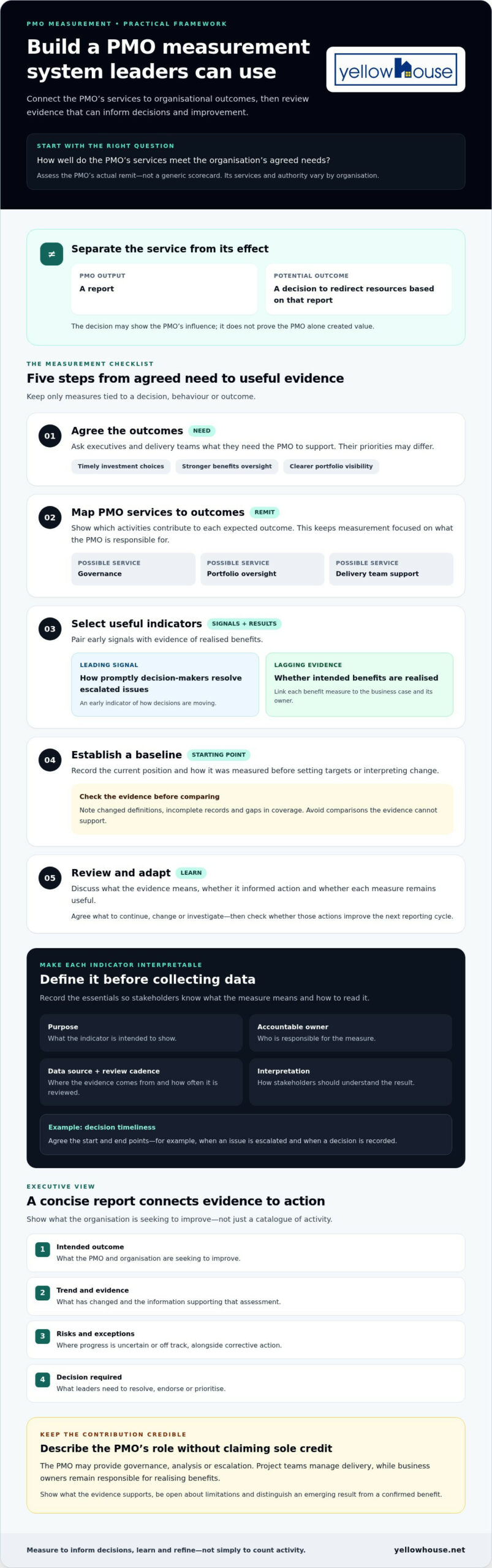
Measuring PMO performance and value starts with a practical question: how well do the PMO’s services meet the organisation’s agreed needs? These services may include governance, portfolio oversight, reporting or support for delivery teams. Their purpose and authority vary, so assess the PMO’s actual remit rather than applying a generic scorecard. A Project Management Office (PMO) can fulfil different functions, making context essential when deciding what effective performance looks like.
PMO value is the contribution its services make to useful decisions and the realisation of organisational benefits. This keeps the focus on contribution: the PMO can inform and enable outcomes without claiming sole responsibility for them.
Which PMO outcomes should measurement reflect?
Ask executives what they need from the PMO, then explore the same question with delivery teams. Leaders may need clearer evidence to prioritise investment, while teams may need timely decisions or consistent governance. These perspectives help identify where the PMO can make a meaningful difference and where its remit does not extend.
Choose outcomes that fit the organisation’s context. Portfolio visibility may help one PMO’s leaders understand competing demands; another may need to focus on benefits oversight or stronger governance. Map each expected outcome to a specific PMO service, then distinguish the service’s output from its effect. A report is an output. A decision to redirect resources based on that report is a potential outcome. The decision shows the PMO’s influence, but does not prove that the PMO alone created value.
Portfolio-office practices, such as those covered through P3O® training, can help clarify how office functions support organisational needs. This gives measurement a credible starting point: assess the services the PMO is responsible for and the outcomes those services are intended to support.
How to build a practical PMO performance and value measurement system
A workable system connects what the PMO does with what the organisation needs to decide or achieve. Keep the measures selective: use only measures tied to a decision, behaviour or outcome. This prevents reporting effort from growing without making the results more useful.
- Agree the outcomes. Confirm what leaders and delivery teams need the PMO to support, such as timely investment choices or stronger benefits oversight.
- Map services to outcomes. Show which PMO activities contribute to each outcome so measures reflect the PMO’s actual remit.
- Select indicators. Pair leading signals, such as how promptly decision-makers resolve escalated issues, with lagging evidence, such as whether intended benefits are realised.
- Establish a baseline. Record the current position and how it was measured before setting targets or interpreting change.
- Review and adapt. Discuss what the evidence means, whether it informed action and whether each measure remains useful.
How should a PMO choose indicators and establish a baseline?
Define each indicator before collecting data. Record its purpose, accountable owner, data source, review cadence and how stakeholders should interpret it. For example, a decision-timeliness measure needs an agreed start and end point, such as when an issue is escalated and when a decision is recorded. Industry guidance, including the Key PMO Metrics for Measuring Value, can prompt discussion, but the final indicators should fit your context.
Use historical data cautiously. Note changes in definitions, incomplete records or gaps in coverage, and avoid comparisons the evidence cannot support. For benefits, link each measure to the relevant business case, expected benefit and person responsible for tracking or realising it. Clear benefits management practices can make that ownership visible. This disciplined approach makes measuring PMO performance and value more credible, even when data has limitations.
How to communicate PMO value and improve performance over time
Executives need a clear view of what the PMO’s work is helping the organisation achieve, not a catalogue of activity. Keep reports concise and connect the evidence to a decision or action. A useful executive view includes:
- Intended outcome: what the PMO and organisation are seeking to improve.
- Trend and evidence: what has changed and the information supporting that assessment.
- Risks and exceptions: where progress is uncertain or off track, alongside corrective action.
- Decision required: what leaders need to resolve, endorse or prioritise.
What should an executive PMO value report include?
Prioritise changes in decision quality, portfolio visibility and confidence in benefits where evidence supports them. For instance, show whether decision-makers received clearer information, what action followed and what remains unresolved. Don’t hide exceptions behind favourable indicators or a count of completed activities. An honest account of limitations helps leaders distinguish an emerging result from a confirmed benefit.
Be precise about contribution. The PMO may provide governance, analysis or escalation, while project teams manage delivery and business owners remain responsible for realising benefits. Describe the PMO’s role as evidence of contribution, not proof of sole causation. Link expected benefits to the business case and clarify who owns their realisation, supported by established benefits management and better business cases.
Use each review to agree what to continue, change or investigate, then check whether those actions improve the next reporting cycle. This makes measuring PMO performance and value a learning process rather than a one-off justification exercise. Where capability or portfolio-office practices need strengthening, P3O training can support that development. Yellowhouse provides portfolio office training through its training services.
Make measurement part of stronger PMO governance
Let your measures mature as organisational priorities and the PMO’s role evolve. Make evidence part of everyday governance so teams can learn from decisions and adjust how they support change. This takes capability as well as good data: people need shared practices for managing projects, programmes and portfolios.
Yellowhouse supports this development through training across project, programme and portfolio management frameworks, alongside strategic change consulting and Gateway assurance. These services can help organisations strengthen the governance and capability that underpin meaningful measurement, without treating a set of indicators as an end in itself. Yellowhouse supports organisations in Brisbane, Sydney, Melbourne, Canberra, Adelaide, Perth, Cairns, Townsville, Hobart, Darwin, Mackay, the Gold Coast, Logan, Ipswich and Toowoomba.
Discuss how Yellowhouse can support stronger PMO governance and identify a practical next step for your organisation. With clear intent and a commitment to learning, your PMO can build a more useful evidence base and support better outcomes over time.
Frequently Asked Questions
How do you measure PMO value?
Measure whether PMO support makes a discernible difference to organisational priorities, using evidence decision-makers can act on. For example, examine a decision log to see whether portfolio recommendations led to reprioritisation, then track what changed as a result. Measuring PMO performance and value means interpreting that evidence in context, including other factors that may have influenced the outcome.
What are useful KPIs for a PMO?
Useful KPIs depend on the PMO’s responsibilities. Possible indicators include the proportion of projects with a named benefits owner, the completeness of portfolio information at review time, or the frequency of decisions later reversed because key information was missing. These measures can reveal where processes need attention. Define terms consistently so teams interpret results in the same way across reporting periods.
How often should PMO performance be reviewed?
Set review timing to match how quickly the PMO’s work and outcomes can change. A monthly check may suit operational signals, while a quarterly discussion may give leaders a clearer view of strategic patterns. Review measures sooner if priorities shift or a major issue emerges. Keep data collection proportionate and reserve time in each review to agree follow-up actions.
Can a PMO demonstrate value without financial measures?
Yes. A PMO can show non-financial value through evidence such as clearer accountability, improved visibility of dependencies or more consistent governance decisions. For example, feedback from project leads may reveal that escalation pathways are easier to use, while meeting records show whether issues reach the right decision-makers. Pair these observations with a defined organisational need and review them over time.


About Post Author
