

Benefits of MSP Certification Australia: A 2026 Career & Governance Guide
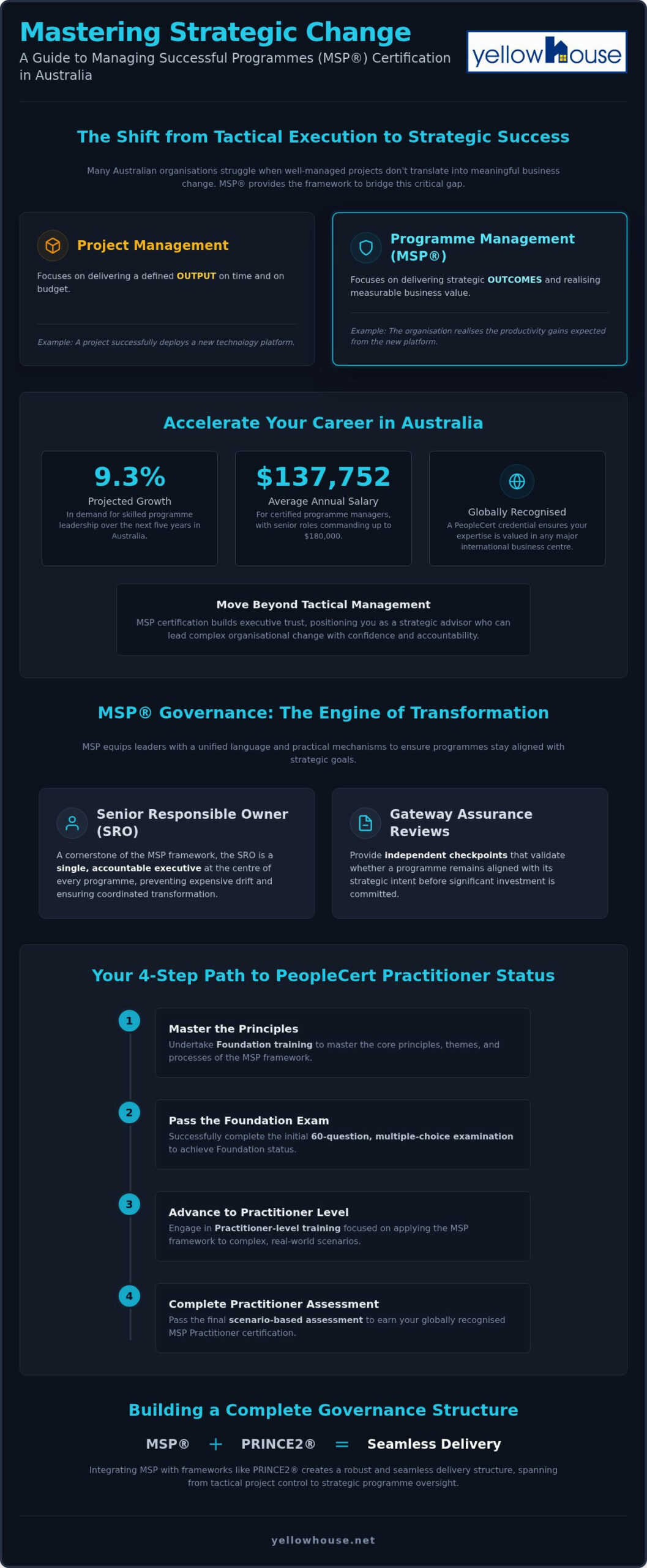
Why do so many complex organisational change initiatives fail even when they’re staffed by talented project managers? You likely recognise the frustration of overseeing disconnected projects that fail to align with your business strategy or lack a standardised governance language. It’s a common hurdle in the Australian market, where the demand for skilled programme leadership is projected to grow by 9.3% over the next five years. Understanding the benefits of MSP certification Australia is the first step toward bridging this gap between tactical execution and strategic success.
We’ll show you how the PeopleCert framework empowers you to manage risk effectively while delivering measurable benefits that justify higher day rates. This 2026 guide explores the essential role of MSP in modern governance and how it can elevate your career to senior-level roles paying an average of $137,752 per year.
Key Takeaways
- Learn to distinguish between managing project outputs and programme outcomes to ensure your change initiatives deliver genuine strategic value to your organisation.
- Explore the professional benefits of MSP certification Australia, from commanding higher day rates to achieving a globally recognised PeopleCert credential.
- Master a proven four-step roadmap to transition from Foundation to Practitioner status while navigating the complexities of the 2026 Australian job market.
- Discover how to align MSP with existing frameworks like PRINCE2 to build a robust governance structure that minimises failure in large-scale organisational change.
Scaling from Projects to Programmes: Why Australian Leaders Need MSP
Managing Successful Programmes (MSP) is the globally recognised PeopleCert framework for leading complex, strategic change. Where project management focuses on delivering a defined output, programme management asks a harder question: is this change actually creating the business value we set out to achieve? That distinction is fundamental, and it’s precisely where many Australian organisations stumble.
Projects produce outputs. Programmes deliver outcomes. A project might successfully deploy a new technology platform on time and on budget, yet the organisation still fails to realise the productivity gains it expected. MSP closes that gap by keeping leadership focused on benefits realisation rather than just solution delivery.
The Strategic Shift: From Solution Delivery to Business Transformation
Australian government and corporate sectors share a common failure pattern: collections of well-managed projects that don’t cohere into meaningful organisational change. The root cause is almost always a siloed mindset, where each project team optimises for its own deliverable without reference to the broader strategic objective. MSP replaces this with a cohesive solution model that connects every workstream to a defined benefit.
Two governance mechanisms make this shift practical. First, Gateway assurance reviews provide independent checkpoints that validate whether a programme remains aligned with its strategic intent before significant investment is committed. Second, the Senior Responsible Owner (SRO) role, a cornerstone of the MSP framework, places a single accountable executive at the centre of every programme. In the Australian context, where large public sector programmes often span multiple agencies, a clearly defined SRO is the difference between coordinated transformation and expensive drift.
Understanding the benefits of MSP certification Australia starts here: it equips leaders with a unified governance language that diverse stakeholder groups, from Treasury to frontline delivery teams, can actually use together.
Quantifiable Benefits: How MSP Certification Accelerates Australian Careers
Achieving a recognised credential significantly accelerates Australian careers by verifying a practitioner’s ability to handle high-stakes complexity. In major hubs like Sydney, Canberra, and Melbourne, the financial rewards reflect the scarcity of these specialized skills. Average annual salaries for programme managers now reach $137,752; however, senior-level practitioners in infrastructure or IT frequently command up to $180,000. Beyond local gains, the PeopleCert credential offers a globally recognised passport for professional mobility, ensuring your expertise is valued in any major international business centre.
Benefit Realisation: The Key to Australian Programme Success
In a landscape defined by rigorous government audits and fiscal scrutiny, Managing Benefits has emerged as the most critical skill for Australian programme offices. The MSP ‘Benefit Map’ serves as a rigorous logic model, ensuring every dollar invested is traceable to a specific, measurable outcome that supports the bottom line. MSP certification transforms a manager’s focus from tracking milestones to delivering measurable organisational value. To begin this transition, consider how PeopleCert accredited training can provide the formal structure required for your next career move.
Implementing MSP in 2026: The Path to PeopleCert Practitioner Status
Transitioning from theory to application requires a structured approach. For Australian professionals, the path to Practitioner status follows a logical four-step roadmap: master the MSP principles through Foundation training, pass the initial 60-question exam, advance to Practitioner-level scenario application, and finally complete the scenario-based assessment. It’s most effective when MSP is integrated with PRINCE2 Programme Management, creating a seamless delivery framework that spans from tactical project control to strategic programme oversight.
A common objection to certification is the perceived gap between academic theory and real-world application. We address this by providing practitioner-led training that draws on actual Australian case studies and seasoned experience. PeopleCert ensures the framework remains modern and rigorous, maintaining high standards that protect the professional integrity of your credential. Realising the benefits of MSP certification Australia depends on this practical grounding, ensuring you can lead complex change with seasoned wisdom rather than just textbook knowledge.
Modern Governance: Integrating MSP with Agile and Digital Frameworks
The 5th Edition of MSP (Version 5) is designed for the high-velocity digital age. It provides the necessary flexibility to support agile delivery models common in the Australian tech sector. There is significant synergy between MSP and PRINCE2 Agile, particularly for large-scale digital transformations where speed and governance must coexist. As we move through 2026, PeopleCert’s focus on AI governance is also beginning to influence programme risk management, providing new tools to oversee automated decision-making and data-driven initiatives. This evolution ensures that the benefits of MSP certification Australia remain relevant in an increasingly automated landscape.
Leading Strategic Change in 2026 and Beyond
The Australian professional landscape requires leaders who can navigate complexity with a focus on measurable outcomes. By mastering the PeopleCert framework, you move beyond simple milestone tracking to become an architect of genuine organisational transformation. The primary benefits of MSP certification Australia lie in this ability to align diverse project outputs with a cohesive business strategy, ensuring every investment delivers its intended value.
Yellowhouse provides expert-led courses delivered by practitioners with real-world Australian experience. Whether you’re based in Brisbane, Sydney, or Melbourne, our flexible delivery options support your journey toward Practitioner status. View upcoming MSP Certification courses at Yellowhouse Australia and take the next step in your professional growth. We look forward to partnering with you on your path to leadership.
Frequently Asked Questions
Is MSP certification better than PMP for Australian programme managers?
MSP and PMP serve different professional purposes within the management hierarchy. While PMP is a project-level qualification, MSP is the specific gold standard for programme management and strategic change. In major centres like Sydney and Canberra, organisations specifically seek MSP-certified leaders to manage complex portfolios. It provides a governance framework that PMP lacks for multi-project coordination and benefits realisation.
How long does it take to complete the MSP Foundation and Practitioner courses in Australia?
Most accredited training providers in Australia offer a combined five-day intensive course covering both Foundation and Practitioner levels. This typically involves three days of Foundation theory followed by two days of Practitioner-level application. Flexible delivery options are available across Brisbane, Melbourne, and Perth, allowing professionals to complete their certification while balancing existing workplace commitments in a single business week.
What are the prerequisites for the MSP Practitioner exam under PeopleCert?
Candidates must successfully pass the MSP Foundation exam before they are eligible to sit the Practitioner exam. This prerequisite ensures you have a firm grasp of the core principles and themes before applying them to complex scenario-based assessments. Achieving both levels is one of the key benefits of MSP certification Australia, as it demonstrates a complete mastery of the PeopleCert programme management framework.
Does the Australian Government recognise MSP for its Gateway Review process?
Yes, the Australian Government and various state agencies highly value MSP for its alignment with Gateway assurance reviews. The framework’s emphasis on benefits management and risk oversight mirrors the requirements of independent Gateway reviews. Using a standardised PeopleCert language allows programme teams to engage effectively with auditors and executive sponsors in cities like Canberra, ensuring high-stakes public sector initiatives remain on track.


About Post Author
