

AI Project Governance Framework: The 2026 Guide to Responsible Innovation
With only 36% of Australians willing to trust AI systems, the pressure to move beyond "black box" deployments has never been higher. You’ve likely felt the tension between the push for rapid innovation and the looming December 2026 Privacy Act reforms. Building a robust AI project governance framework isn’t just about ticking boxes. It’s about ensuring your agentic systems don’t become reputational liabilities while navigating the new Office of AI standards.
Aligning these emerging technologies with established PRINCE2 or MSP structures can feel like a complex puzzle. This guide provides a repeatable model for AI stewardship, helping you master the PeopleCert ITIL 6C Model and DTA standards to deliver ethical projects that pass every assurance gate. You’ll learn how to secure ITIL AI Governance (Version 5) certification and navigate the Investment Oversight Framework with confidence. We’ll show you how to turn regulatory ambiguity into a distinct competitive advantage.
Key Takeaways
- Transition your approach from restrictive compliance to value-enabling stewardship to effectively manage the unique risks associated with autonomous agentic AI systems.
- Implement a robust AI project governance framework Australia wide by leveraging the PeopleCert 6C Model and selecting the most appropriate governance pattern for your project’s complexity.
- Seamlessly integrate AI governance into your existing PRINCE2 and MSP structures by aligning AI-specific risks with established organisational themes and Senior Responsible Official accountabilities.
- Gain the practical knowledge required to pass the ITIL AI Governance (Version 5) assessment and successfully navigate Australian DTA Gateway assurance reviews.
The Australian AI Landscape: Why Governance is Non-Negotiable in 2026
Effective governance acts as the steering system for innovation rather than a handbrake. In 2026, a robust AI project governance framework Australia wide must move beyond rigid compliance toward active stewardship. Traditional IT governance often fails because it’s designed for static assets. The shift toward agentic AI, where systems act with a degree of autonomy, demands a more dynamic oversight model. These "rogue" risks aren’t hypothetical; they’re the result of applying 20th-century controls to 21st-century intelligence while navigating the new Office of AI standards.
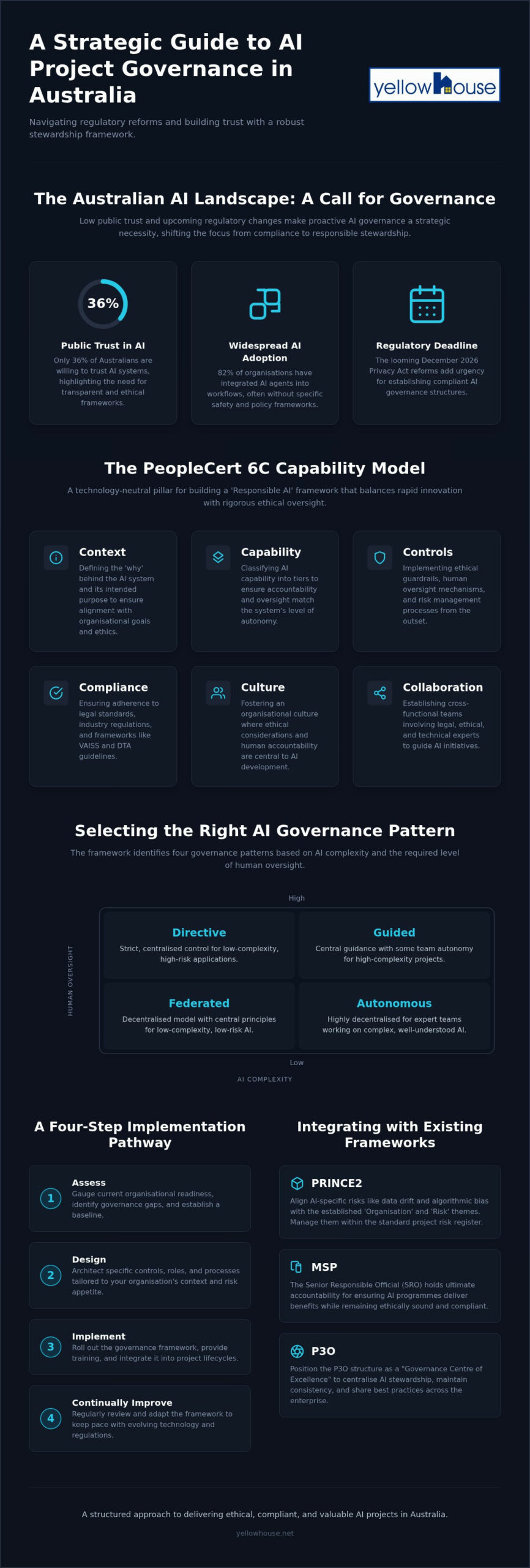
Recent industry insights show that 82% of organisations have integrated AI agents into their workflows, yet many lack the specific policy frameworks required to manage them safely. This disconnect leaves leaders vulnerable to operational and ethical lapses. Aligning your strategy with Global AI Ethics Principles is a vital first step in ensuring that human accountability remains central to every automated decision. It’s about protecting your organisation’s reputation while unlocking the full potential of your technical investments.
Navigating the DTA and Investment Oversight Framework
The Digital Transformation Agency (DTA) oversees the Investment Oversight Framework (IOF), which guides projects through six distinct states from Strategic Planning to Operations. For AI initiatives to succeed, they must demonstrate "Governance by Design" to satisfy the AI Review Committee’s scrutiny. This approach embeds ethical guardrails directly into the project lifecycle. Engaging independent Gateway assurance allows your team to identify critical governance gaps early. These reviews ensure your project remains compliant with the Voluntary AI Safety Standard (VAISS) and the Guidance for AI Adoption (AI6), providing a clear path through every assurance gate.
The PeopleCert AI Governance Framework: Implementing the 6C Model
Establishing a standard is the first step toward reliable innovation. The PeopleCert 6C Capability Model serves as a technology-neutral pillar for any AI project governance framework Australia requires today. It ensures that ethical considerations aren’t sidelined by technical momentum. This model provides the necessary structure to manage the unique risks of machine learning while maintaining the agility needed for modern delivery.
Mastering the 6C Capability Model
The 6Cs encompass Context, Capability, Controls, Compliance, Culture, and Collaboration. By evaluating these categories, you can build a "responsible AI" framework that balances rapid innovation with rigorous ethics. This involves defining the ‘why’ behind the system and the ‘how’ of its oversight. Professionals seeking to master this approach should consider the ITIL AI Governance certification, which provides the formal grounding needed for high-stakes environments.
To manage diverse AI applications, the framework identifies four governance patterns: Directive, Guided, Federated, and Autonomous. Selecting the right pattern involves a 2×2 matrix that weighs the complexity of the AI against the required level of human oversight. The 6C Model classifies AI capability into distinct tiers to ensure accountability matches the autonomy of the system.
Implementation follows a logical four-step pathway: Assess, Design, Implement, and Continually Improve. You start by gauging current organisational readiness before architecting specific controls. This methodical cycle ensures that your AI stewardship remains relevant as your technical capabilities evolve. It’s a structured way to prove that your AI project governance framework Australia wide is both principled and practical.
Integrating AI Governance with PRINCE2 and MSP
Strategic AI implementation requires more than just technical expertise. It demands a seamless blend with established project methodologies to ensure that innovation doesn’t outpace oversight. An effective AI project governance framework Australia relies on integrates directly with the PRINCE2 project management "Organisation" and "Risk" themes. This alignment ensures that AI-specific risks, such as data drift or algorithmic bias, are managed within the standard project risk register. Under MSP standards, the Senior Responsible Official (SRO) holds the ultimate accountability for ensuring that AI programs deliver their intended benefits while remaining ethically sound.
A P3O structure acts as the vital hub for AI stewardship across the enterprise. By positioning the P3O as a "Governance Centre of Excellence," organisations can centralise their AI governance patterns and maintain a consistent approach to autonomous systems. This centralised oversight helps project teams navigate the complexities of agentic AI while ensuring every initiative remains aligned with broader strategic objectives.
The Path to AI Governance Certification
Validating your capability is the final step in establishing professional authority. The ITIL AI Governance assessment involves 40 questions over 90 minutes, with a 70% pass requirement to earn your certification. Maintaining a PeopleCert Plus membership provides ongoing access to the latest tools and capability development resources. For teams based in Brisbane, Sydney, or Canberra, our 2-day accredited classroom sessions provide the practical experience needed to lead responsible innovation. Book your session now to ensure your organisation is ready for the 2026 regulatory landscape.
Future-Proofing Your AI Stewardship
Implementing a robust AI project governance framework Australia wide is the most effective way to ensure your innovation remains ethical and high-performing. By adopting the PeopleCert 6C Model, you move beyond basic compliance to true organisational stewardship. This approach ensures your agentic systems are managed with the same rigour as your PRINCE2 projects, satisfying DTA standards and passing every Gateway assurance gate with confidence.
As a PeopleCert Accredited Training Organisation, Yellowhouse provides the expert-led guidance you need to lead these complex initiatives across all major Australian cities. Our Gateway assurance specialists are ready to help you navigate the 2026 regulatory landscape while building your team’s internal capability. Take the next step in your professional development and enrol in ITIL AI Governance training with Yellowhouse today. We’re here to help you turn governance into your organisation’s greatest competitive advantage.
Frequently Asked Questions
What is the most common AI governance framework used in Australia?
Most Australian organisations currently rely on the government’s Voluntary AI Safety Standard (VAISS) and the "Guidance for AI Adoption" (AI6). However, for project-level implementation, the PeopleCert 6C Model is becoming the preferred AI project governance framework Australia wide. It provides a structured, technology-neutral approach that integrates with existing management systems to ensure ethical stewardship and successful Gateway assurance outcomes.
How does the PeopleCert AI Governance certification differ from generic AI ethics courses?
This certification differs by providing a practical, technology-neutral playbook for real-world application rather than just theoretical ethics. It introduces the 6C Capability Model and four governance patterns to classify AI autonomy. You’ll master a repeatable implementation pathway (Assess, Design, Implement, Improve), ensuring accountability is embedded into your delivery lifecycle. This approach helps project leaders in Melbourne and Brisbane manage autonomous system risks effectively.
Does the DTA require a specific AI project governance framework for government contracts?
While the Digital Transformation Agency (DTA) doesn’t mandate a specific commercial framework, it requires compliance with the Investment Oversight Framework (IOF). To pass Gateway assurance reviews, projects must demonstrate "Governance by Design" and align with VAISS guardrails. Utilising a robust AI project governance framework Australia wide, like the PeopleCert model, provides the documented evidence needed to satisfy the AI Review Committee’s scrutiny.
Can I integrate AI governance into my existing PRINCE2 project structure?
You can seamlessly integrate AI governance patterns into the PRINCE2 "Organisation" and "Risk" themes. This allows you to manage specific AI risks, such as data drift, within your existing project structures. Agencies in Canberra or Sydney often use their P3O as a Governance Centre of Excellence to ensure consistent stewardship across all programmes, making the Senior Responsible Official’s oversight more effective.


About Post Author
