

Benefits of a P3O Model: How It Improves Organisational Delivery
What if better organisational delivery depends on clearer decisions, not more process? When project activity feels disconnected from strategic priorities and reporting varies across initiatives, it’s reasonable to ask whether an office would improve outcomes or simply add bureaucracy. The benefits of a P3O model come from the value its support and governance functions provide, not from adding structure for its own sake.
This article explains how a P3O model can strengthen strategic alignment, coordination, resource visibility and decision-making. It also covers how different configurations can support different delivery environments, and what to consider when assessing whether a model fits your organisation. The practical starting point is to identify the delivery problems you need to solve, then decide which P3O functions could help.
Key Takeaways
- The benefits of a P3O model depend on how well its support connects delivery activity with organisational priorities.
- Identify delivery challenges and desired outcomes before choosing a proportionate structure or adding processes.
- Centralised, distributed and hybrid P3O designs offer different ways to coordinate support across an organisation.
- Use observable signs and leadership questions to assess fit, then build framework understanding to inform organisation-specific decisions.
Benefits of a P3O model: connect delivery activity with organisational priorities
A P3O, or Portfolio, Programme and Project Offices, model provides a structured way to organise support for portfolio, programme and project work. It can bring governance, reporting and specialist expertise together, giving leaders a clearer view of delivery across the organisation. Without that shared view, updates from separate initiatives may use different formats or definitions, making it difficult to compare progress and act on emerging issues.
Consistent information can help decision-makers see whether initiatives remain aligned with organisational priorities, where resources are committed and which issues need attention. For example, if several projects rely on the same specialist team, a portfolio-level view can reveal competing demands. Leaders can then consider whether to change priorities, adjust sequencing or provide additional support.
The benefits of a P3O model are greatest when information helps people make a decision, rather than simply meet a reporting requirement. A common view of progress supports informed prioritisation, but it can’t guarantee that a project will succeed or deliver its intended benefits.
How does P3O support better decisions and strategic alignment?
Coordinated reporting gives decision-makers a basis for comparing initiatives against agreed priorities. Useful information can include objectives, status, dependencies, risks and resource needs. Together, these details can show where delivery is progressing as intended, where priorities have shifted and where leaders need to resolve competing demands. The information supports judgement; it doesn’t replace it.
Strategic alignment makes prioritisation better informed by showing how proposed and active work relates to organisational objectives. To assess whether an initiative is achieving its intended outcomes, organisations also need to define what success looks like and monitor progress against those outcomes. Managing benefits guidance can help clarify the link between intended change and the value an organisation seeks to realise.
How to realise P3O model benefits without creating unnecessary bureaucracy
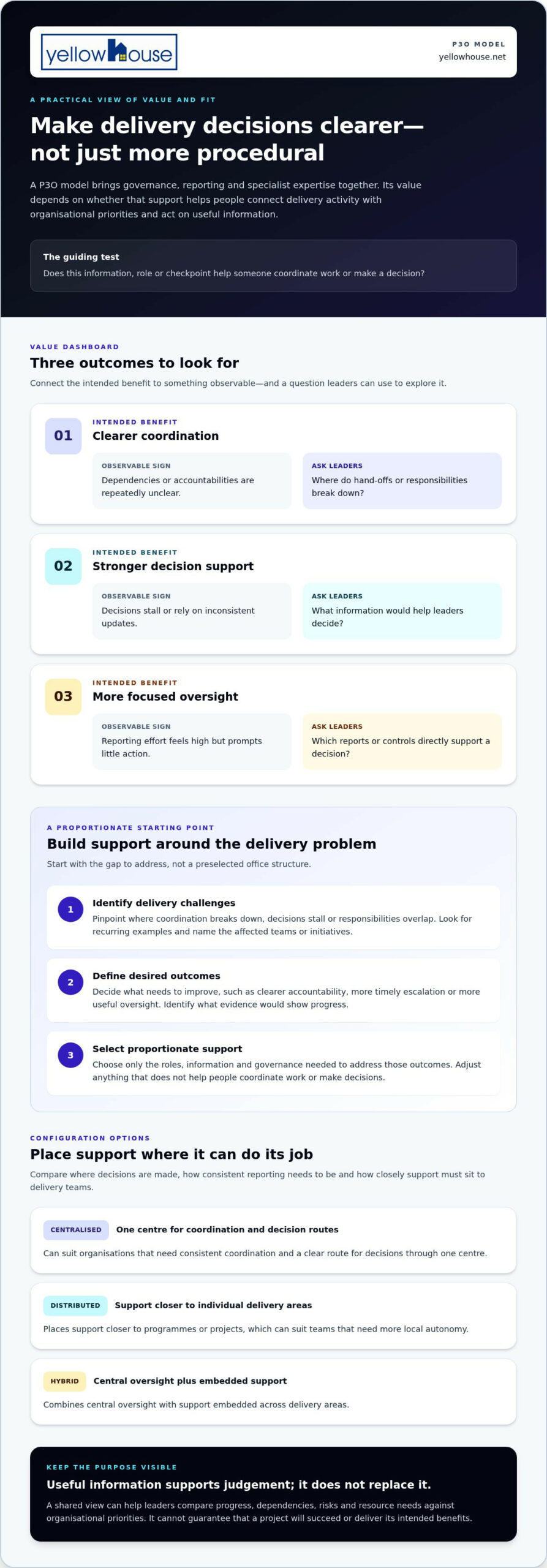
Start with the delivery problem, not a preselected office structure. A P3O should make a real organisational need easier to manage. Before introducing a report, approval or coordination role, identify the gap it is meant to address and who will use the resulting information.
- Identify delivery challenges. Pinpoint where coordination breaks down, decisions stall or responsibilities overlap. Name the affected teams or initiatives, and look for recurring examples rather than isolated frustrations.
- Define desired outcomes. Decide what needs to improve, such as clearer accountability, more timely escalation or more useful oversight. Identify what evidence would show progress before adding reporting activity.
- Select proportionate support. Choose only the roles, information and governance needed to address those outcomes. Review whether each element helps people coordinate work or make decisions, and adjust if it doesn’t.
Which P3O configuration fits your organisation?
A centralised office can suit organisations that need consistent coordination and a clear route for decisions through one centre. A distributed arrangement places support closer to individual programmes or projects, which can suit teams that need more local autonomy. A hybrid model combines central oversight with support embedded across delivery areas. Compare the options by asking where decisions are made, how consistent reporting needs to be and how closely support must sit to delivery teams. The P3O framework and office support provide a basis for considering these design options.
P3O design should reflect your organisation’s context and the outcomes its support is intended to enable. Before introducing a report or governance checkpoint, ask who will use the information, what decision it supports and how often that decision needs to be made. If there’s no clear answer, the activity may add overhead without improving oversight.
Understanding the framework helps teams take part in informed design discussions. Yellowhouse provides P3O training to build framework understanding, so practitioners can discuss P3O functions and design choices with a shared vocabulary. Training supports those discussions; the organisation still needs to make design decisions based on its own context.
Assess the benefits of a P3O model and choose your next capability step
Before investing in P3O capability, look for recurring problems rather than starting with a preferred structure. Are teams unclear about who makes decisions? Do leaders lack a reliable view of competing initiatives? Are support roles duplicated, or do important delivery issues reach decision-makers too late? Specific patterns help distinguish a capability gap from a broader organisational design question.
Use this assessment to connect the value you want from P3O with observable evidence and useful leadership discussion:
The answers can indicate whether people need a stronger understanding of P3O, whether existing support needs adjustment or whether leaders need to consider wider changes to roles and governance. Training builds framework knowledge and gives practitioners a shared language for discussing offices, functions and support. It doesn’t determine the structure that will suit your organisation; that choice depends on your context, priorities and operating arrangements.
What should leaders assess before investing in P3O capability?
Agree on the problem to address, the evidence that would show progress and who owns decisions about organisational change. Then decide whether learning is the immediate next step or whether design work needs to come first. This keeps the benefits of a P3O model grounded in organisational needs, rather than treating training as an implementation plan.
Yellowhouse provides P3O framework training to help practitioners develop a structured understanding of the framework.
Turn delivery insight into your next capability step
The value of a P3O model isn’t measured by the number of offices, reports or controls an organisation creates. It’s reflected in whether people have the understanding and support to make sound delivery choices as priorities evolve. Build that understanding before deciding what organisational changes, if any, are needed.
Yellowhouse provides project, programme and portfolio management training and consulting for Australian organisations and practitioners in Brisbane, Sydney, Melbourne, Canberra, Adelaide, Perth, Cairns, Townsville, Hobart, Darwin, Mackay, the Gold Coast, Logan, Ipswich and Toowoomba. If you’re ready to develop your P3O capability, explore P3O training with Yellowhouse.
The benefits of a P3O model are most relevant when they support the outcomes your organisation cares about. Start by identifying the delivery challenges you need to address, then build the framework knowledge to discuss your next step with confidence.
Frequently Asked Questions
Can a small organisation benefit from a P3O model?
Yes, a small organisation can benefit from a P3O model if it addresses a real delivery need. The benefits of a P3O model might include clearer ownership when one person is managing several initiatives alongside operational work. A lightweight arrangement, such as assigning a defined coordination responsibility within an existing role, may be more suitable than establishing a separate office.
Does a P3O model replace project management frameworks such as PRINCE2?
No, P3O doesn’t replace PRINCE2 or another project management method. They serve different purposes: a delivery method guides how a project is managed, while P3O concerns the support around portfolio, programme and project work. An organisation can use P3O alongside a method it already applies, without adopting several frameworks simply because it establishes P3O support.
Who should be involved when an organisation considers a P3O model?
Involve the people who set priorities, make delivery decisions and understand how work is currently supported. This could include an executive sponsor, portfolio or programme leads, project managers and staff who prepare delivery information. For example, asking report users and authors where updates become unclear can reveal different needs before leaders decide on responsibilities or structure.
How can an organisation avoid making a P3O office overly bureaucratic?
Keep each P3O activity connected to a practical purpose. For a proposed status report, identify the decision it should inform and who will use it. If it merely repeats existing information, simplify or remove it. Review governance steps when priorities or delivery needs change, so controls remain useful rather than becoming routine tasks that consume time without guiding action.


About Post Author
