

Roles and Responsibilities in a PMO: A Practical Guide
What if the issue with your PMO isn’t too little control, but responsibilities that don’t fit your organisation? The roles and responsibilities in a PMO should make ownership clear and support the work your organisation needs.
When ownership of standards, reporting and project support is blurred, teams can duplicate effort or assume someone else is accountable. It’s also easy to confuse the PMO’s role with a project manager’s responsibility for delivering a specific project.
This guide explains what a PMO typically does, who contributes to its key functions and where role boundaries sit. You’ll find practical ways to assign responsibilities, shape services around organisational needs and review whether the PMO is helping. A structured P3O approach can help bring consistency to project, programme and portfolio offices without adding process for its own sake.
Key Takeaways
- Distinguish a PMO’s organisational support function from the authority it holds in your specific context.
- Use the roles and responsibilities in a PMO to assign clear ownership across governance, reporting, standards, coordination and capability development.
- Keep project managers accountable for delivering their assigned projects while PMO staff carry out agreed organisational functions.
- Shape the PMO around your needs: identify priorities, choose useful services, assign owners and review outcomes.
What does a PMO do? Understand its purpose and boundaries
A project management office (PMO) is an organisational function that helps coordinate, oversee or support project work. Its purpose is to make agreed ways of working more consistent and give people the information and support they need to make informed decisions.
A PMO supports project work across an organisation; an individual project team delivers a specific project. That distinction is useful, but it doesn’t prescribe one structure. Some PMOs focus on guidance and shared tools. Others coordinate planning or provide more central oversight. The right services and level of authority depend on organisational needs, governance arrangements and the PMO’s agreed remit. The Project Management Office (PMO) definition and functions overview provides further context on common PMO forms and activities.
For organisations seeking a structured way to understand office roles and arrangements, P3O® Portfolio, Programme and Project Offices training explores a framework for portfolio, programme and project offices.
Where does a PMO’s remit begin and end?
The PMO’s remit should specify what it guides, coordinates or oversees, and what remains with project teams. For example, a PMO might maintain shared reporting guidance and consolidate project information. A project manager then uses that guidance to plan and manage delivery, and remains accountable for day-to-day project decisions within their authority. This supports consistency without shifting delivery ownership to the PMO.
Sponsors, project managers and PMO staff contribute from different positions. A sponsor provides direction and makes decisions within their delegated authority. The project manager leads the assigned project and raises issues that need attention. The PMO may provide information, guidance or coordination to support those decisions and delivery activities. Make these boundaries explicit rather than relying on assumptions about the PMO’s title.
Clear boundaries are central to defining the roles and responsibilities in a PMO. Document who provides advice, who makes decisions and who owns delivery. This helps prevent gaps and duplicated effort, while leaving room to adapt the PMO as organisational needs change.
PMO roles and responsibilities: map the work to clear accountabilities
Clear accountabilities turn PMO activity into practical organisational support. Typical responsibilities span several connected areas:
- Governance support: prepare decision forums, track actions and maintain visibility of issues, approvals and decisions required.
- Reporting: consolidate project updates so leaders can compare progress and understand risks, dependencies and decisions needed.
- Standards: maintain agreed guidance, templates and processes, adapting them to the organisation’s delivery environment.
- Coordination: connect teams, share information and identify cross-project dependencies, such as competing demands for the same specialist.
- Capability development: support consistent practice through guidance, learning and knowledge sharing.
Clear accountability gives decision-makers more consistent project information and a sounder basis for action. Define the PMO’s agreed functions separately from project managers’ delivery responsibilities. A responsibility map can show who prepares information, who reviews it, who makes decisions and who follows up actions. For each activity, name one accountable owner, even if several people contribute.
Which responsibilities belong to PMO staff, project managers, and sponsors?
The split depends on the organisation, and responsibilities may overlap in a smaller team. The key is to name an owner for each activity, even when one person performs more than one role.
| Role | Typical contribution |
|---|---|
| PMO staff | Coordinate shared processes, reporting, guidance and cross-project information. |
| Project manager | Plan and lead delivery, manage the project team, and report progress and issues. |
| Sponsor | Provide direction, champion the work and make decisions within their authority. |
Use the map to resolve overlaps. The PMO might consolidate risk information, while the project manager manages project risks and the sponsor considers escalated decisions. Specify who escalates an issue, who decides how to respond and who communicates the outcome. A structured P3O® approach to portfolio, programme and project offices can help clarify how these functions fit together. Yellowhouse’s P3O training builds practical understanding of these responsibilities.
How to shape PMO responsibilities around organisational needs
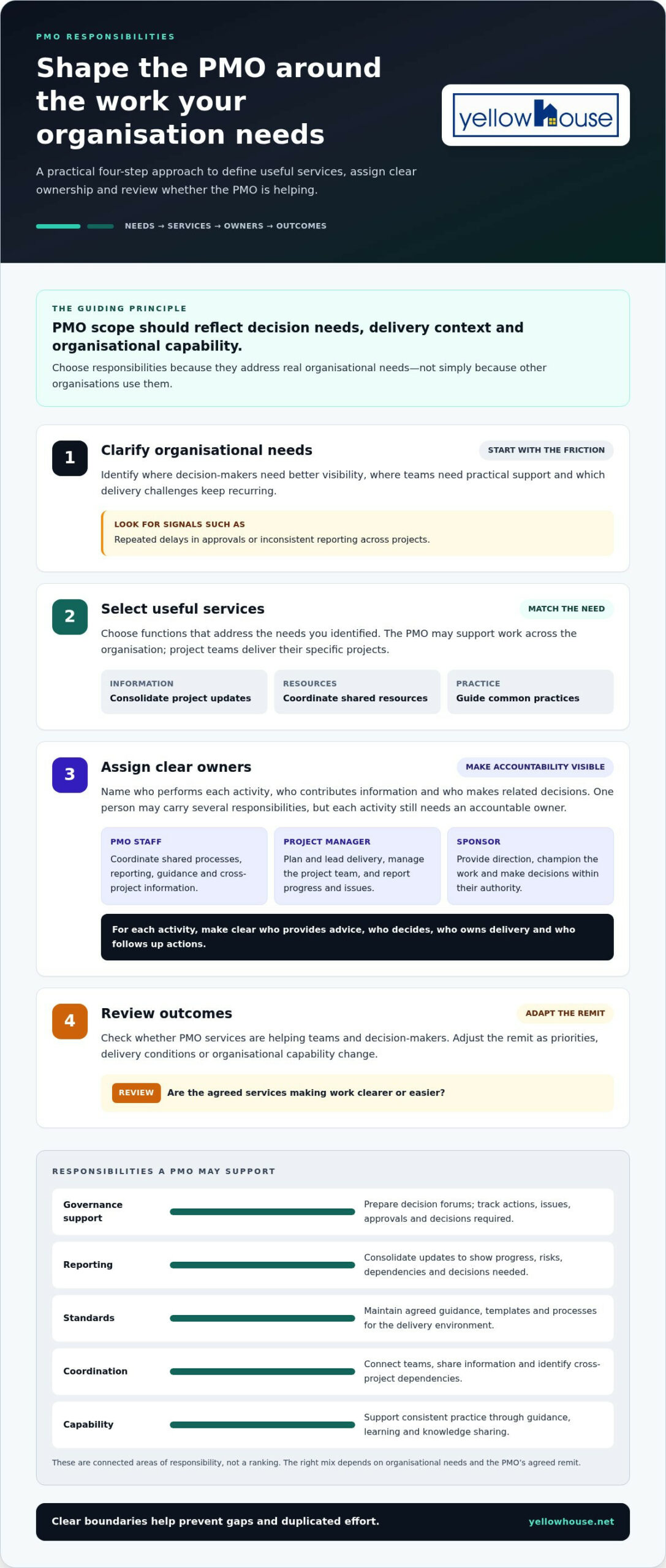
Start with the work your organisation needs the PMO to make clearer or easier. PMO scope should reflect decision needs, delivery context and organisational capability. This keeps responsibilities purposeful instead of adding processes simply because other organisations use them.
- Clarify organisational needs. Identify where decision-makers need better visibility, where teams need practical support and which delivery challenges keep recurring. For example, look for repeated delays in approvals or inconsistent reporting across projects.
- Select useful services. Choose functions that address those needs, such as consolidating project information, coordinating shared resources or providing guidance on common practices.
- Assign owners. Name who performs each activity, who contributes information and who makes related decisions. This remains important when one person carries several responsibilities.
- Review outcomes. Check whether the services are helping teams and decision-makers. Adjust the remit as priorities, delivery conditions or organisational capability change.
A support-focused PMO may concentrate on guidance, templates and reporting assistance, leaving project teams to apply them in their own context. A more centrally coordinated PMO may bring planning and oversight activities together across projects. Neither model is inherently better. Choose based on the coordination and decision support the organisation needs, balanced against the authority and capability it can sustain. If a service doesn’t solve a clear problem, reconsider whether it belongs in the PMO’s remit.
When can P3O help clarify a PMO’s structure?
P3O provides a framework for considering how portfolio, programme and project offices can be arranged and how their functions relate. It can help organisations decide which responsibilities belong at each level and how offices can support consistent delivery, without assuming every organisation needs the same design. To develop practical knowledge of PMO structures and accountabilities, explore Yellowhouse P3O training.
Make your PMO responsibilities work in practice
Treat the PMO remit as a working agreement, not a static chart. As priorities shift, revisit whether its services still help people make decisions and deliver change, and whether owners have the authority and capability to carry them out. This keeps the roles and responsibilities in a PMO connected to organisational purpose, rather than process for its own sake.
A practical next step is to identify one point of friction, such as unclear escalation or duplicated reporting. Agree who owns the issue, what action they will take and how you’ll know whether it helped. A focused adjustment gives teams a useful starting point for improving collaboration and identifying the support that works best.
To build a structured understanding of office arrangements and accountabilities, explore Yellowhouse P3O training. Use what you learn to refine the approach as your organisation evolves and help people move forward with clarity.
Frequently Asked Questions
Does every organisation need a PMO?
No, an organisation doesn’t automatically need a dedicated PMO. Project practices may be coordinated by existing leaders or through a lightweight arrangement. Consider formalising the function if competing initiatives repeatedly clash over specialist people, or decision-makers can’t see how commitments affect one another. The trigger is a recurring coordination problem, not a preferred organisational chart.
Can a PMO be temporary?
Yes. An organisation might establish a temporary PMO to support a defined period of change, such as introducing a new delivery approach or coordinating a time-limited programme. Set an intended end point and agree what must be in place before the PMO closes, such as transferring records, knowledge and ongoing tasks to permanent teams.
What is the difference between a PMO and a project manager?
A project manager leads a particular project, while a PMO is a function that can support work across several projects. For example, if two projects rely on the same specialist, the PMO might make the dependency visible. Each project manager still manages their own plans and raises impacts. Explicitly delegate any authority to resolve the conflict.
How should an organisation decide what its PMO is responsible for?
Define the roles and responsibilities in a PMO by documenting the outcomes it must support, the services it will provide and the limits of its authority. For distributed teams across Brisbane, Sydney, Melbourne, Canberra, Adelaide, Perth, Cairns, Townsville, Hobart, Darwin, Mackay, Gold Coast, Logan, Ipswich and Toowoomba, include how information and decisions move between locations. Review the agreement with the people who rely on it.


About Post Author
