

Types of PMO Models: How to Choose the Right Structure
What if the PMO designed to improve delivery is the very thing slowing it down? Choosing among the types of PMO models isn’t just a matter of terminology: each structure gives the office a different level of influence over standards, decisions and project work. Stronger oversight can add bureaucracy if it isn’t tied to a clear delivery need, while too little consistency can make it hard to compare progress or coordinate work.
The right choice depends on what your organisation needs the PMO to do, which decisions it should own and how much consistency your delivery environment requires. This guide compares supportive, controlling and directive models, then considers options such as enterprise and departmental PMOs. You’ll find practical criteria for matching authority to delivery needs, along with steps for defining roles, useful governance and support that helps teams deliver.
Key Takeaways
- Understand how supportive, controlling and directive types of PMO models differ in authority, oversight and delivery support.
- Compare each model’s decision rights and services with your organisation’s governance needs and delivery maturity.
- Shape a practical PMO by clarifying outcomes, defining services and assigning clear accountability.
- Pilot the arrangements and use feedback from delivery teams to refine governance and keep the PMO useful.
What are the main types of PMO models, and how do they differ?
A Project Management Office (PMO) is an organisational function that supports or governs how projects are delivered. It might share methods and expertise, set common expectations or take direct responsibility for delivery. The Project Management Office (PMO) on Wikipedia provides further background on the function and its history. For choosing a structure, focus on the office’s authority, services and scope.
What distinguishes supportive, controlling and directive PMOs?
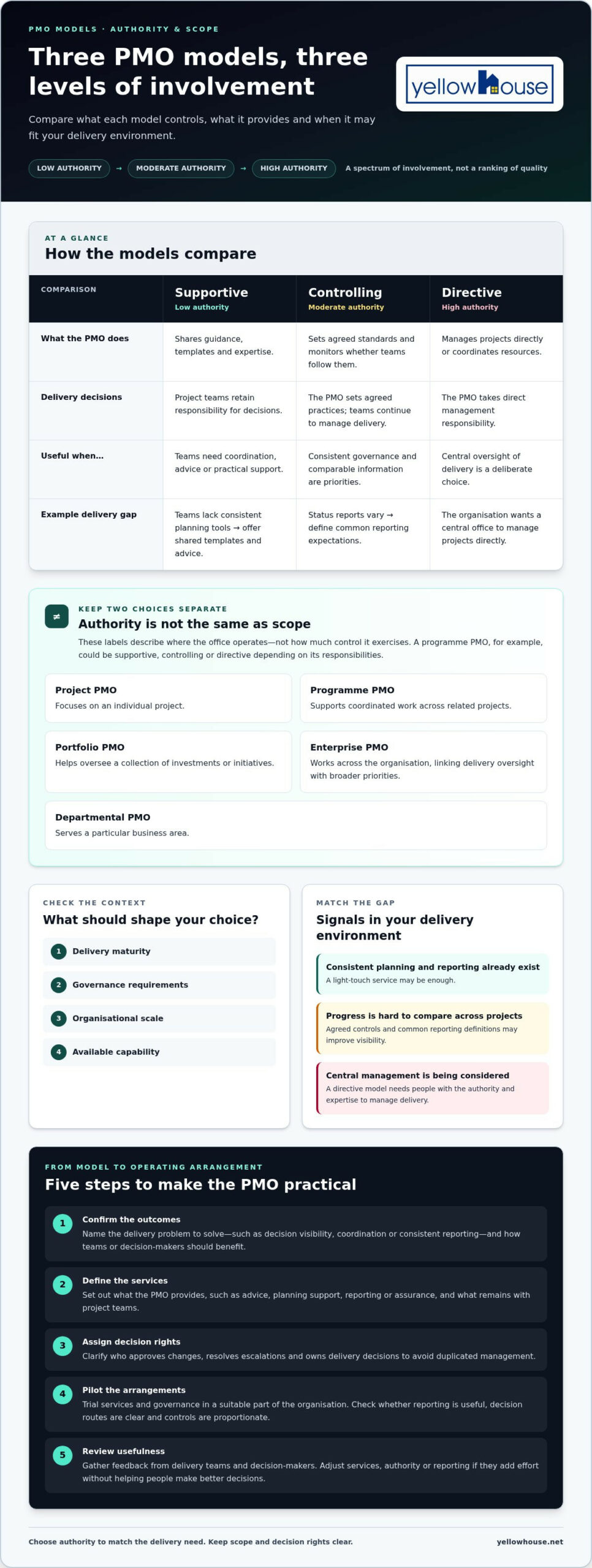
Think of these models as a spectrum of involvement, rather than a ranking of quality. A supportive PMO offers guidance, templates and expertise while project teams retain responsibility for decisions. A controlling PMO sets agreed standards and monitors whether teams follow them, creating consistency while teams continue to manage delivery. A directive PMO takes a hands-on role, directly managing projects or coordinating resources.
For example, if teams lack consistent planning tools, a supportive PMO could provide shared templates and advice. If leaders struggle to compare project status because teams report in different ways, a controlling PMO could define common reporting expectations. If the organisation wants a central office to manage projects directly, a directive model may fit. In all three cases, specify who makes decisions and what the PMO is accountable for. That helps prevent useful oversight from turning into duplicated work.
Authority is separate from scope. A project PMO focuses on an individual project, while a programme PMO supports coordinated work across related projects. A portfolio PMO helps oversee a collection of investments or initiatives; an enterprise PMO works across the organisation, connecting delivery oversight with broader priorities. A departmental PMO serves a particular business area. These labels describe where the office operates, not how much control it exercises.
So a programme PMO could be supportive, controlling or directive, depending on its responsibilities. Organisations designing office structures can build their understanding through P3O® training for portfolio, programme and project offices, which covers office roles and services.
How do you compare PMO models against your organisation’s needs?
Compare each model by the work it must perform, not by title alone. The Association for Project Management’s guide to PMO structures also considers how offices can be organised, including central and embedded arrangements. Use the table to identify the level of authority and support your delivery environment needs.
| Model | Authority | Typical services | Decision rights | Suitable context |
|---|---|---|---|---|
| Supportive | Low | Guidance, templates, shared expertise | Teams retain delivery decisions | Teams need coordination or practical support |
| Controlling | Moderate | Standards, reporting, compliance monitoring | PMO sets agreed practices; teams manage delivery | Consistent governance and information are priorities |
| Directive | High | Project management and resource coordination | PMO takes direct management responsibility | Central oversight of delivery is an explicit choice |
Then assess your delivery maturity, governance requirements, organisational scale and available capability. If teams already plan and report consistently, a light-touch service may be enough. If decision-makers can’t compare progress across projects, agreed controls and common reporting definitions may improve visibility. A directive arrangement requires people with the authority and expertise to manage delivery, not just a mandate on paper.
Which PMO model fits your delivery environment?
Start with the gap you need to address. Choose supportive arrangements when teams need coordination, advice or shared delivery resources. Consider controlling arrangements when consistent methods, comparable reporting and oversight are priorities. Use directive arrangements only when central management responsibility is a deliberate choice and the PMO has the capability to carry it out.
Keep scope distinct from authority: a project, programme or portfolio office describes the level of work it supports, while the model describes its influence. P3O® training for portfolio, programme and project offices can help build understanding of office roles and services as you refine that structure.
How can you shape a PMO model that delivers practical value?
A PMO earns its place by solving delivery problems without adding unnecessary process. Turn your choice of PMO model into an operating arrangement that teams can understand, use and improve.
- Confirm the outcomes. Identify what the office must improve, such as decision visibility, coordination or consistent reporting. Describe the specific problem it is there to solve and how teams or decision-makers should benefit.
- Define the services. List what the PMO will provide, such as advice, planning support, reporting or assurance. Set out what remains with project teams so people know where to go for help and who owns each task.
- Assign decision rights. Name who approves changes, resolves escalations and owns delivery decisions. Make accountability clear so oversight doesn’t become duplicated management.
- Pilot the arrangements. Trial the services and governance in a suitable part of the organisation. Check whether reporting is useful, decision routes are clear and controls are proportionate to the work. Use feedback to identify gaps or friction before applying the approach more widely.
- Review usefulness. Gather feedback from delivery teams and decision-makers. Adjust services, authority or reporting when they create effort without helping people make better decisions.
What should a PMO model define before it starts operating?
Document the PMO’s remit, service boundaries, reporting relationships and escalation pathways. Explain what information teams must provide, how the PMO uses it to support governance, and where delivery responsibility stays with project or programme leaders. This gives staff a shared reference when priorities compete or an issue needs to reach a higher decision-maker.
The right balance can change as organisational needs develop. Review whether teams use the PMO’s services, whether accountability is understood and whether governance gives leaders useful information without burdening teams with avoidable reporting. If a service is rarely used, find out whether it is unnecessary or whether teams don’t understand how it helps.
For organisations developing structured portfolio, programme and project office capability, Yellowhouse’s P3O® training builds understanding of office roles and services. It provides a foundation for shaping those arrangements around practical delivery needs.
Make your PMO a structure that can grow
Treat the design as a working agreement, not a permanent organisational chart. As priorities, delivery demands and team capability shift, revisit whether your chosen types of PMO models still support the outcomes you need. Check whether the PMO’s authority remains appropriate, its services address real needs and its reporting helps people make decisions. A thoughtful review can keep the office useful without adding process for its own sake.
Where a change in direction affects governance or delivery confidence, Yellowhouse’s strategic change consulting and Gateway assurance can support organisations through that work. To develop office capability, explore Yellowhouse P3O® training and management courses. Yellowhouse provides training for learners and organisations in Brisbane, Sydney, Melbourne, Canberra, Adelaide, Perth, Cairns, Townsville, Hobart, Darwin, Mackay, the Gold Coast, Logan, Ipswich and Toowoomba. Choose a clear purpose for your PMO, define its decision rights and use team feedback to keep its structure aligned with delivery needs.
Frequently Asked Questions
What is the difference between a supportive and a controlling PMO?
A supportive PMO offers teams tools and advice, while a controlling PMO expects them to follow agreed practices. The distinction matters when teams need both autonomy and reliable information. For example, a supportive office might provide a reporting template for teams to use; a controlling one may require the template so leaders can compare project updates consistently. The better fit depends on whether standardisation is essential or simply helpful.
Is a directive PMO suitable for every organisation?
No. Among the types of PMO models, a directive arrangement gives the office substantial delivery responsibility, so it needs authority, capable project leaders and organisational backing. It may suit an environment where central management is deliberate, but can frustrate teams if introduced without clear reasons or decision boundaries. Consider whether leaders genuinely want the PMO to manage delivery, rather than simply improve visibility or offer specialist support.
Can an organisation use more than one PMO model?
Yes. An organisation can combine approaches where different parts of its work have different needs. For instance, a central office might set shared reporting expectations, while local teams receive hands-on project management for a complex initiative. Make the interfaces explicit: clarify which standards apply across the organisation, who can adapt them and where teams escalate decisions. Without those agreements, a blended setup can create conflicting instructions.
Is a PMO model the same as P3O?
No. A PMO model describes how much authority an office has, while P3O is an approach to portfolio, programme and project offices, including how their structures and services can be designed. Yellowhouse provides P3O® training in Australia for learners in Brisbane, Sydney, Melbourne, Canberra, Adelaide, Perth, Cairns, Townsville, Hobart, Darwin, Mackay, Gold Coast, Logan, Ipswich and Toowoomba. The training helps learners build structured office capability.


About Post Author
