

Critical Project Management Skills 2026: Australian Guide
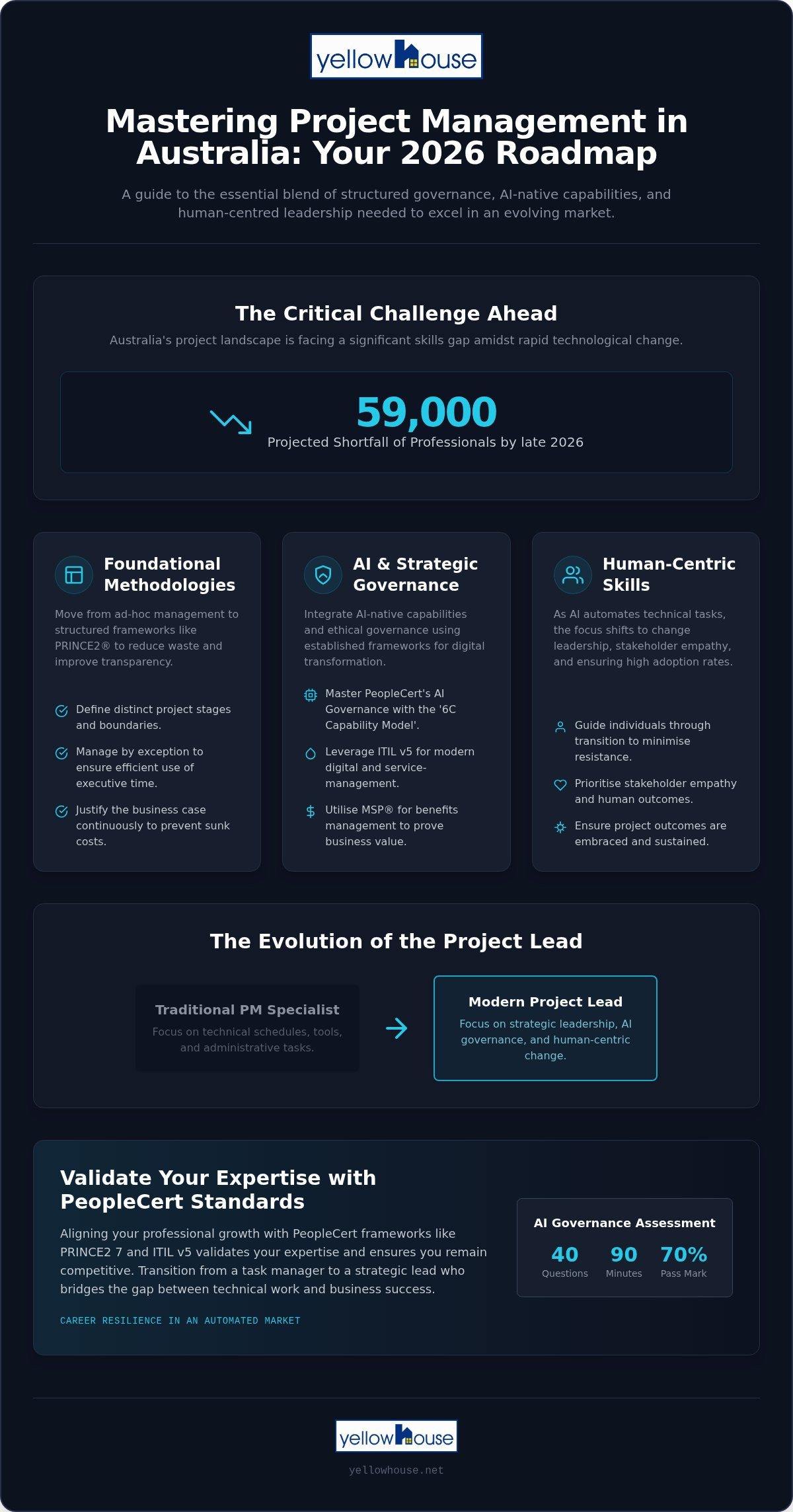
With a projected shortfall of 59,000 professionals across the country by late 2026, the Australian project landscape has never been more competitive. You’ve likely noticed that the skills needed for project management have shifted from simple scheduling to a complex mix of AI orchestration and strategic governance. It’s natural to feel a sense of unease as automated tools arrive faster than the frameworks required to manage them, often leaving practitioners struggling to link technical work to boardroom outcomes.
This guide provides a roadmap to master the essential blend of structured governance, AI-native capabilities, and human-centred leadership. You’ll discover how to bridge the gap between technical tools and business success by leveraging the 6C Capability Model. We’ll also examine how validating your expertise through PeopleCert standards, such as PRINCE2 7 and ITIL v5, ensures your career remains resilient in an increasingly automated and specialised market.
Key Takeaways
- Adopt structured frameworks like PRINCE2 to move away from ad-hoc management, significantly reducing project waste and improving transparency across Australian organisations.
- Identify the evolving skills needed for project management by mastering AI-native capabilities and ethical governance frameworks found in ITIL v5.
- Cultivate Change Leadership and human-centric skills to ensure project outcomes are embraced and sustained, even as technical tasks become increasingly automated.
- Align your professional growth with PeopleCert standards to validate your expertise and remain competitive in a landscape facing a significant shortfall of qualified project leads.
The Foundational Methodologies: Why Structured Frameworks are Your Primary Skill
Methodological competence is the defining trait of a senior practitioner. It’s the ability to apply a consistent, repeatable framework like PRINCE2® project management to diverse and often volatile environments. While many beginners focus on “tool skills” like Jira or Trello, these are merely platforms for execution. The high-level skills needed for project management involve “framework skills,” which include:
- The capacity to define distinct project stages and boundaries.
- Management by exception to ensure the efficient use of executive time.
- Constant justification of the business case to prevent “sunk cost” fallacies.
Australian organisations are increasingly abandoning ad-hoc management styles. They’ve found that moving toward structured project management methodologies reduces project waste and provides the transparency required for executive oversight. True success requires balancing control with flexibility. Managing successful projects in 2026 demands a mastery of both PRINCE2 and Agile principles. This hybrid approach ensures you can maintain rigorous governance while adapting to rapid delivery cycles. It’s about knowing when to pivot and when to hold the line on quality.
Mastering PeopleCert Frameworks for Career Longevity
Adopting PRINCE2 Agile® Training provides the hybrid skill set necessary to manage fast-paced delivery within regulated corporate environments. A critical component of this is “Business Case” mastery. This is the essential skill of ensuring a project remains viable throughout its entire lifecycle, rather than just at the initial approval stage. PRINCE2 is a principle-based framework that enables effective delegation and authority within a project team. By focusing on these PeopleCert standards, you transition from a task manager to a strategic lead who understands the broader skills needed for project management and Strategic Change Consulting.
Strategic Governance and AI-Native Capabilities for 2026
AI is no longer a peripheral tool; it’s a core component of the modern project environment. By 2026, AI Governance has become a non-negotiable skill. This involves moving beyond simple automation to responsible, ethical stewardship. The PeopleCert AI Governance playbook introduces the ‘6C Capability Model’, which provides a structured framework for classifying and managing AI capabilities. This model ensures that digital agents are integrated safely and effectively without compromising organisational integrity.
The shift to ITIL v5 equips practitioners with the digital and service-management capabilities required to thrive. These are now essential project management skills for those overseeing complex digital transformations. To ensure these transformations actually deliver measurable outcomes, professionals must master ‘Benefits Management’. Utilising frameworks like MSP® allows you to bridge the gap between technical implementation and strategic business value.
Navigating AI Governance and ITIL v5 Frameworks
Professional competence is now benchmarked by the AI Governance assessment. This 40-question, 90-minute exam requires a 70% pass mark to validate your ability to manage AI risks. In the Australian market, a ‘value-enabling stewardship’ approach is replacing the outdated ‘compliance-only’ mindset. This perspective treats governance as a driver of success rather than a hurdle. You can explore ITIL to understand the full lifecycle of digital services. Building these skills needed for project management ensures you stay relevant as the industry evolves. If you’re ready to lead, consider how PeopleCert accredited training can elevate your professional standing.
Change Leadership and the Human-Centric Skills of a Modern Lead
As AI automates technical administration, the project manager’s role shifts heavily toward Strategic Change Consulting and stakeholder empathy. Change Leadership is now the ability to guide individuals through the transition from a current state to a desired future state. This ensures high adoption rates and minimised resistance across the workforce. While Project Management Specialists traditionally focused on technical schedules, modern leads must prioritise the human impact of every delivery.
Governance Literacy is equally vital. It’s the capacity to work within P3O® standards to support high-performing project offices. You also need the skill of Gateway Assurance. This involves facilitating independent reviews to confirm a project is ready to progress. These aren’t just administrative hurdles; they’re critical check-points for success that require a deep understanding of the skills needed for project management in complex environments.
Leading Strategic Change in Australian Workplaces
Effective digital communication is a cornerstone of this human-centric approach; to explore strategies for better online engagement, check out Achieve With Nate Movement for a practical guide to enhancing your digital messaging.
Success in Australian organisations depends on the “human element” of technical frameworks. Project outcomes must align with local workplace culture to be sustainable and effective. The Praxis Framework™ is an excellent resource here. It integrates project, programme, and portfolio management into a single, community-driven skill set. This holistic approach helps you manage the entire lifecycle of change rather than just isolated tasks.
Using Gateway reviews as a collaborative tool helps teams identify risks early. Instead of viewing them as obstacles, treat them as a partnership for quality and assurance. Mastering these soft and hard skills needed for project management allows you to lead with confidence. You’ll move beyond just managing tasks to governing for long-term strategic success in the Australian market.
Future-Proofing Your Career in a Digital-First Landscape
The landscape of 2026 rewards those who can bridge the gap between human empathy and digital automation. Mastery of the skills needed for project management now hinges on your ability to apply rigorous PeopleCert frameworks while leading strategic change. Yellowhouse stands as your partner in this journey, offering accredited training for PRINCE2, ITIL, and MSP. Our team of Australian-based expert practitioners is trusted by government and Fortune 500 organisations to deliver professional development that sticks. By focusing on governance literacy and benefits management, you move beyond the role of a coordinator to become a strategic advisor. Enrol in an accredited PeopleCert course with Yellowhouse today to secure your professional future. Your expertise is the most reliable asset in a world of rapid change, and we’re here to help you refine it.
Frequently Asked Questions
What are the essential skills needed for project management in 2026?
The essential skills needed for project management in 2026 involve a blend of structured governance, AI orchestration, and strategic change leadership. Professionals must move beyond simple task tracking to focus on benefits management and stakeholder empathy. Mastering frameworks like PRINCE2 7 ensures you can maintain control while navigating the rapid integration of digital agents and automated workflows in Australian workplaces.
How does the new ITIL v5 framework impact project management roles?
ITIL v5 transforms project management by embedding AI-native capabilities directly into the service lifecycle. It provides a structured path for managing digital products from strategy through to continual improvement. This framework helps project leads in cities like Sydney and Melbourne align technical delivery with service value, ensuring that AI-driven transformations remain ethical, sustainable, and focused on delivering measurable business outcomes.
Is a PRINCE2 certification still relevant for agile projects in Australia?
Yes, PRINCE2 remains highly relevant by providing the necessary governance layer for agile delivery. The 7th Edition places a strong emphasis on people and sustainability, while PRINCE2 Agile specifically bridges the gap between control and flexibility. This hybrid approach is one of the essential skills needed for project management demanded by Australian government and corporate sectors to reduce project waste.
What is AI Governance and why is it a critical skill for project managers?
What is AI Governance and why is it a critical skill for project managers?
AI Governance is a value-enabling stewardship that ensures responsible and ethical AI adoption. It’s a critical skill because 90% of organisations now use AI daily, yet few have robust policies. By mastering the 6C Capability Model and passing the 40-question PeopleCert assessment with a 70% pass mark, project managers can safely classify and manage AI capabilities to mitigate organisational risk. To better prepare for the logical challenges of such professional certifications, you can read more about sharpening your cognitive and analytical skills for high-stakes exams.


About Post Author
