

MSP Practitioner Australia: The 2026 Guide to Mastering Programme Management
The gap between delivering a successful project and realising a strategic organisational vision is often wider than Australian leaders care to admit. You likely feel the mounting pressure to demonstrate tangible ROI while managing complex governance structures in an increasingly volatile market. It’s a common challenge, especially when you’re transitioning from Foundation level and need to prove your ability to lead high-stakes transformational change. By becoming an MSP practitioner Australia professional, you’ll gain the PeopleCert credentials necessary to turn these hurdles into strategic advantages. This 2026 guide explores how to master the MSP framework to drive excellence and align your leadership skills with rigorous Gateway assurance standards. We’ll examine the practical path from theory to application, ensuring you’re prepared to handle both the human and technical elements of modern programme management.
Key Takeaways
- Understand the critical shift from managing project outputs to delivering strategic outcomes and measurable benefits within the Australian business landscape.
- Navigate the 2026 certification pathway by identifying the mandatory prerequisites and selecting a PeopleCert accredited partner for your MSP practitioner Australia training.
- Learn how to integrate the MSP framework with Australian Gateway assurance standards to strengthen governance in high-stakes sectors like energy and healthcare.
- Gain the practical tools required to lead complex transformational change, ensuring your professional skills align perfectly with long-term organisational goals.
Understanding the MSP Practitioner Certification in the Australian Context
The MSP Practitioner level represents the critical point where theoretical knowledge transforms into the ability to lead complex, real-world initiatives. While the Foundation stage establishes the essential language of the framework, the MSP practitioner Australia certification demands a sophisticated application of these concepts. It requires a deep understanding of how to tailor methodologies to specific organisational contexts; this ensures that governance remains flexible yet robust during periods of significant upheaval.
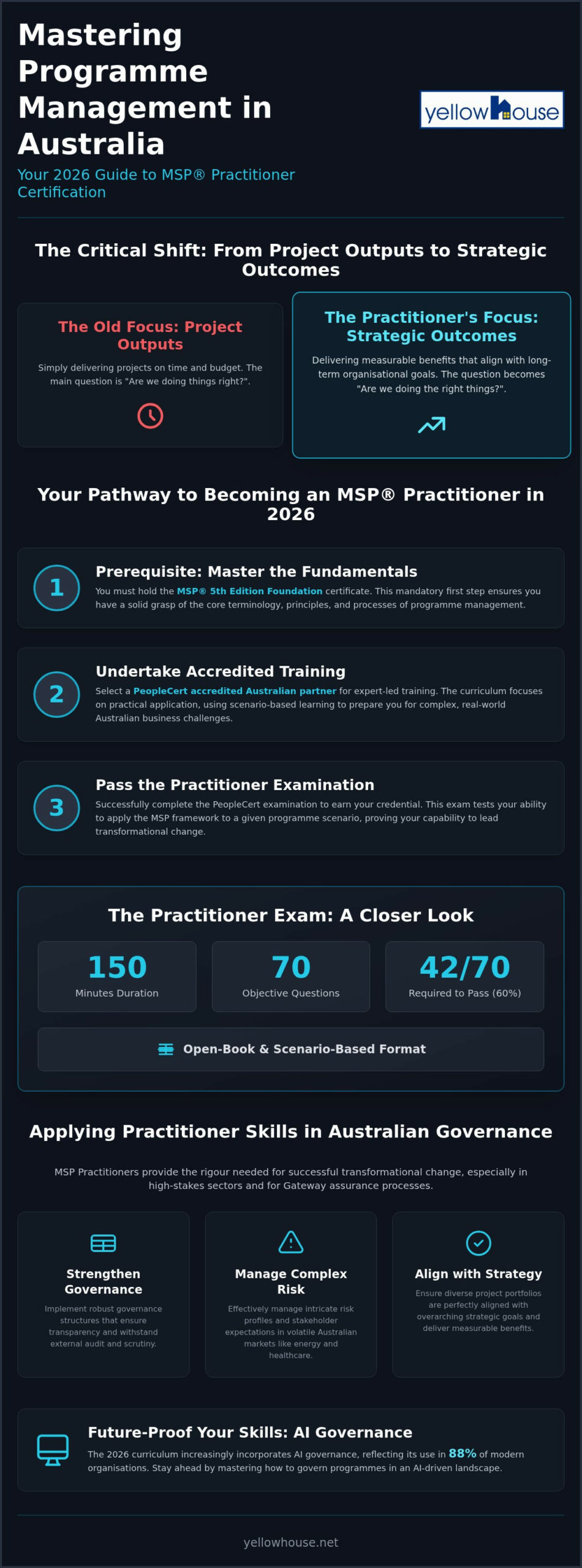
In the current Australian landscape, there’s a distinct shift away from simply managing project outputs. Leading organisations now prioritise professional programme management that focuses on achieving strategic outcomes and measurable benefits. PeopleCert maintains this global standard, providing a rigorous benchmark that ensures practitioners can navigate market volatility while remaining strictly aligned with corporate strategy. This transition from “doing things right” to “doing the right things” is what defines the Practitioner level.
Why Australian Programme Leaders Need Practitioner-Level Skills
Modern Australian programmes often operate within intricate, multi-stakeholder environments, particularly across major hubs like Canberra and Sydney. Senior leaders need MSP practitioner Australia level skills to move beyond technical delivery and master strategic change management. This involves more than just process. It requires a unique brand of “quiet expertise” to manage high-risk public sector and corporate initiatives where the cost of failure is significant.
Government and infrastructure sectors increasingly mandate Practitioner-level credentials for senior leadership roles. This ensures that those at the helm possess a proven methodology to:
- Align diverse project portfolios with overarching strategic goals.
- Manage complex risk profiles and stakeholder expectations in volatile markets.
- Implement rigorous governance structures that withstand external audit and scrutiny.
The Pathway to Becoming an MSP Practitioner in 2026
Achieving the MSP practitioner Australia credential is a structured journey that demands more than simple rote learning. It begins with the mandatory MSP Foundation certificate. This prerequisite ensures you’ve mastered the core terminology before moving into advanced application. Selecting an accredited Australian provider like Yellowhouse is the next step. Expert-led delivery, whether in a physical classroom or a virtual environment, provides the necessary nuance for high-level leadership.
Successful candidates master the framework’s principles, themes, and processes through rigorous scenario-based learning. You aren’t just memorising facts; you’re learning to apply the framework to complex Australian business cases. This practical focus mirrors the Australian Government’s approach to digital program management, where strategic benefits realisation is central to every initiative.
Navigating the PeopleCert Examination and Membership
The examination is a 150-minute, open-book, scenario-based test consisting of 70 questions. To pass, you must score at least 42. In 2026, the MSP practitioner Australia curriculum increasingly incorporates AI governance to address the 88% of organisations now utilising AI in core business functions. Joining PeopleCert Plus membership provides ongoing access to professional development resources and CPD points. This membership is essential for maintaining your status and staying current with evolving global methodologies. If you’re ready to take the next step in your career, you can review our MSP programme management training schedules to find a course that fits your professional timeline.
Applying MSP Practitioner Principles to Australian Governance
Robust governance serves as the cornerstone of successful transformational change within the Australian public and private sectors. An MSP practitioner Australia professional provides the technical rigour required to support the Gateway assurance process, ensuring that large-scale initiatives remain transparent and accountable. This is particularly vital in high-stakes sectors like energy and healthcare, where governance failures can have significant societal impacts. By mastering the framework, leaders can effectively manage benefits and provide stakeholders with the data-driven justification needed for continued investment. Yellowhouse acts as a dedicated collaborator, helping organisations implement these high standards through a blend of expert-led training and strategic advisory.
Integrating MSP with Gateway Assurance and Local Frameworks
The synergy between MSP governance themes and independent Gateway reviews creates a powerful defensive layer against programme failure. Many senior leaders also choose to adopt the Praxis Framework alongside MSP to bridge the gap between project, programme, and portfolio management. This integrated approach ensures a comprehensive management style that fits the unique requirements of the Australian market. To align your programmes with the latest local best practices, consider this brief checklist:
- Map MSP roles directly to your organisation’s existing governance committees.
- Schedule internal health checks to occur three months before formal Gateway stages.
- Ensure all benefits realisation plans are formally signed off by operational owners rather than just the programme team.
- Verify that your risk management strategy accounts for specific Australian regulatory requirements.
Leading Strategic Change in the Australian Landscape
Mastering the MSP framework is about more than a certificate; it’s about gaining the confidence to lead high-stakes programmes that deliver genuine benefits. This credential bridges the gap between project delivery and strategic goals, especially when aligned with local Gateway assurance standards. As an Australian-owned and operated training provider, Yellowhouse brings the “quiet expertise” required to help you succeed in any capital city. We’re an accredited PeopleCert training partner trusted by government and Fortune 500 organisations to deliver excellence. Achieving your MSP practitioner Australia status ensures you remain at the forefront of modern governance and AI-integrated leadership. Taking this step will empower you to manage volatility with a disciplined, principled approach.
Enrol in our next MSP Practitioner course and lead with confidence. Your path to professional mastery starts with a partner who understands the unique hurdles of the Australian business environment.
Frequently Asked Questions
What is the difference between MSP Foundation and MSP Practitioner?
MSP Foundation introduces the essential language and concepts of the framework, while the Practitioner level focuses on applying and tailoring that knowledge to complex, real-world scenarios. For an MSP practitioner Australia candidate, this means demonstrating the ability to manage programmes effectively within local governance structures. While Foundation is about understanding, Practitioner is about leadership and strategic execution in volatile markets.
How long does the MSP Practitioner certification remain valid in Australia?
The MSP Practitioner certification remains valid for three years from the date of issue. To maintain your status, you must renew your qualification through the PeopleCert professional development programme. This typically involves logging Continuing Professional Development (CPD) points via a PeopleCert Plus membership; this ensures your skills stay relevant for senior roles in major hubs like Sydney, Melbourne, and Canberra.
Can I take the MSP Practitioner exam online through PeopleCert?
Yes, you can complete the MSP Practitioner examination online using PeopleCert’s remote proctoring service. This flexibility allows professionals across Australia, from Brisbane to Perth, to sit their exams at a time and location that suits their schedule. You simply need a reliable internet connection and a compatible device to access the official scenario-based assessment from your home or office.
How does MSP Practitioner complement PRINCE2 certification for Australian project managers?
While PRINCE2 focuses on the successful delivery of specific project outputs, MSP provides the framework for managing broader strategic outcomes and benefits. For an MSP practitioner Australia professional, these certifications work together to bridge the gap between individual project success and long-term organisational goals. This combination is highly valued during Australian Gateway assurance reviews, where both project rigour and programme alignment are assessed.


About Post Author
