

A Strategic Guide to Portfolio Governance Frameworks
What if your organisation’s project investments are actually pulling you away from your strategic goals instead of towards them? It’s a common frustration for Australian leaders who see competing initiatives drain resources while failing to deliver tangible value. You’ve likely experienced the friction caused by a lack of transparency in investment prioritisation or the struggle to align project outcomes with your broader business strategy. Adopting a structured portfolio governance framework is the essential first step to regaining control and ensuring every initiative serves a specific, measurable purpose.
In this guide, we’ll show you how a robust governance structure ensures your investments align perfectly with strategic objectives while maximising value across the board. This article provides a clear roadmap for improved decision-making and better ROI. We’ll explore how to organise your initiatives for maximum impact and implement standardised assurance processes, such as Gateway reviews, to maintain high standards of delivery. You’ll discover how to transform governance from a bureaucratic hurdle into a strategic enablement tool that secures your organisation’s future in the 2026 landscape.
Key Takeaways
- Distinguish between project-level execution and a strategic portfolio governance framework that focuses on directing and controlling your organisation’s investment in change.
- Establish transparent, criteria-based systems for investment prioritisation to ensure project selection aligns perfectly with your long-term business objectives.
- Optimise resource capacity management to protect your people from over-commitment while maximising the return on your capital investments.
- Learn how to integrate strategic assurance processes like Gateway reviews to provide independent confidence in your portfolio’s delivery.
- Navigate the human element of implementing oversight by fostering a culture of accountability and transparency across all competing initiatives.
Table of Contents
Understanding the Portfolio Governance Framework: More Than Just Oversight
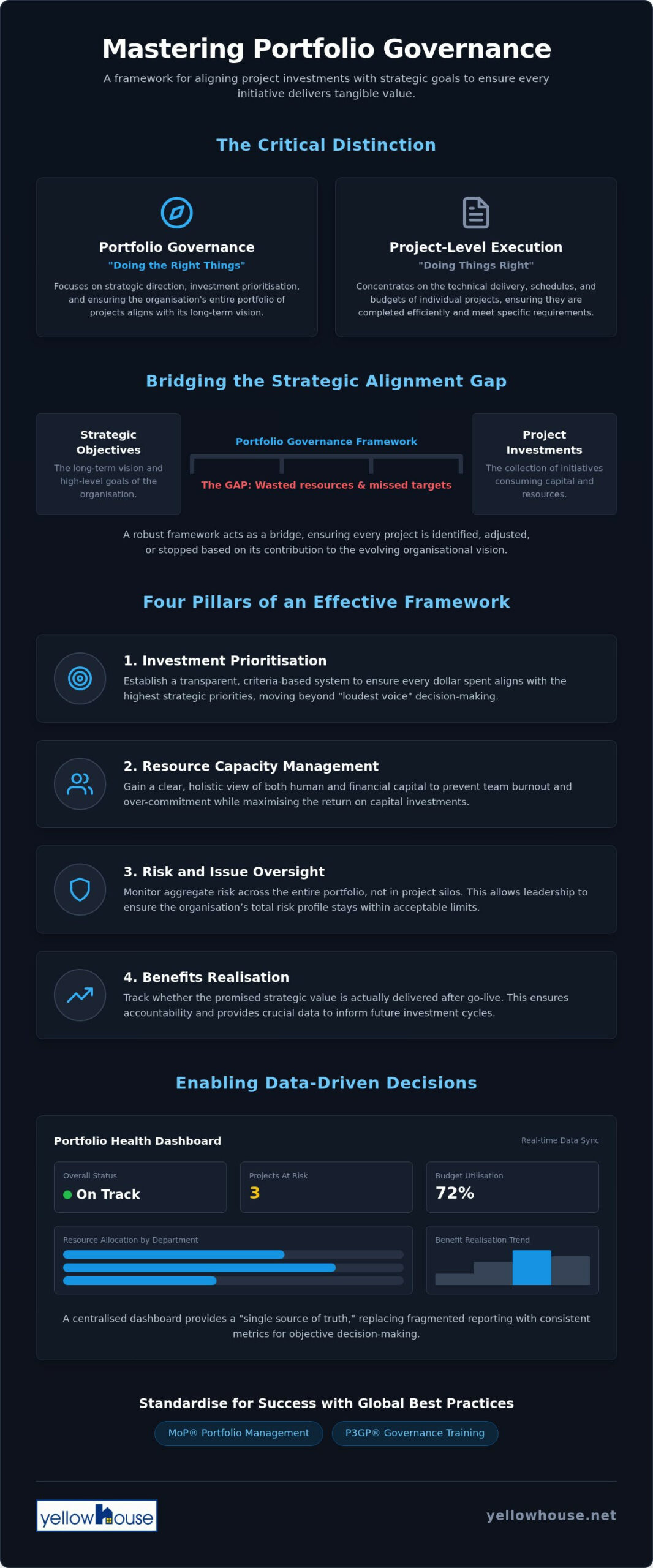
A portfolio governance framework isn’t just a set of rules; it’s the heartbeat of an organisation’s investment strategy. It provides the structured system through which an organisation’s total investment in change is directed and controlled. While project-level governance focuses on "doing things right" by prioritising technical delivery and schedules, portfolio governance ensures the business is "doing the right things." This distinction is critical. Many Australian entities find themselves delivering projects successfully that simply don’t contribute to the broader vision. By adopting a formal framework, leaders can ensure that the portfolio office is inextricably linked to strategic planning.
To manage this complexity effectively, many executives rely on Project portfolio management principles to gain a holistic view of their initiatives. We’re seeing a significant shift across the Australian public and private sectors toward integrated P3O® models. These models centralise governance, providing a "single source of truth" that allows boards to make informed decisions based on real-time data rather than optimistic projections. Public sector leaders in particular can benefit from understanding how to apply these principles through a government portfolio management framework Australia public sector practitioners can adapt to their departmental context.
The Strategic Alignment Gap
Projects often meet every technical requirement but still fail to deliver meaningful value. This usually happens because of a strategic alignment gap where tactical execution drifts away from high-level goals. A robust portfolio governance framework acts as a bridge. It ensures that if a project no longer fits the organisation’s evolving vision, it’s identified early and either adjusted or stopped before more capital is wasted.
Governance vs. Management: Defining the Boundaries
It’s vital to separate governance from management to maintain clear accountability. The Portfolio Board holds the decision-making authority and sets the strategic direction, whereas the Portfolio Manager handles the day-to-day coordination of the various initiatives. When these boundaries are blurred, decision-making slows down and resource allocation becomes inefficient. Clear authority structures ensure that everyone knows who is responsible for the "why" and who is responsible for the "how."
Core Pillars of an effective Portfolio Management Framework
Effective governance relies on four fundamental pillars that transform a collection of projects into a strategic asset. A well-designed portfolio governance framework provides the structure needed to manage these pillars consistently across the business. Without these foundations, organisations risk wasting capital on initiatives that don’t move the needle on their long-term goals.
-
Investment Prioritisation: Organisations must move beyond "loudest voice" decision-making. By establishing a transparent, criteria-based system, you ensure every dollar spent aligns with the highest strategic priorities.
-
Resource Capacity Management: With the 2026 talent market remaining highly competitive, ensuring you don’t over-commit your people is vital. You need a clear view of both human and financial capital to prevent burnout and delivery failure.
-
Risk and Issue Oversight: Rather than viewing risks in project silos, portfolio governance monitors aggregate risk. This allows leaders to see if the total risk profile of the organisation stays within acceptable limits.
-
Benefits Realisation: The work doesn’t end at go-live. Tracking whether the promised strategic value is actually delivered ensures accountability and informs future investment cycles.
Standardising with MoP® and P3GP®
The Portfolio Dashboard: data-driven decision making
Executive teams need a "single source of truth" to make objective decisions in real-time. A centralised portfolio dashboard replaces fragmented reporting with consistent, live metrics. This allows for an "apples-to-apples" comparison between disparate projects, ensuring that interventions are based on hard data rather than optimistic projections or gut feelings. When every stakeholder looks at the same data, the path to resolution becomes much clearer.
Implementing Governance and the role of Strategic Assurance
Transitioning from a fragmented project environment to a structured portfolio governance framework is a significant undertaking that requires more than just updated spreadsheets. It involves a fundamental shift in how an organisation perceives value and accountability. Many Australian leaders find that the biggest hurdle isn’t the technical design of the framework, but the "human element." Team members often view new reporting requirements as a bureaucratic burden rather than a strategic aid. Overcoming this resistance is why implementing change management frameworks is essential for long-term governance success. By treating the rollout of governance as a change initiative itself, you can foster a culture that values transparency and collective success over individual project silos.
Independent reviews play a vital role in maintaining the integrity of this system. They provide a level of objectivity that internal reporting simply cannot match. Strategic assurance ensures that the framework remains robust and that decision-makers receive an unbiased view of the portfolio’s health. This alignment with independent oversight reflects broader national trends, such as the Australian Government’s Digital and ICT Investment Oversight Framework, which prioritises central assurance for high-value initiatives to ensure they remain on track and deliver promised benefits. For public sector professionals managing large-scale digital investments, a structured government portfolio management framework for Australia’s 2026 digital investment landscape provides the practical roadmap needed to satisfy Department of Finance requirements and maintain line of sight between spending and strategic outcomes.
Gateway Assurance: The Gold Standard
The Gateway review process has become the gold standard for assurance in Australia, particularly within high-stakes government and corporate sectors. These independent "health checks" occur at critical project stages to ensure everything remains on track before further funding is released. By identifying risks early, Gateway assurance significantly reduces the likelihood of project failure and ensures that public or shareholder resources are used responsibly. It provides the Board with the confidence that the path to benefits realisation is clear and well-managed.
Continuous Improvement of the Framework
Governance isn’t a "set and forget" exercise. As your organisation grows, your portfolio governance framework must evolve to remain fit for purpose. Regular maturity assessments, such as P3M3®, allow you to identify gaps in your current processes and scale your oversight to match increasing organisational complexity. This commitment to continuous improvement ensures that your governance remains a lean, effective tool rather than an outdated administrative hurdle. It allows the framework to scale alongside your strategic ambitions while maintaining rigorous control over investment outcomes.
Securing your Organisation’s Strategic Future
Establishing a resilient portfolio governance framework is more than a compliance exercise; it’s a commitment to ensuring every initiative delivers maximum value. We’ve explored how prioritising the right investments and managing resource capacity protects your organisation from waste. Success depends on balancing these technical pillars with the human element of change.
Yellowhouse is a trusted partner in this journey. As an accredited provider for P3GP® and PeopleCert MoP® certifications, we help professionals build the specific capabilities required for executive-level oversight. Our consultants also provide independent Gateway assurance for major Australian initiatives, offering seasoned wisdom to keep high-stakes projects on track. Mastering these methodologies is the most effective way to turn strategic intent into tangible reality.
If you’re ready to elevate your career and your organisation’s performance, enrol in MoP® Portfolio Management Training to master these frameworks. We look forward to working alongside you to help you reach your full potential.
Frequently Asked Questions
What is the difference between project governance and portfolio governance?
Project governance focuses on the successful delivery of a specific initiative; ensuring it meets its technical, financial, and timeline requirements. In contrast, a portfolio governance framework manages the collective investment to ensure the organisation is "doing the right things" at a strategic level. It provides the high-level oversight needed to balance risks and resources across all competing projects within the business.
How does the P3GP® certification help in establishing a governance framework?
The P3GP® certification equips professionals with the specific skills required to design and implement effective governance structures. It moves beyond delivery management to focus on the principles of accountability and decision-making authority. This qualification is particularly valuable for those in oversight roles who need to ensure their organisation’s governance remains transparent and fit for purpose in a complex corporate environment.
Why is strategic alignment the most important part of portfolio management?
Strategic alignment ensures that every project in the portfolio contributes directly to the organisation’s long-term vision. Without this link, entities risk wasting capital on initiatives that don’t deliver a measurable return on investment. It’s the primary mechanism for prioritising high-value work and stopping projects that no longer fit the business’s evolving objectives, regardless of their technical success.
Can a portfolio governance framework work with Agile and PRINCE2®?
Yes, a portfolio governance framework is designed to be methodology-neutral; meaning it works seamlessly with both PRINCE2® and Agile approaches. While Agile focuses on iterative delivery and PRINCE2® provides structured management stages, governance provides the overarching guardrails for investment and risk. This ensures that regardless of how a team builds the product, the project remains accountable to the organisation’s strategic goals.


About Post Author
