

What Does ITIL Certification Get You? Skills, Credibility and Career Value
What does ITIL certification get you beyond a credential on your CV? It gives you a structured understanding of service-management practices and a shared professional language to apply to workplace challenges. It won’t guarantee a new role, promotion or business result, so it’s worth considering how the learning relates to your responsibilities.
The value depends on how you use it. ITIL supports collaboration, outcome-focused thinking and informed decision-making, particularly in roles connected to digital products and services. This article explains the capabilities certification can help you develop, the career directions it may support and its limits. You’ll also learn how to assess whether ITIL fits your role and turn the learning into practical steps at work.
Key Takeaways
- Explore how ITIL connects strategy, design, delivery, experience and continual improvement across digital products and services.
- Understand what does ITIL certification get you in demonstrable framework knowledge, and assess its relevance to your role and career direction.
- Identify a learning level that aligns with your responsibilities, from Foundation through core and extension modules to specialist and senior pathways.
- Make learning practical by choosing a service-management challenge at work where you can apply the concepts.
What does ITIL certification get you in practical terms?
ITIL certification demonstrates that you’ve learned ITIL service-management practices. It gives you a structured way to think about how digital products and services are shaped, delivered and improved, from strategy and design to user experience and continual improvement. For background on the framework’s purpose and evolution, see the ITIL Wikipedia article.
In day-to-day work, what does ITIL certification get you? It gives you shared concepts for discussing service quality, user needs, responsibilities and improvement opportunities. These can help teams connect operational decisions with the outcomes a service is meant to support. The framework is most useful when you apply its concepts to real decisions in your role and organisation.
Certification demonstrates knowledge of ITIL practices; it does not guarantee employment, promotion or a particular career outcome. Employers also consider your experience, judgement and fit for the role.
Which capabilities can you take into your work?
Shared practices give colleagues from different teams a clearer basis for collaboration. They can help teams focus on outcomes and make more informed decisions, rather than interpreting service issues in isolation.
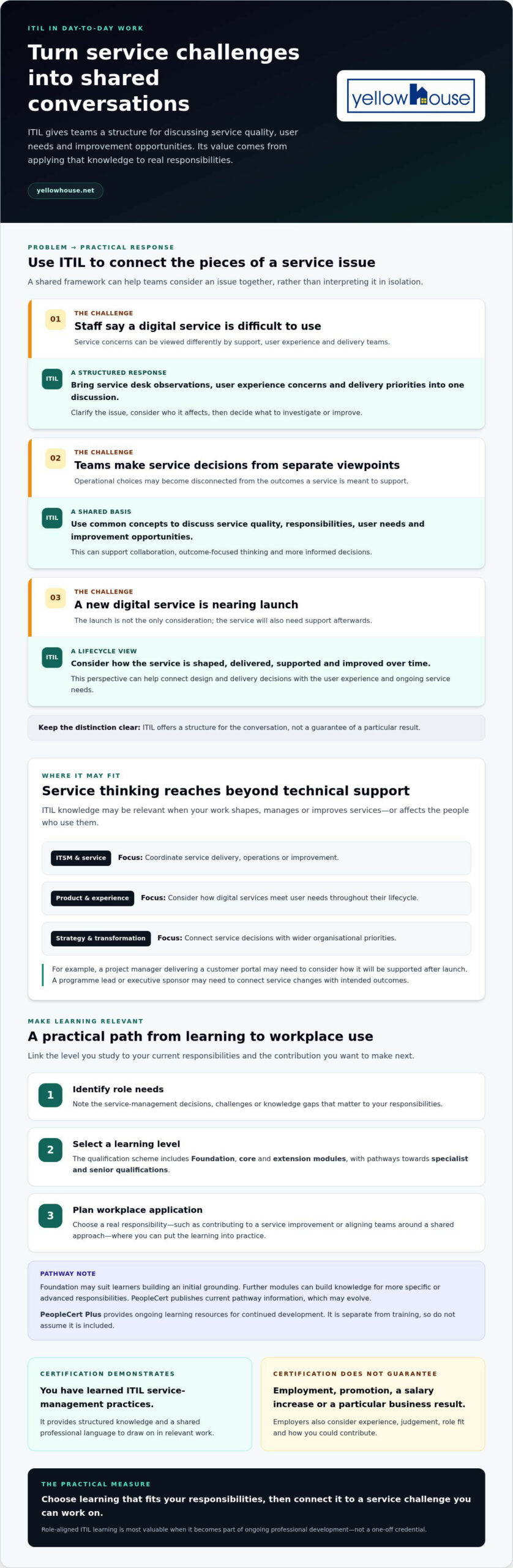
For example, if staff report that a digital service is difficult to use, you could bring service desk observations, user experience concerns and delivery priorities into one discussion. Clarify the issue, consider who it affects and decide what to investigate or improve. ITIL offers a structure for that conversation, not a guarantee of a particular result.
To build relevant capability, connect ITIL concepts to the decisions and responsibilities you already handle. ITIL service-management training from Yellowhouse can help you develop framework knowledge, while applying it at work makes the practices meaningful in your organisation.
Is ITIL certification worth it if it cannot guarantee a promotion?
ITIL certification can be worthwhile if the knowledge supports work you do now or want to move towards. A credential doesn’t guarantee a job, promotion or salary increase. It demonstrates learning; employers make decisions based on the capabilities they need, your experience and how you could contribute in a particular role.
In practical terms, ITIL certification gives you a structured understanding of service management to draw on when making relevant workplace decisions. That knowledge may strengthen your professional profile, but it is different from evidence that you have applied the practices successfully. The official ITIL website explains the framework. To assess its career relevance, compare its subject matter with the responsibilities you want to develop.
ITIL’s value depends on the work you do: the closer your responsibilities are to digital services, the more directly you can apply its concepts.
Who may find ITIL knowledge useful beyond technical support?
ITIL can be relevant beyond hands-on support. Consider whether your work involves shaping, managing or improving services, or making decisions that affect their users. A project manager delivering a customer portal, for example, may need to consider how it will be supported after launch. A programme lead or executive sponsor may need to connect service changes with intended outcomes.
- ITSM and service roles: Coordinate service delivery, operations or improvement.
- Product and experience roles: Consider how digital services meet user needs throughout their lifecycle.
- Strategy and transformation roles: Connect service decisions with wider organisational priorities.
List the decisions you make and the teams you work with. Then consider whether ITIL’s concepts would help with those tasks. Yellowhouse’s ITIL Service Management training can help you build knowledge to apply in your role.
How can you turn ITIL certification into a useful next step?
Start with a clear development goal. Before choosing a course or module, connect what you want to learn with your current work and the responsibilities you hope to take on next.
- Identify role needs. Note the service-management decisions, challenges or knowledge gaps that matter to your responsibilities.
- Select a learning level. The ITIL qualification scheme includes Foundation, core and extension modules, with pathways towards specialist and senior qualifications.
- Plan workplace application. Choose a real responsibility, such as contributing to a service improvement or aligning teams around a shared approach, where you can put the learning into practice.
Match your learning pathway to your responsibilities
Foundation may suit learners developing an initial grounding in ITIL. Further modules can build knowledge for more specific or advanced responsibilities. Consider your experience and where you want to contribute, rather than choosing a level for the credential alone. PeopleCert publishes current information about qualification pathways, which may evolve.
PeopleCert Plus provides ongoing learning resources for continued development. It is separate from training, so don’t assume it is included. Role-aligned ITIL learning is most valuable when it becomes part of your ongoing professional development, not a one-off credential.
For a practical next step, identify one capability you want to develop, then explore Yellowhouse’s ITIL Service Management training and choose a learning level that fits your goals.
Make your next learning step count
What does ITIL certification get you? Its value grows when you connect learning to a responsibility you want to take on, a capability you want to strengthen or a service challenge you want to understand better. Before enrolling, write down one practical outcome you hope to work towards. This gives you a way to judge whether the learning fits your direction and how you could apply it.
Yellowhouse delivers ITIL Service Management training in Australia. The training can support your professional development as you build knowledge of the framework and consider how to use it at work.
Yellowhouse supports learners and organisations across Brisbane, Sydney, Melbourne, Canberra, Adelaide, Perth, Cairns, Townsville, Hobart, Darwin, Mackay, the Gold Coast, Logan, Ipswich and Toowoomba. Explore Yellowhouse ITIL training and choose a learning step that fits the work you want to do.
Frequently Asked Questions
Can you benefit from ITIL certification without working in a technical IT role?
Yes. For people outside technical IT, ITIL certification can provide a shared basis for considering how a digital service works for users. A coordinator planning an online booking service, for example, might consider support arrangements after launch alongside delivery milestones. The key is whether your role influences how the service is designed, delivered or improved.
Does ITIL certification guarantee a job or promotion?
No. A credential alone can’t determine an employer’s decision. To make the learning useful in an application, connect a concept to a specific piece of work. For instance, describe how you helped clarify service ownership during a system handover, what you contributed and what you learned. This gives an interviewer concrete context for your capability without treating certification as proof of performance.
Can ITIL knowledge be relevant to AI governance work?
Yes. ITIL AI Governance is relevant to people involved in governing AI products or services, not only technical specialists. A business lead overseeing an AI-enabled customer service initiative, for example, may work with product, service and technical colleagues on accountable use and governance arrangements. PeopleCert’s published information can help you understand the current qualification pathway.


About Post Author
